
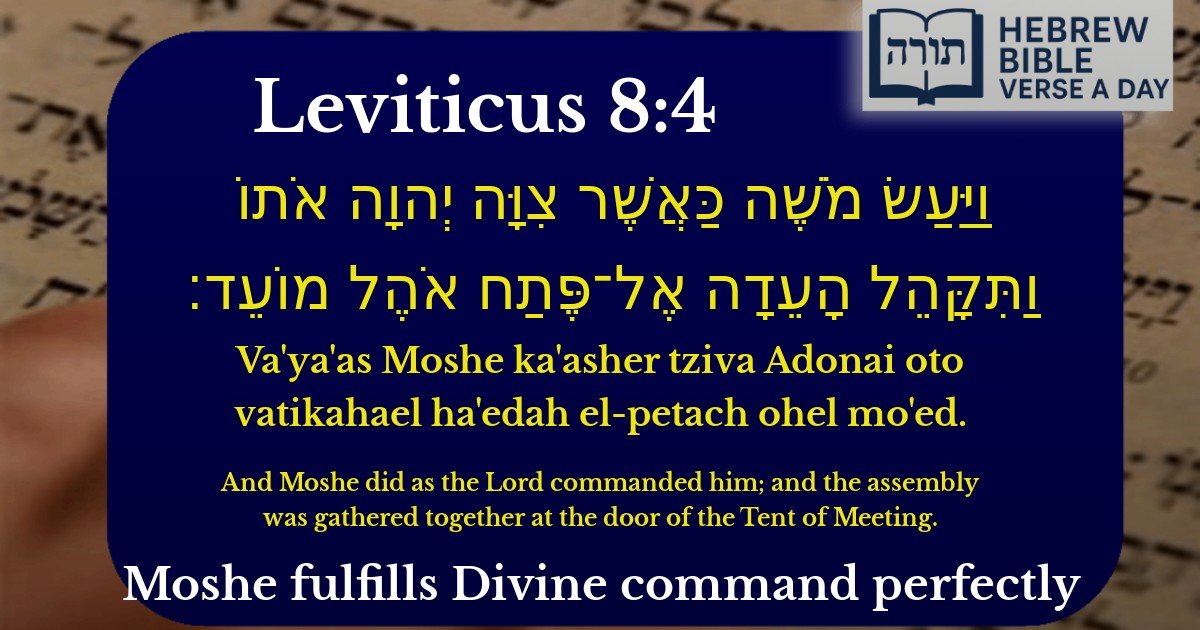

Leviticus 8:4 - Moshe fulfills Divine command perfectly

Leviticus 8:4 - ויקרא 8:4

Hebrew Text

וַיַּעַשׂ מֹשֶׁה כַּאֲשֶׁר צִוָּה יְהוָה אֹתוֹ וַתִּקָּהֵל הָעֵדָה אֶל־פֶּתַח אֹהֶל מוֹעֵד׃

English Translation

And Moshe did as the Lord commanded him; and the assembly was gathered together at the door of the Tent of Meeting.

Transliteration

Va'ya'as Moshe ka'asher tziva Adonai oto vatikahael ha'edah el-petach ohel mo'ed.

Hebrew Leining Text

וַיַּ֣עַשׂ מֹשֶׁ֔ה כַּֽאֲשֶׁ֛ר צִוָּ֥ה יְהֹוָ֖ה אֹת֑וֹ וַתִּקָּהֵל֙ הָֽעֵדָ֔ה אֶל־פֶּ֖תַח אֹ֥הֶל מוֹעֵֽד׃

🎵 Listen to leining

Parasha Commentary

Moses's Exact Obedience to Divine Command

The verse states, "And Moshe did as the Lord commanded him", emphasizing Moshe's unwavering adherence to Hashem's instructions. Rashi (Shemot 40:16) highlights that this phrase appears multiple times in the parsha to underscore Moshe's meticulous fulfillment of every detail of the command regarding the Mishkan. The Midrash Tanchuma (Pekudei 11) further explains that Moshe's precise execution serves as a model for all future generations in performing mitzvot with exactness and devotion.

The Assembly at the Entrance of the Tent of Meeting

The second part of the verse, "and the assembly was gathered together at the door of the Tent of Meeting", signifies the unity of Bnei Yisrael in this sacred moment. The Ramban (Shemot 40:2) notes that the gathering at the entrance of the Ohel Moed symbolizes the people's readiness to receive the Divine Presence. The Talmud (Yoma 54a) teaches that the entrance of the Mishkan was a place of profound spiritual encounter, where the Shechinah would manifest to the nation.

Lessons in Leadership and Unity

  • Leadership by Example: Moshe's exactitude in fulfilling Hashem's command demonstrates the importance of leaders setting a standard in mitzvah observance (based on Sifrei Devarim 41).
  • Collective Responsibility: The gathering of the entire assembly reflects the principle that the sanctity of the Mishkan depended on the unity of Klal Yisrael (as derived from Vayikra Rabbah 30:12).
  • Preparation for Divine Service: The positioning at the entrance teaches that approaching kedushah requires both physical and spiritual preparation (based on Mesillat Yesharim, Chapter 1).

📚 Talmud Citations

This verse is not quoted in the Talmud.

Frequently Asked Questions

Q: What does Leviticus 8:4 teach us about Moshe's obedience?
A: Leviticus 8:4 highlights Moshe's complete obedience to Hashem's commandments. According to Rashi, this verse emphasizes that Moshe carried out every detail exactly as instructed, setting an example for future leaders in following divine commandments precisely.
Q: Why was the assembly gathered at the Tent of Meeting in Leviticus 8:4?
A: The assembly was gathered at the Tent of Meeting for the inauguration of the Mishkan (Tabernacle) and the consecration of Aharon and his sons as Kohanim (priests). The Midrash explains that this public gathering demonstrated the importance of communal participation in sacred events.
Q: What lesson can we learn from Moshe's actions in Leviticus 8:4?
A: We learn the importance of fulfilling mitzvos (commandments) exactly as prescribed. The Rambam teaches that Moshe's precise adherence serves as a model for how we should perform mitzvos - with care for every detail and without adding or subtracting from Hashem's instructions.
Q: How does the concept of 'as Hashem commanded' in Leviticus 8:4 apply today?
A: This principle applies today in our observance of mitzvos. The Talmud (Eruvin 13b) teaches that we must follow Torah commandments as transmitted through our mesorah (tradition), just as Moshe followed Hashem's exact instructions. This includes following halacha (Jewish law) as passed down by our sages.
Q: What is the significance of the phrase 'the door of the Tent of Meeting' in this verse?
A: Rashi explains that the 'door of the Tent of Meeting' was the appropriate place for this sacred assembly because it was the entrance to the Mishkan where divine service occurred. The Sforno adds that gathering at this threshold symbolized the people's readiness to enter into a closer relationship with Hashem through the Mishkan's service.