Frequently Asked Questions
Q: What are the Urim and Tummim mentioned in Leviticus 8:8?
A: The Urim and Tummim were sacred objects placed inside the Kohen Gadol's (High Priest's) breastplate (Choshen). According to Rashi and the Talmud (Yoma 73b), they were used to receive divine answers to important national questions. The exact nature of these objects is not fully described in the Torah, but they functioned as a means of communication with Hashem for the Jewish people.
Q: Why were the Urim and Tummim placed in the breastplate?
A: The breastplate (Choshen) was one of the eight special garments worn by the Kohen Gadol. The Urim and Tummim were placed inside it because, as Rambam explains (Hilchos Klei HaMikdash 10:11), they were essential for receiving divine guidance. The breastplate, with the names of the twelve tribes engraved on its stones, represented the unity of Israel, making it the appropriate vessel for this holy function.
Q: Do the Urim and Tummim still exist today?
A: According to traditional Jewish sources, the Urim and Tummim were only functional when the Mishkan (Tabernacle) or the Beis HaMikdash (Temple) stood in Jerusalem. The Talmud (Sotah 48b) states that they ceased to function after the destruction of the First Temple. Today, we no longer have access to them, as they were lost with the destruction of the Temple.
Q: What can we learn from the Urim and Tummim today?
A: The Urim and Tummim teach us about the importance of seeking divine guidance in major decisions. While we no longer have them, we learn from the Talmud (Berachos 4a) and Rambam that we must turn to Torah study and prayer for direction. They also remind us of the holiness of the Beis HaMikdash and our hope for its rebuilding, when such divine communication may be restored.
Q: How did the Urim and Tummim work?
A: The Talmud (Yoma 73b) explains that the Kohen Gadol would ask a question, and the letters on the stones of the breastplate would light up in response. Through divine inspiration, the Kohen Gadol would then interpret the sequence of letters to form the answer. Rashi (on Shemos 28:30) adds that the name 'Urim' comes from 'light' (אור), referring to the illuminated letters, and 'Tummim' from 'perfect' (תמים), as the answers were complete and truthful.

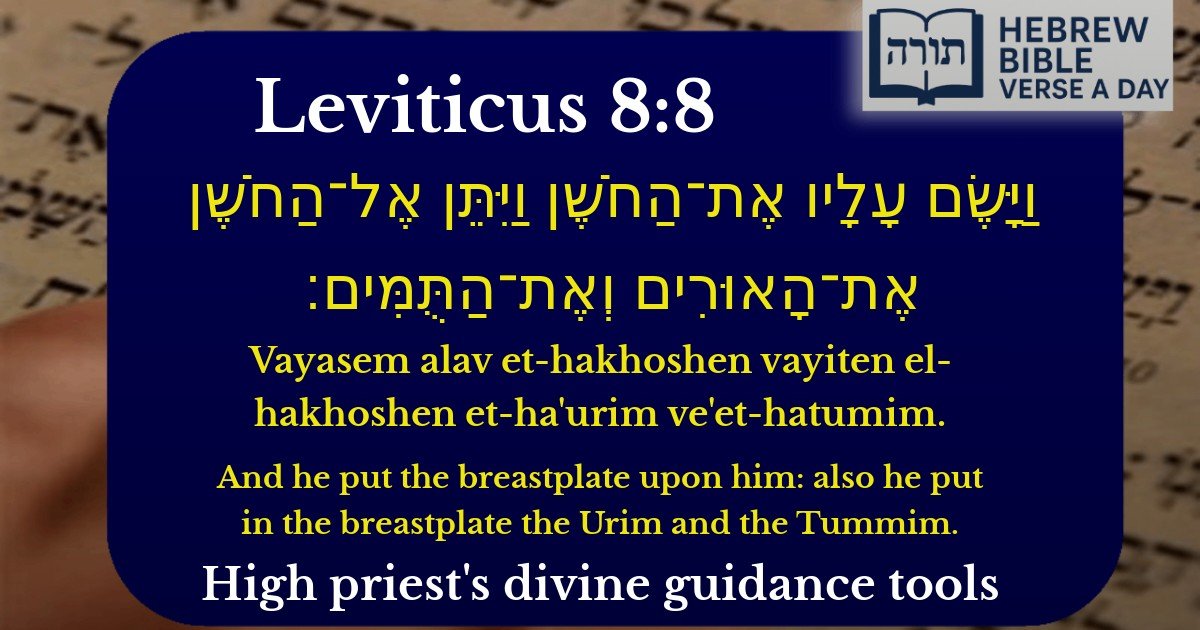

The Placement of the Choshen (Breastplate)
The verse describes Moshe placing the Choshen (breastplate) upon Aharon and inserting the Urim v'Tumim into it. Rashi (Shemos 28:30) explains that the Choshen was a folded pouch-like garment, and the Urim v'Tumim were placed inside this fold. The Choshen was one of the eight garments worn by the Kohen Gadol (High Priest), each serving a unique purpose in the avodah (service) of the Mishkan (Tabernacle).
The Nature of the Urim v'Tumim
According to Rambam (Hilchos Klei HaMikdash 10:10-11), the Urim v'Tumim was a Divine mechanism through which the Kohen Gadol could receive answers to national questions. The letters on the twelve stones of the Choshen would illuminate in response to inquiries, providing guidance from Hashem. The Talmud (Yoma 73b) elaborates that the Urim ("lights") caused the letters to shine, while the Tumim ("perfections") ensured the message was interpreted correctly.
The Significance of the Names
The Midrash (Bamidbar Rabbah 15:10) teaches that the names Urim v'Tumim reflect their function:
Connection to the Kohen Gadol’s Role
The Choshen with the Urim v'Tumim was worn over the heart (Shemos 28:29), symbolizing the Kohen Gadol’s role as an intermediary between Klal Yisrael and Hashem. The Ramban (Shemos 28:30) emphasizes that this was not mere magic but a sacred means of communication, dependent on the Kohen Gadol’s purity and the sanctity of the Mishkan.
Historical Usage
The Talmud (Sotah 48b) states that the Urim v'Tumim ceased functioning after the destruction of the First Temple, as the Divine Presence diminished. However, the Choshen itself remained part of the Kohen Gadol’s attire in the Second Temple, albeit without its prophetic function (Rambam, Hilchos Klei HaMikdash 10:10).