

Join Our Newsletter To Be Informed When New Videos Are Posted
Hebrew Text
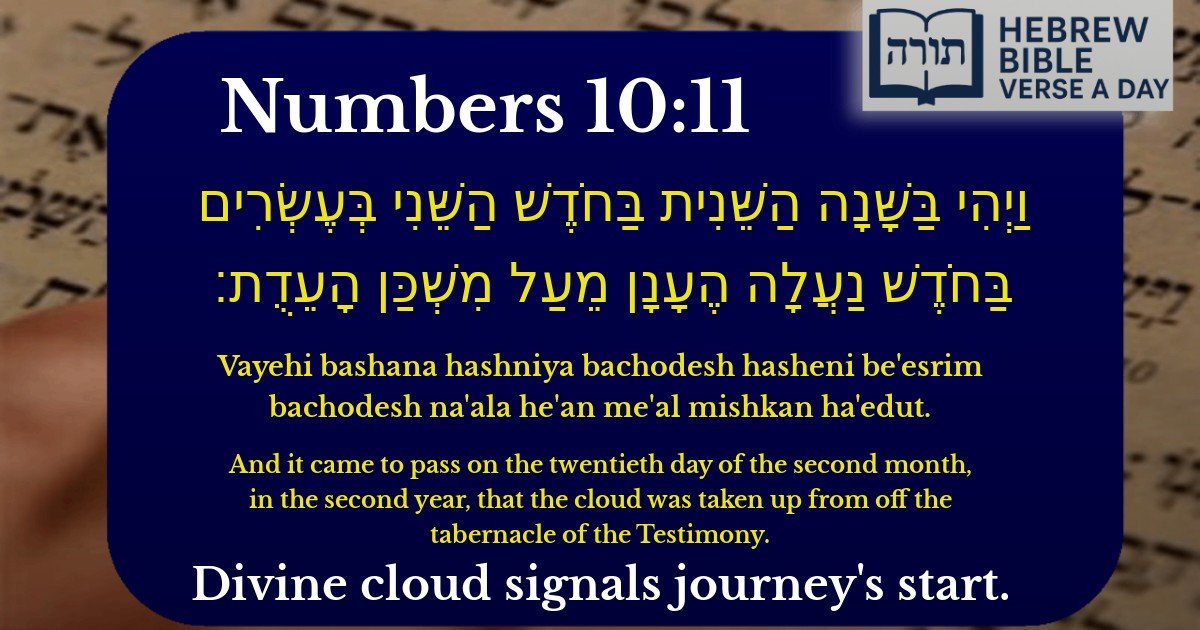
וַיְהִי בַּשָּׁנָה הַשֵּׁנִית בַּחֹדֶשׁ הַשֵּׁנִי בְּעֶשְׂרִים בַּחֹדֶשׁ נַעֲלָה הֶעָנָן מֵעַל מִשְׁכַּן הָעֵדֻת׃
English Translation
And it came to pass on the twentieth day of the second month, in the second year, that the cloud was taken up from off the tabernacle of the Testimony.
Transliteration
Vayehi bashana hashniya bachodesh hasheni be'esrim bachodesh na'ala he'an me'al mishkan ha'edut.
Hebrew Leining Text
וַיְהִ֞י בַּשָּׁנָ֧ה הַשֵּׁנִ֛ית בַּחֹ֥דֶשׁ הַשֵּׁנִ֖י בְּעֶשְׂרִ֣ים בַּחֹ֑דֶשׁ נַעֲלָה֙ הֶֽעָנָ֔ן מֵעַ֖ל מִשְׁכַּ֥ן הָעֵדֻֽת׃
🎵 Listen to leining
Parasha Commentary
📚 Talmud Citations
This verse is not quoted in the Talmud.
Context and Significance of the Verse
The verse (Bamidbar 10:11) describes the moment when the cloud representing the Divine Presence (ענן ה') lifted from the Mishkan (Tabernacle), signaling Bnei Yisrael to begin their journey from Har Sinai toward Eretz Yisrael. This event marks a pivotal transition in their wilderness travels.
Rashi's Explanation
Rashi (Rabbi Shlomo Yitzchaki) notes that this occurred exactly one year, one month, and twenty days after Yetziat Mitzrayim (the Exodus from Egypt). The timing reflects Hashem's mercy, as He allowed Bnei Yisrael to remain at Har Sinai long enough to:
Ramban's Insight
Ramban (Rabbi Moshe ben Nachman) emphasizes that the cloud's movement was a supernatural sign of Divine guidance. Unlike ordinary clouds, this one ascended vertically—indicating a deliberate, miraculous departure rather than natural wind dispersal. This reinforced that their travels were directed by Hashem's will.
Midrashic Perspectives
The Midrash Tanchuma (Bamidbar 12) compares the cloud's ascent to a parent rousing a child: just as a parent gently prepares a child for travel, Hashem gave Bnei Yisrael three days' notice (as inferred from Bamidbar 10:33, "a three-day journey") before the cloud lifted fully.
Halachic Implications
The Rambam (Hilchot Yesodei HaTorah 8:1) cites this verse as proof that the Mishkan's movements were guided by explicit Divine command, not human discretion. This principle extends to all aspects of Jewish leadership—decisions must align with Torah directives, not personal judgment alone.
Symbolism of the "Second Year"
Rabbeinu Bachya connects the phrase "בשנה השנית" (the second year) to spiritual growth: the first year was dedicated to foundational mitzvot (e.g., Korban Pesach, Matzah); the second year introduced higher responsibilities (e.g., Mishkan service), symbolizing the Jewish people's maturation in avodat Hashem.