Frequently Asked Questions
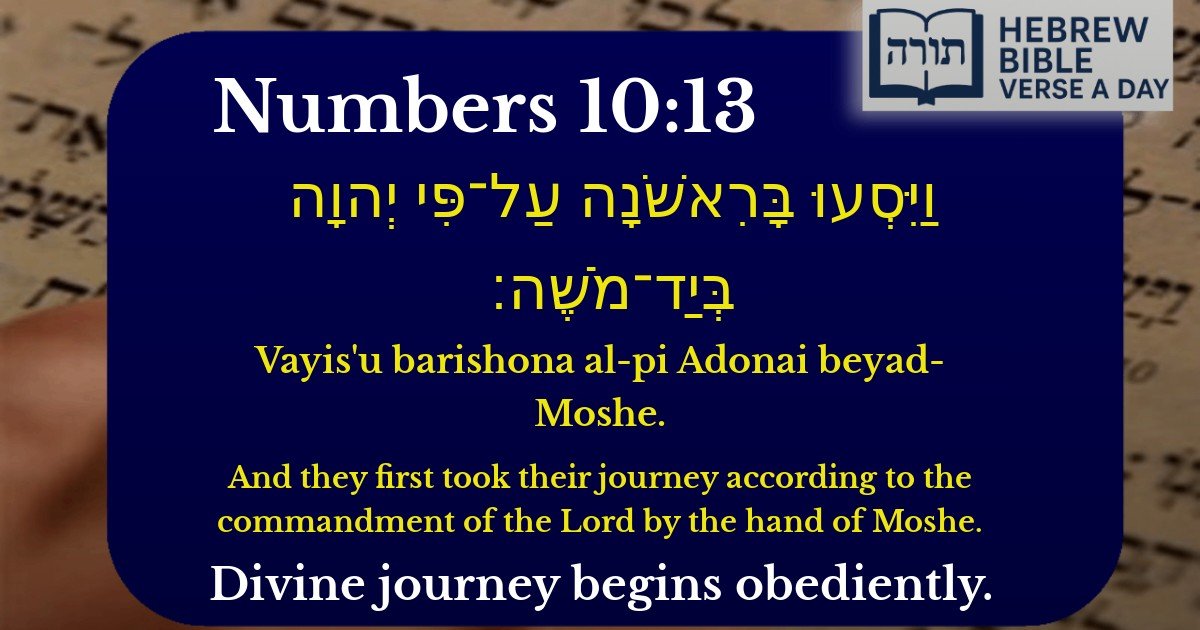
Q: What does 'they first took their journey according to the commandment of the Lord' mean in Numbers 10:13?
A: This verse describes the Israelites beginning their journey through the wilderness under Hashem's direct command, as transmitted through Moshe. Rashi explains that this marks the first time they traveled after the Mishkan (Tabernacle) was erected, showing their obedience to divine guidance.
Q: Why is it significant that the Israelites traveled 'by the hand of Moshe'?
A: The phrase emphasizes that Moshe was the faithful conduit for Hashem's instructions. The Rambam teaches that this highlights the principle of prophetic leadership in Judaism - the people followed not Moshe's personal will, but the divine word he transmitted.
Q: What lesson can we learn from how the Israelites began their journey?
A: The Midrash Tanchuma teaches that this models the Jewish approach to major life transitions - beginning with divine guidance rather than human impulse. Just as the Israelites waited for Hashem's command before moving, we should seek spiritual direction when making important decisions.
Q: How does the concept of traveling 'according to the commandment of the Lord' apply today?
A: The Sfas Emes explains that just as the Israelites followed divine guidance through the wilderness, Jews today must follow Torah as our roadmap through life's challenges. The verse reminds us that our 'journeys' - both physical and spiritual - should align with halachah and Torah values.
Q: What does 'first took their journey' teach us about new beginnings?
A: The Ohr HaChaim notes the word 'first' teaches that every Jewish endeavor should begin with divine connection. Just as the nation's first journey was by Hashem's command, our own new undertakings should start with prayer, Torah study, and seeking rabbinic guidance when needed.


Understanding the Verse in Context
The verse (Bamidbar 10:13) describes the Israelites' first journey after the construction of the Mishkan (Tabernacle) and the establishment of their encampment around it. The phrase "וַיִּסְעוּ בָּרִאשֹׁנָה" ("And they first took their journey") marks a pivotal moment in their travels through the wilderness.
Rashi's Commentary
Rashi explains that the term "בָּרִאשֹׁנָה" ("first") refers to the initial departure from Har Sinai, where they had been encamped for nearly a year. He emphasizes that this journey was "עַל־פִּי יְהוָה" ("according to the commandment of the Lord"), meaning it was directed by divine instruction, not human initiative. Rashi further notes that the phrase "בְּיַד־מֹשֶׁה" ("by the hand of Moshe") underscores Moshe's role as the intermediary through whom Hashem communicated His will to the people.
Rambam's Perspective
Rambam (Hilchot Yesodei HaTorah 9:1) highlights the principle of prophecy in this verse. The journey was not based on Moshe's personal authority but on his prophetic transmission of Hashem's command. This reinforces the idea that all movements of Bnei Yisrael in the wilderness were guided by divine providence, not human planning.
Midrashic Insights
The Significance of Order
The Talmud (Shabbat 116a) derives from this verse that the Israelites traveled in a specific, divinely ordained formation, with each tribe assigned its place. This reflects the importance of structure and unity in fulfilling Hashem's will, both in physical journeys and spiritual growth.
Practical Lessons