
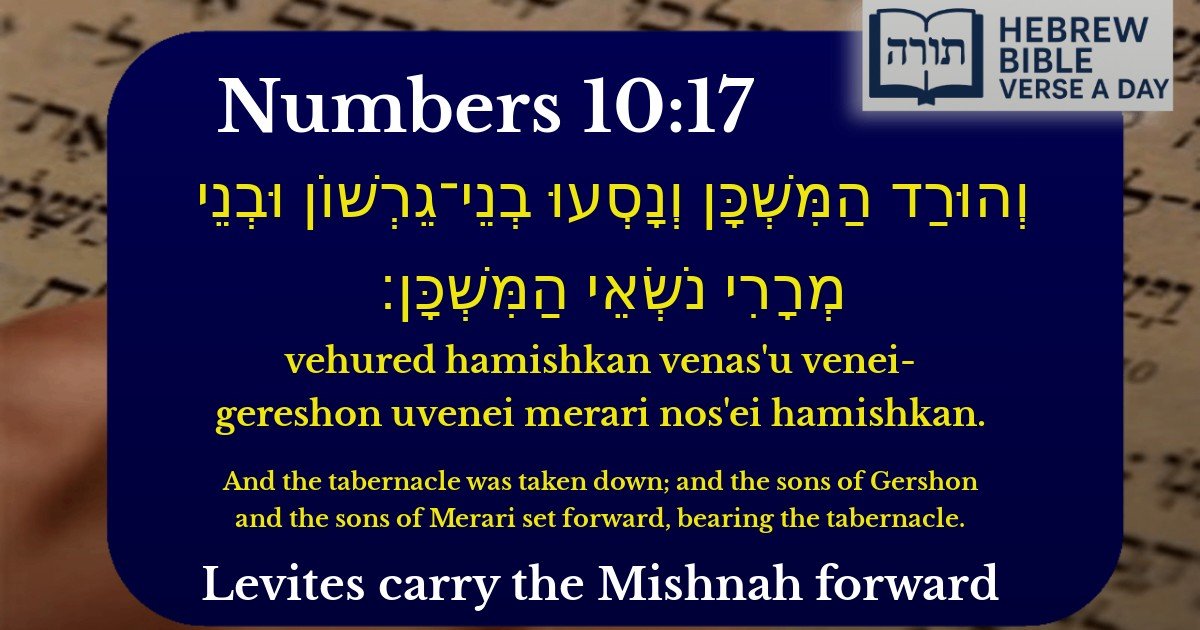

Numbers 10:17 - Levites carry the Mishnah forward

Numbers 10:17 - במדבר 10:17

Hebrew Text

וְהוּרַד הַמִּשְׁכָּן וְנָסְעוּ בְנֵי־גֵרְשׁוֹן וּבְנֵי מְרָרִי נֹשְׂאֵי הַמִּשְׁכָּן׃

English Translation

And the tabernacle was taken down; and the sons of Gershon and the sons of Merari set forward, bearing the tabernacle.

Transliteration

Vehured hamishkan venas'u venei-gereshon uvenei merari nos'ei hamishkan.

Hebrew Leining Text

וְהוּרַ֖ד הַמִּשְׁכָּ֑ן וְנָסְע֤וּ בְנֵֽי־גֵרְשׁוֹן֙ וּבְנֵ֣י מְרָרִ֔י נֹשְׂאֵ֖י הַמִּשְׁכָּֽן׃

🎵 Listen to leining

Parasha Commentary

Context in the Wilderness Journey

The verse (Bamidbar 10:17) describes the orderly dismantling and transport of the Mishkan (Tabernacle) during Bnei Yisrael's travels in the wilderness. According to Rashi, this was part of the Divinely ordained sequence for the tribes' movements, where the Mishkan's components were carried by the families of Gershon and Merari from the tribe of Levi, following the departure of Yehuda's camp.

Roles of Gershon and Merari

  • Bnei Gershon carried the Mishkan's coverings, curtains, and screens (Bamidbar 4:24-26), as noted by Ramban. Their load consisted of the softer, textile-based components.
  • Bnei Merari transported the heavier structural elements—the planks, bars, pillars, and sockets (Bamidbar 4:31-32), as explained by Sforno. Their task required greater physical strength.

Symbolism of the Mishkan's Transport

The Midrash Tanchuma (Bamidbar 12) highlights that the Mishkan's portability reflects Hashem's constant presence with Bnei Yisrael, even during their journeys. The Rambam (Hilchot Beit HaBechirah 1:1) derives from this that the Divine Presence accompanies Israel in exile, just as it did in the wilderness.

Orderly Process as a Model

Rabbeinu Bachya emphasizes that the meticulous procedure for dismantling and transporting the Mishkan teaches the importance of treating sacred objects with reverence. The sequence ensured that no part of the Mishkan was left unattended or disrespected during transit.

📚 Talmud Citations

This verse is not quoted in the Talmud.

Frequently Asked Questions

Q: What does Numbers 10:17 teach us about the roles of the Levites?
A: Numbers 10:17 describes how the sons of Gershon and Merari, who were from the tribe of Levi, were responsible for transporting the Mishkan (Tabernacle) when the Israelites traveled. According to Rashi and the Talmud (Sotah 37a), the Gershonites carried the curtains and coverings, while the Merarites carried the heavy structural parts like beams and sockets. This teaches us the importance of each group having a specific role in serving the community.
Q: Why was the Mishkan taken down and moved in Numbers 10:17?
A: The Mishkan was taken down and moved because the Israelites were journeying through the wilderness toward the Land of Israel. As Rambam explains in Mishneh Torah (Hilchot Beit HaBechirah 1:12), the Mishkan was designed to be portable so that the Divine Presence (Shechinah) could accompany the people wherever they traveled. This verse highlights how Hashem’s presence was always with them.
Q: What can we learn from the teamwork in Numbers 10:17?
A: Numbers 10:17 shows us the importance of teamwork and shared responsibility in holy work. The Gershonites and Merarites had different tasks in carrying parts of the Mishkan, but both were essential. The Midrash (Bamidbar Rabbah 5:6) teaches that this division of labor reflects how every Jew has a unique role in serving Hashem, and all contributions are needed for the greater good.
Q: How does the concept of the Mishkan’s transport apply to us today?
A: Just as the Mishkan was portable to accompany the Israelites, today we carry holiness with us wherever we go. The Talmud (Berachot 8a) teaches that synagogues and study halls are like miniature sanctuaries. Additionally, the Rambam (Hilchot Tefillah 1:1-3) explains that prayer replaces the service of the Mishkan, showing that we can connect to Hashem in all places, just as the Mishkan traveled with the people.