Frequently Asked Questions
Q: What does the 'standard of the camp of Reuben' represent in Numbers 10:18?
A: The 'standard of the camp of Reuben' refers to the flag or banner that identified the tribe of Reuben as they traveled through the wilderness. According to Rashi, each of the four main camps of Israel (led by Reuben, Judah, Ephraim, and Dan) had their own unique flag with colors corresponding to the stones on the High Priest's breastplate (Choshen). This helped maintain order during their journeys.
Q: Why is Eliẓur mentioned as the leader of Reuben's tribe in this verse?
A: Eliẓur ben Shede'ur is mentioned because he was the divinely appointed prince (nasi) of the tribe of Reuben, as listed earlier in Numbers 1:5. The Torah emphasizes that each tribe had its own leader to maintain structure and responsibility. The Midrash (Bamidbar Rabbah) explains that these leaders were chosen for their wisdom and ability to guide their tribes.
Q: What practical lesson can we learn from the orderly travel of the tribes in this verse?
A: This verse teaches the importance of organization and unity within a community. The Talmud (Eruvin 54b) derives from the Israelites' orderly travel that every group should have clear structure and leadership. Just as each tribe moved under its banner with its appointed leader, Jewish communities today also require proper leadership and structure to function harmoniously.
Q: How does the concept of tribal flags apply to Jewish life today?
A: While we no longer have tribal flags, the principle of maintaining Jewish identity remains. Just as each tribe had its own banner, today different Jewish communities may have distinct customs (minhagim) while remaining united in Torah observance. The Rambam (Hilchos Knesses Yisrael) emphasizes that unity doesn't require uniformity - different groups can maintain their traditions while working together for common goals.
Q: Why does the Torah specify the travel order of the tribes so precisely?
A: The precise travel order, as explained by Rashi and the Midrash (Bamidbar Rabbah 2:10), reflects divine wisdom in organizing the nation. Judah's camp traveled first as kingship would come from them, Reuben followed as the firstborn, and the Mishkan (Tabernacle) was in the center. This arrangement teaches that every individual and group has their proper place in serving Hashem collectively.

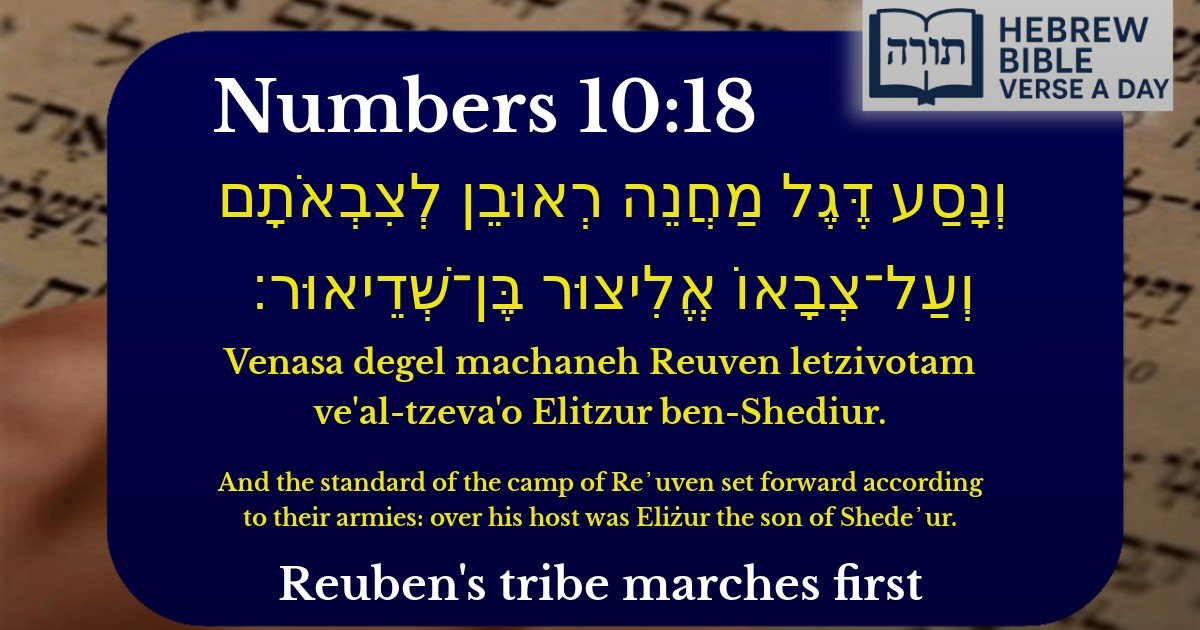

Positioning of the Camp of Reuven
The verse describes the movement of the camp of Reuven, which traveled under its banner (degel) as part of the Israelite encampment in the wilderness. According to Rashi (Bamidbar 2:10), Reuven's camp was positioned to the south of the Mishkan (Tabernacle), alongside the tribes of Shimon and Gad. This arrangement was divinely ordained, as each tribe had a fixed place in the formation around the Mishkan.
Leadership of Eliẓur ben Shede'ur
Eliẓur ben Shede'ur served as the nasi (prince) of Reuven, leading his tribe's military division. The Midrash (Bamidbar Rabbah 2:7) highlights that the selection of tribal leaders was not arbitrary—each nasi was chosen based on merit and divine wisdom. Ramban (Bamidbar 2:2) further explains that the leaders were appointed to ensure orderly travel and to maintain the sanctity of the camp.
Symbolism of the Degel
The degel (standard) represented more than just a military banner. The Talmud (Shabbat 99a) teaches that each tribe's degel bore unique colors and symbols reflecting their ancestral blessings. Reuven's banner, according to Midrashic tradition (Bamidbar Rabbah 2:7), was red with embroidered mandrakes, alluding to the incident involving Reuven and the duda'im (mandrakes) in Bereishit 30:14.
Order and Unity in the Camp
The structured movement of the tribes, as described in this verse, emphasizes the importance of unity and discipline among Bnei Yisrael. The Sforno (Bamidbar 2:2) notes that this arrangement prevented chaos during travel and reinforced the centrality of the Mishkan. Each tribe had a designated role, ensuring that the entire nation moved as one cohesive unit under Hashem's guidance.