

Join Our Newsletter To Be Informed When New Videos Are Posted
Hebrew Text
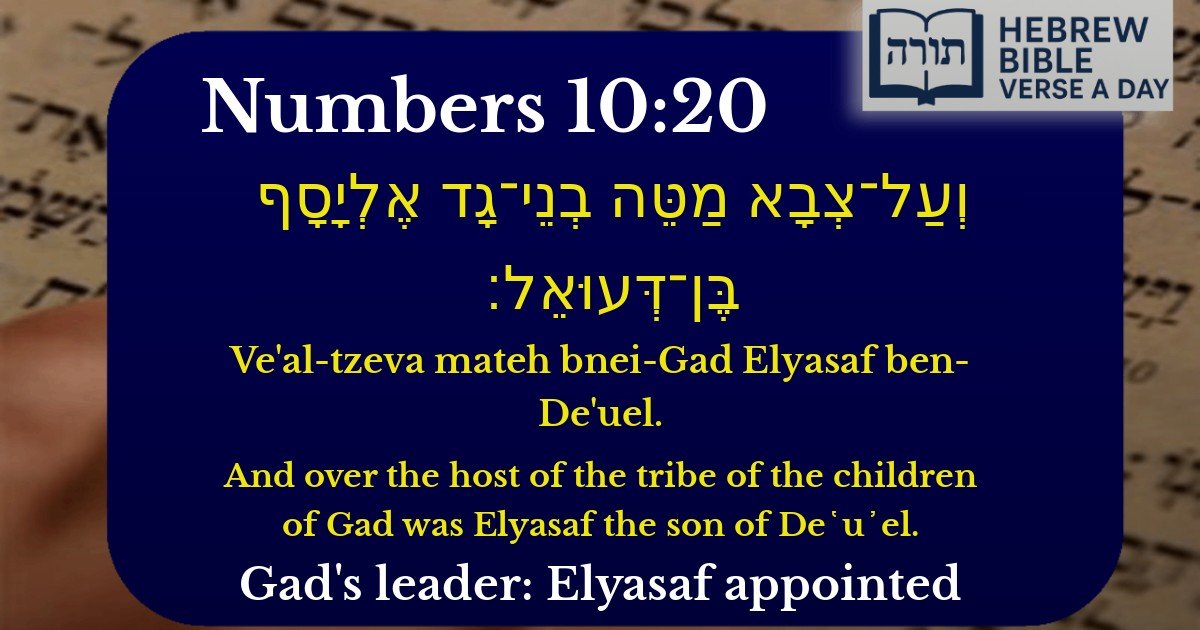
וְעַל־צְבָא מַטֵּה בְנֵי־גָד אֶלְיָסָף בֶּן־דְּעוּאֵל׃
English Translation
And over the host of the tribe of the children of Gad was Elyasaf the son of De῾u᾽el.
Transliteration
Ve'al-tzeva mateh bnei-Gad Elyasaf ben-De'uel.
Hebrew Leining Text
וְעַל־צְבָ֖א מַטֵּ֣ה בְנֵי־גָ֑ד אֶלְיָסָ֖ף בֶּן־דְּעוּאֵֽל׃
🎵 Listen to leining
Parasha Commentary
📚 Talmud Citations
This verse is not quoted in the Talmud.
Context in the Torah
The verse (Bamidbar 10:20) appears in the context of the arrangement of the Israelite camp during their travels in the wilderness. Each tribe had a designated leader (נשיא) who was responsible for organizing and leading his respective tribe. Elyasaf ben De'uel was the appointed leader of the tribe of Gad.
Elyasaf's Leadership Role
Rashi (on Bamidbar 10:20) explains that Elyasaf was chosen as the נשיא (prince) of the tribe of Gad, responsible for assembling and directing his tribe during their journeys. The term "צְבָא" (host) refers to the military-like formation in which the tribes traveled, emphasizing order and discipline under divine command.
The Meaning of "De'uel"
The name De'uel (דְּעוּאֵל) is significant. Rashi notes that in an earlier verse (Bamidbar 1:14), the name appears as "Re'uel" (רְעוּאֵל). The Talmud (Sotah 11b) and Midrash (Bamidbar Rabbah 2:7) explain that the variation reflects a change in his name due to his righteous deeds—"De'uel" meaning "knowledge of G-d," indicating his piety and devotion. Alternatively, some commentators suggest scribal differences or linguistic variations.
The Tribe of Gad's Position
According to Rambam (Hilchot Klei HaMikdash 3:7), the tribes were arranged in a specific formation around the Mishkan (Tabernacle). Gad was part of the southern camp, alongside Reuven and Shimon, led by the tribe of Reuven. Elyasaf's role was thus crucial in maintaining the unity and discipline of his tribe within this structure.
Spiritual Lessons