
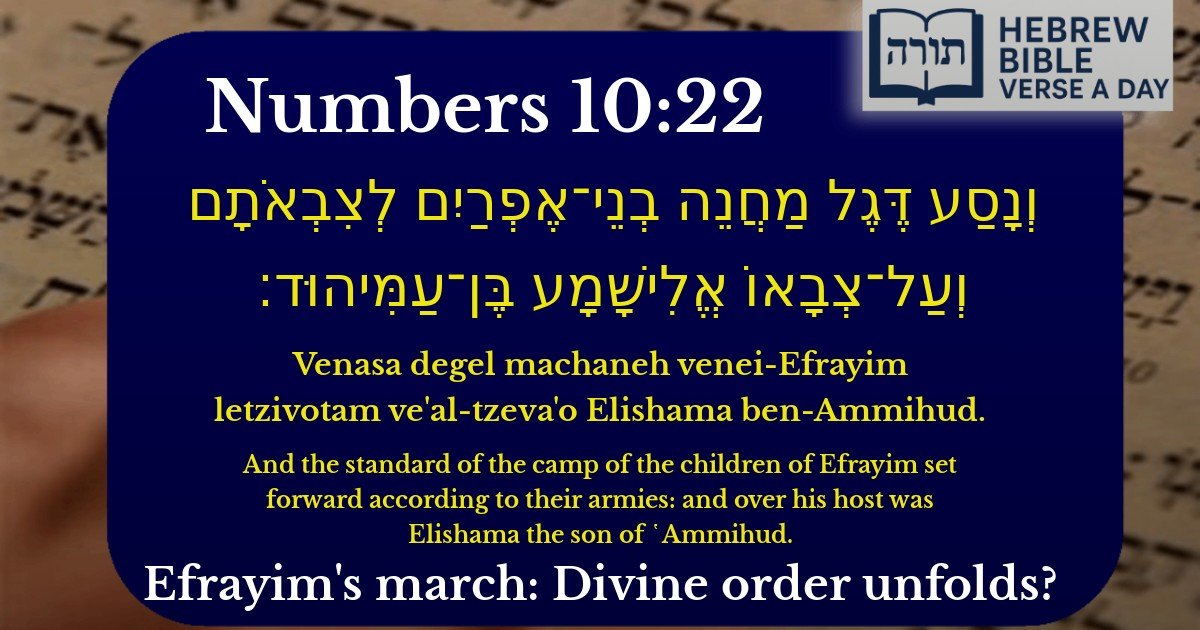

Numbers 10:22 - Efrayim's march: Divine order unfolds?

Numbers 10:22 - במדבר 10:22

Hebrew Text

וְנָסַע דֶּגֶל מַחֲנֵה בְנֵי־אֶפְרַיִם לְצִבְאֹתָם וְעַל־צְבָאוֹ אֱלִישָׁמָע בֶּן־עַמִּיהוּד׃

English Translation

And the standard of the camp of the children of Efrayim set forward according to their armies: and over his host was Elishama the son of ῾Ammihud.

Transliteration

Venasa degel machaneh venei-Efrayim letzivotam ve'al-tzeva'o Elishama ben-Ammihud.

Hebrew Leining Text

וְנָסַ֗ע דֶּ֛גֶל מַחֲנֵ֥ה בְנֵֽי־אֶפְרַ֖יִם לְצִבְאֹתָ֑ם וְעַ֨ל־צְבָא֔וֹ אֱלִישָׁמָ֖ע בֶּן־עַמִּיהֽוּד׃

🎵 Listen to leining

Parasha Commentary

The Order of the Camps in the Wilderness

The verse (Bamidbar 2:18) describes the movement of the camp of Efrayim, one of the twelve tribes of Israel, as they journeyed through the wilderness. According to Rashi, the placement of the tribes around the Mishkan (Tabernacle) was divinely ordained, with each tribe assigned a specific position under its respective degel (standard). Efrayim traveled on the west side of the Mishkan, following the camp of Reuven.

The Leadership of Elishama ben Ammihud

The verse highlights Elishama ben Ammihud as the leader of Efrayim's host. The Midrash (Bamidbar Rabbah 2:8) explains that each tribal prince was chosen based on merit and noble lineage. Ramban notes that Elishama's leadership was particularly significant because Efrayim, as a descendant of Yosef, held a distinguished position among the tribes, symbolizing spiritual and material blessing (Bereshit 48:20).

Symbolism of the Degel

  • Unity and Identity: The degel (standard) represented tribal identity and unity. The Talmud (Shabbat 22a) teaches that the flags were divinely inspired, each bearing unique colors and symbols corresponding to the tribes.
  • Divine Protection: The Midrash (Bamidbar Rabbah 2:3) compares the degel to the banners of Hashem’s heavenly hosts, signifying that the tribes marched under divine protection.
  • Order and Discipline: The structured movement of the camps, as emphasized in this verse, reflects the importance of order in serving Hashem, as noted by the Rambam in Hilchot Klei HaMikdash.

Efrayim’s Position in the Camp

According to the Sforno, Efrayim’s placement on the west side of the Mishkan was symbolic of their role in upholding Torah wisdom, as the west was associated with the Holy Ark, which housed the Luchot (Tablets). The Zohar (Bamidbar 119a) further elaborates that the tribes' arrangement mirrored the celestial order, with Efrayim corresponding to the attribute of hod (majesty).

📚 Talmud Citations

This verse is not quoted in the Talmud.

Frequently Asked Questions

Q: What does the verse about the camp of Efrayim setting forward mean?
A: This verse describes the orderly movement of the Israelite camp in the wilderness. The tribe of Efrayim, part of the camp led by Yosef's descendants, traveled under their banner (דֶּגֶל) in a specific formation. Rashi explains that each tribe had its own flag with unique colors, symbolizing their distinct identity while remaining united under Hashem's guidance.
Q: Why is Elishama mentioned as the leader of Efrayim's army?
A: Elishama ben Ammihud was appointed by Hashem (as listed in Numbers 2:18) to lead Efrayim's tribe during the journeys. The Midrash teaches that leadership roles were assigned based on merit and Divine wisdom. Each tribal prince (נָשִׂיא) had qualities needed to guide their specific tribe.
Q: What can we learn from the tribes traveling under banners?
A: The banners teach unity with individuality. The Talmud (Bamidbar Rabbah 2:7) explains that just as flags distinguish armies, each tribe had its own way of serving Hashem while working toward the common purpose of fulfilling the Torah. This shows that Judaism values both communal unity and personal spiritual expression.
Q: How does the concept of tribal banners apply today?
A: While we no longer have tribal banners, the idea remains relevant. The Rambam (Hilchos Dei'os 6:1) teaches that communities need structure and leadership. Just as each tribe contributed uniquely to Klal Yisrael, today different Jewish groups—Sephardic, Ashkenazi, etc.—have traditions that collectively enrich Judaism while maintaining shared Torah principles.