Frequently Asked Questions
Q: What is the meaning of Numbers 11:12?
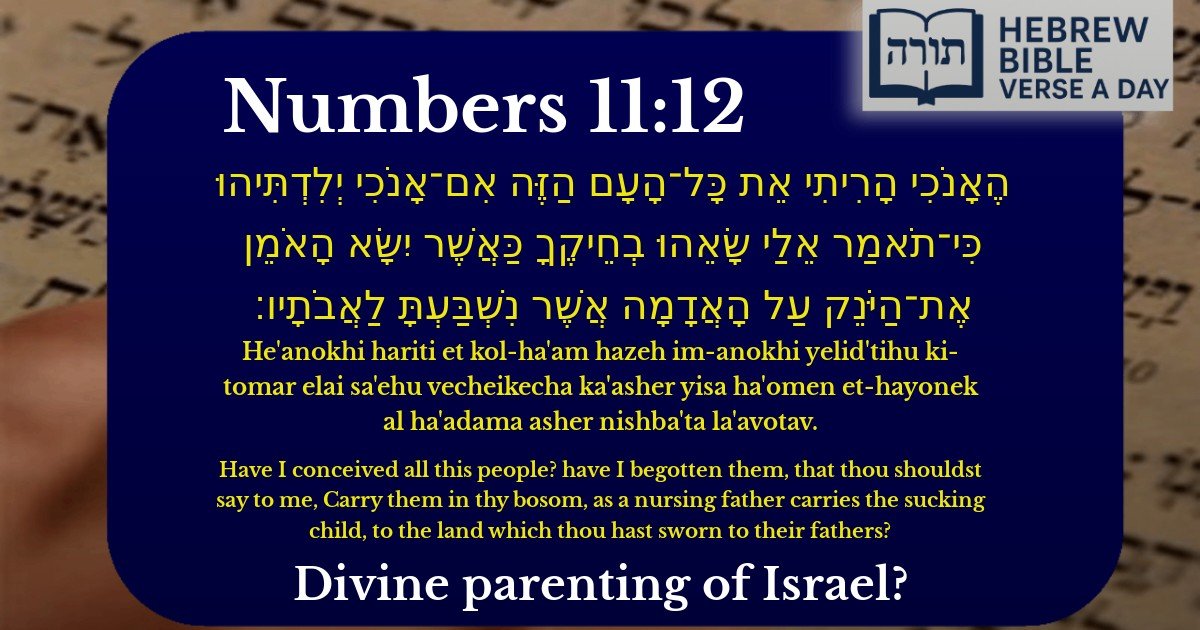
A: In Numbers 11:12, Moshe (Moses) expresses his frustration to Hashem about the burden of leading the Jewish people. He compares himself to a nursing father carrying a child, emphasizing how overwhelming it feels to care for the entire nation alone. Rashi explains that Moshe is saying, 'Did I create this nation that I should be solely responsible for them?' This shows the immense pressure Moshe felt as their leader.
Q: Why did Moshe compare himself to a nursing father in this verse?
A: Moshe uses the metaphor of a nursing father (אֹמֵן) to illustrate the constant care and responsibility he felt for the Jewish people. The Talmud (Ketubot 50a) discusses the deep level of dedication required in nurturing others. Moshe highlights that just as a caregiver must attend to a child's every need, he was expected to provide for the entire nation—a task he found overwhelming without divine assistance.
Q: What lesson can we learn from Moshe's words in Numbers 11:12?
A: From Moshe's words, we learn that even great leaders need humility and reliance on Hashem. The Midrash (Bamidbar Rabbah 15:16) teaches that Moshe’s complaint was not out of arrogance but from recognizing his human limitations. This teaches us that when faced with overwhelming responsibilities, we should turn to Hashem for strength and guidance rather than trying to bear the burden alone.
Q: How does Numbers 11:12 relate to leadership in Judaism?
A: This verse highlights the challenges of Jewish leadership. Rambam (Hilchot Sanhedrin 2:7) explains that leaders must care for their people with compassion, like a parent. Moshe’s words remind us that true leadership involves selflessness but also requires seeking help when needed. The Torah shows that even Moshe, the greatest prophet, needed support—teaching future leaders to balance responsibility with humility.
Q: What is the significance of the 'land sworn to their fathers' in this verse?
A: Moshe mentions the Promised Land (אֶרֶץ אֲשֶׁר נִשְׁבַּעְתָּ לַאֲבֹתָיו) to remind Hashem of the covenant with Avraham, Yitzchak, and Yaakov. Rashi notes that Moshe is saying, 'You swore to bring them to this land—shouldn’t You help me guide them there?' This reinforces the idea that Jewish leadership is tied to fulfilling divine promises, and Hashem ultimately ensures the nation’s destiny.


Context of the Verse
This verse (Numbers 11:12) is part of Moshe Rabbeinu's plea to Hashem during the incident of the mit'onenim (the complainers) in the wilderness. The people were dissatisfied with the manna and demanded meat, leading Moshe to express his frustration at the overwhelming burden of leading Bnei Yisrael.
Literal Interpretation (Peshat)
Moshe questions whether he is the father or mother of the nation, responsible for their every need. The metaphor of a nursing father ("as a nursing father carries the sucking child") emphasizes the constant, exhausting care required—akin to a parent tending to an infant. Rashi explains that Moshe is expressing the impossibility of bearing this responsibility alone, as he did not create the people nor is he their sole sustainer.
Midrashic Insights
The Midrash Tanchuma (Bamidbar 16) elaborates that Moshe's words reflect his humility and sense of inadequacy. By saying "Have I conceived all this people?", he acknowledges that the nation is Hashem's creation, not his own. The comparison to a nursing father (omen) underscores the unnatural expectation—just as a father does not typically nurse a child, Moshe cannot single-handedly provide for the nation.
Halachic and Philosophical Perspectives
Symbolism of the "Land Sworn to Their Fathers"
Moshe references the promised land to remind Hashem of His covenant. The Netziv (Ha'amek Davar) notes that Moshe subtly invokes the merit of the Avot (forefathers), implying that the people's journey—and his leadership—are part of a divine plan beyond human capacity.