Frequently Asked Questions
Q: What does Numbers 11:14 mean when Moshe says 'I cannot bear this people alone'?
A: In Numbers 11:14, Moshe expresses his difficulty in leading the Jewish people alone. According to Rashi, the burden was not just physical but also spiritual—Moshe felt overwhelmed by their constant complaints and disputes. This teaches us that even great leaders need support.
Q: Why was leading the Jewish people 'too heavy' for Moshe?
A: The Talmud (Sanhedrin 8a) explains that Moshe was not just dealing with physical leadership but also with the spiritual and moral guidance of the nation. The people's complaints (like in the incident of the quail) made the responsibility overwhelming. Hashem later instructed Moshe to appoint 70 elders to share the burden (Numbers 11:16-17).
Q: What lesson can we learn from Moshe admitting he couldn't lead alone?
A: The Midrash (Bamidbar Rabbah 15:16) teaches that Moshe's humility in admitting his limitations sets an example for leadership. Even the greatest prophet needed help, showing that no one should carry responsibility alone. This applies today in community leadership—delegation and teamwork are essential.
Q: How did Hashem respond to Moshe's plea in Numbers 11:14?
A: Hashem responded by instructing Moshe to gather 70 elders (Numbers 11:16-17), upon whom He would place some of Moshe's spirit. Rambam (Hilchot Sanhedrin 1:3) explains that this established the Sanhedrin, showing that Torah leadership is meant to be shared wisely.
Q: Does Numbers 11:14 teach us about asking for help?
A: Yes! The verse highlights that even Moshe, the greatest leader, recognized when he needed assistance. The Talmud (Berachot 6a) teaches that seeking help is a sign of wisdom, not weakness. This applies to all areas of life—spiritual, communal, or personal challenges.

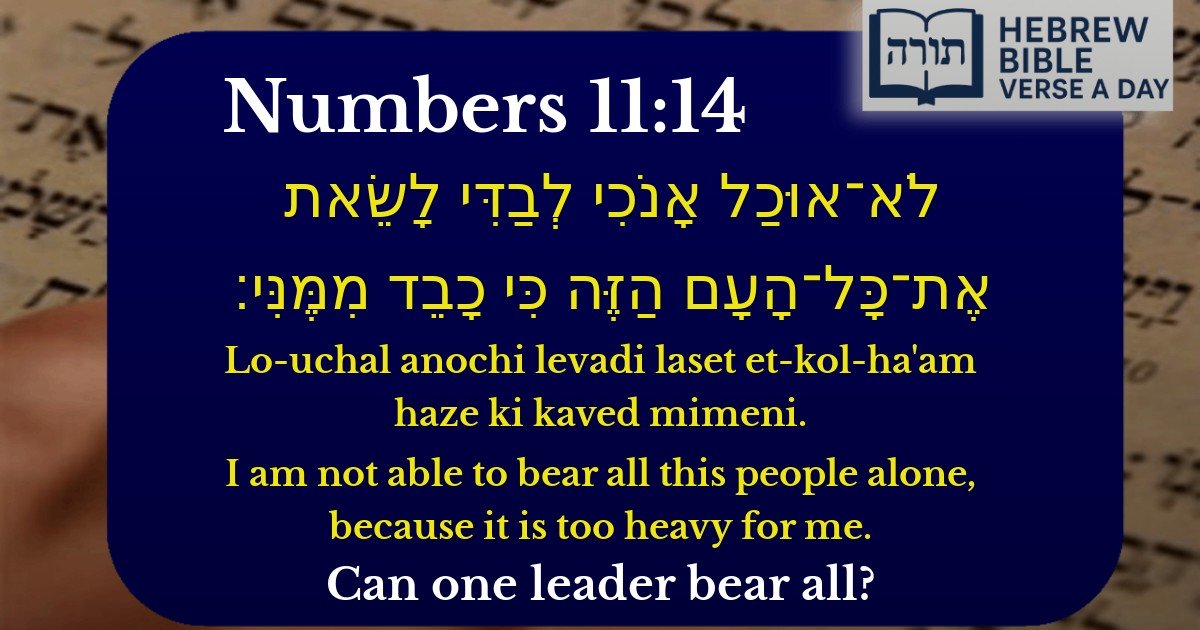

Context of the Verse
The verse (Bamidbar 11:14) records Moshe Rabbeinu's plea to Hashem, expressing his inability to bear the burden of leading Bnei Yisrael alone. This occurs after the people complain about the manna and demand meat, demonstrating their lack of gratitude and spiritual immaturity.
Rashi's Explanation
Rashi explains that Moshe's statement "כי כבד ממני" ("because it is too heavy for me") refers not just to the physical burden but to the spiritual responsibility. The people's constant complaints and lack of faith made the leadership role unbearable. Rashi cites the Sifrei, which interprets "כבד" as referring to the weight of their sins, implying that Moshe felt the moral burden of their behavior.
Rambam's Perspective
In Moreh Nevuchim (1:54), Rambam discusses Moshe's humility and leadership. He notes that Moshe's admission of inability was not a sign of weakness but of wisdom—recognizing the limits of human capacity and the need for divine assistance. This aligns with the principle that true leaders must acknowledge their limitations and seek guidance from Hashem.
Talmudic Insights
Midrashic Interpretation
The Midrash Tanchuma (Bamidbar 16) elaborates that Moshe's plea led to the appointment of 70 elders to share the leadership role. This underscores the Torah's model of decentralized authority, where wisdom is distributed among many to prevent any one individual from being overwhelmed.
Practical Lessons