
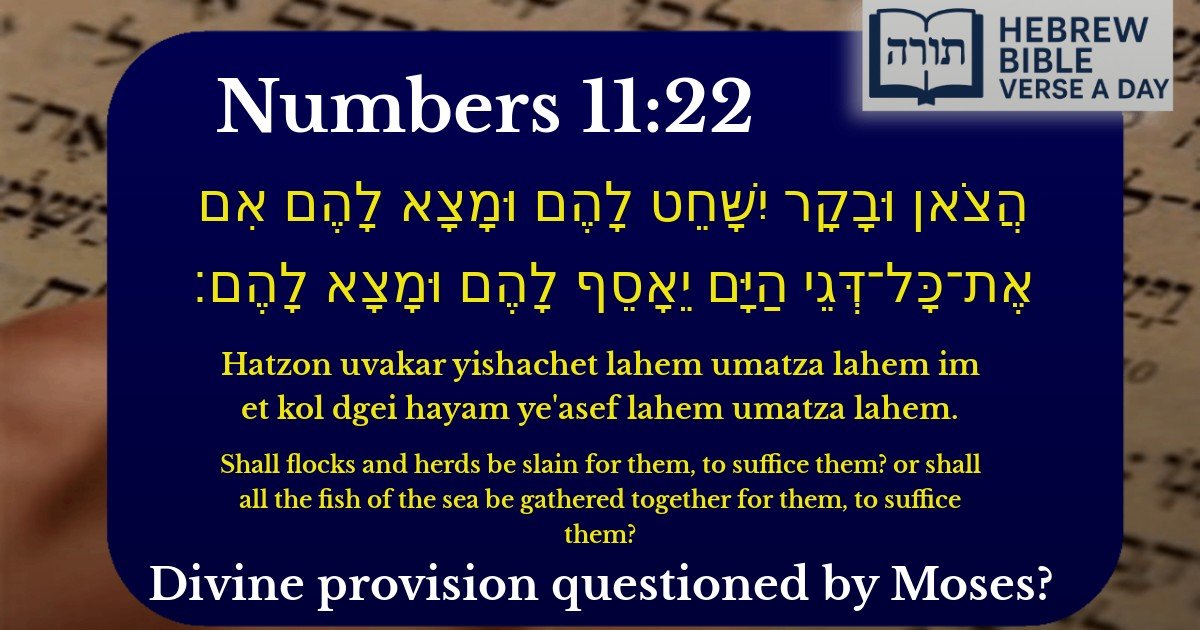

Numbers 11:22 - Divine provision questioned by Moses?

Numbers 11:22 - במדבר 11:22

Hebrew Text

הֲצֹאן וּבָקָר יִשָּׁחֵט לָהֶם וּמָצָא לָהֶם אִם אֶת־כָּל־דְּגֵי הַיָּם יֵאָסֵף לָהֶם וּמָצָא לָהֶם׃

English Translation

Shall flocks and herds be slain for them, to suffice them? or shall all the fish of the sea be gathered together for them, to suffice them?

Transliteration

Hatzon uvakar yishachet lahem umatza lahem im et kol dgei hayam ye'asef lahem umatza lahem.

Hebrew Leining Text

הֲצֹ֧אן וּבָקָ֛ר יִשָּׁחֵ֥ט לָהֶ֖ם וּמָצָ֣א לָהֶ֑ם אִ֣ם אֶֽת־כׇּל־דְּגֵ֥י הַיָּ֛ם יֵאָסֵ֥ף לָהֶ֖ם וּמָצָ֥א לָהֶֽם׃ {פ}

🎵 Listen to leining

Parasha Commentary

Context of the Verse

This verse appears in Bamidbar (Numbers) 11:22, where Moshe responds to Hashem's promise to provide meat for Bnei Yisrael in the wilderness. Moshe expresses doubt about how such a vast quantity of meat could be supplied for the entire nation. The verse reflects Moshe's astonishment at the logistical challenge of feeding so many people in a barren desert.

Rashi's Explanation

Rashi (Bamidbar 11:22) explains that Moshe's question is rhetorical, emphasizing the impossibility of procuring enough meat naturally in the wilderness. Rashi notes that Moshe was not doubting Hashem's power but rather expressing human astonishment at the scale of the miracle required. He compares it to the earlier miracle of the manna, where Hashem provided sustenance supernaturally.

Rambam's Perspective

Rambam (Maimonides), in Moreh Nevuchim (Guide for the Perplexed), interprets Moshe's words as a reflection of his deep humility and human perspective. Moshe, despite being the greatest prophet, still grappled with the limitations of human understanding when faced with divine promises. Rambam emphasizes that Moshe's question highlights the tension between human reasoning and divine omnipotence.

Midrashic Insights

  • The Midrash Tanchuma (Bamidbar 16) elaborates that Moshe's mention of "flocks and herds" and "fish of the sea" symbolizes the totality of creation. His question underscores that only Hashem, the Creator, could orchestrate such a provision.
  • The Sifrei (Bamidbar 89) adds that Moshe's words were meant to teach Bnei Yisrael the magnitude of Hashem's kindness and the futility of complaining, as their needs would be met in ways beyond natural law.

Theological Implications

This verse serves as a lesson in bitachon (trust in Hashem). Moshe's rhetorical question ultimately leads to the miracle of the slav (quail) in the following verses (Bamidbar 11:31-32), demonstrating that Hashem's providence transcends human limitations. Orthodox Jewish commentators emphasize that this narrative reinforces the idea that divine sustenance is not bound by natural constraints.

📚 Talmud Citations

This verse is not quoted in the Talmud.

Frequently Asked Questions

Q: What is the context of Numbers 11:22?
A: Numbers 11:22 is part of Moshe's (Moses') response to Hashem when the Israelites complained about the manna and demanded meat. Moshe expresses doubt about how enough meat could be provided for so many people in the wilderness. Rashi explains that Moshe was questioning the feasibility of supplying meat for 600,000 men (plus women and children) in a desert environment.
Q: Why did Moshe mention fish in this verse?
A: Moshe mentions fish to emphasize the enormity of the request for meat. The Talmud (Yoma 75a) explains that Moshe was making a rhetorical point - even if they could gather all the fish in the sea, it wouldn't satisfy the people's cravings. This shows how unreasonable their demands were after Hashem had already provided them with miraculous manna.
Q: What lesson can we learn from Numbers 11:22?
A: This verse teaches us about the danger of ingratitude. Despite receiving miraculous sustenance (the manna), the Israelites complained and demanded more. The Rambam (in Shemona Perakim) uses this episode to discuss how uncontrolled desires can lead people to make unreasonable demands, even when their basic needs are being met.
Q: How does this verse relate to trusting in Hashem?
A: The Midrash (Tanchuma Beha'alotcha 16) explains that Moshe's words show his human calculation of the situation, while Hashem responds (in the following verses) that nothing is impossible for the Divine. This teaches that even great leaders like Moshe can have moments of limited perspective, but we must remember that Hashem can provide in ways beyond human understanding.
Q: What is the significance of the mention of flocks, herds and fish?
A: Rashi notes that Moshe mentions three categories: 1) צאן (flocks - sheep and goats), 2) בקר (herds - cattle), and 3) דגי הים (fish of the sea). This progression from land animals to sea creatures shows Moshe systematically considering and dismissing every possible source of meat to emphasize the impossibility of the request through natural means.