

Join Our Newsletter To Be Informed When New Videos Are Posted
Hebrew Text
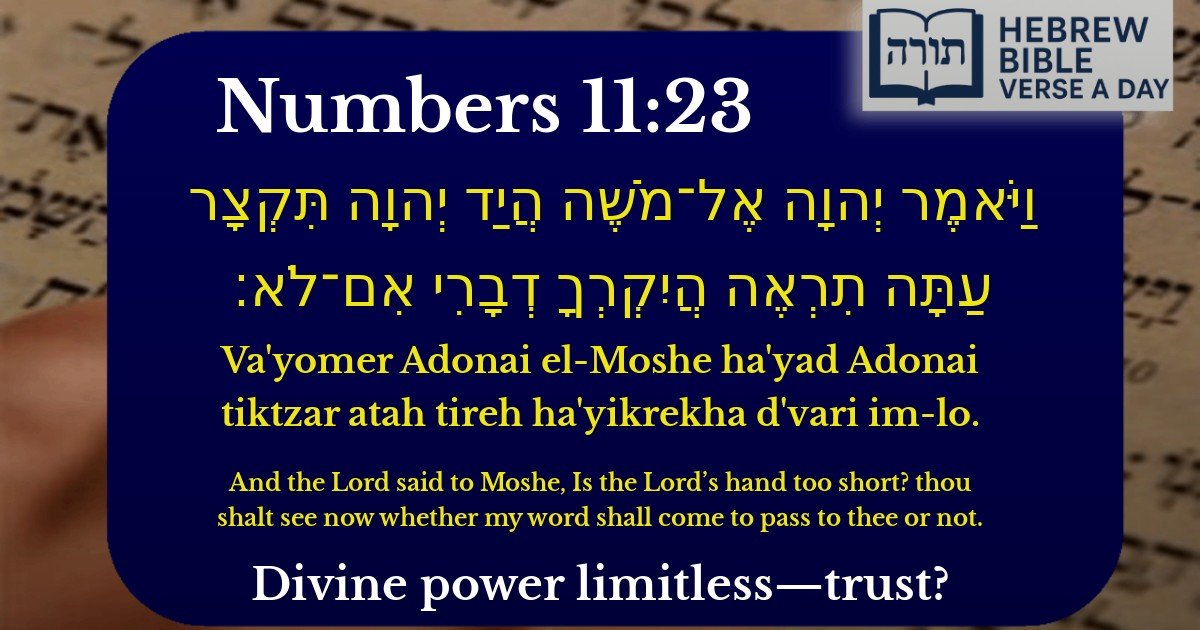
וַיֹּאמֶר יְהוָה אֶל־מֹשֶׁה הֲיַד יְהוָה תִּקְצָר עַתָּה תִרְאֶה הֲיִקְרְךָ דְבָרִי אִם־לֹא׃
English Translation
And the Lord said to Moshe, Is the Lord’s hand too short? thou shalt see now whether my word shall come to pass to thee or not.
Transliteration
Va'yomer Adonai el-Moshe ha'yad Adonai tiktzar atah tireh ha'yikrekha d'vari im-lo.
Hebrew Leining Text
וַיֹּ֤אמֶר יְהֹוָה֙ אֶל־מֹשֶׁ֔ה הֲיַ֥ד יְהֹוָ֖ה תִּקְצָ֑ר עַתָּ֥ה תִרְאֶ֛ה הֲיִקְרְךָ֥ דְבָרִ֖י אִם־לֹֽא׃
🎵 Listen to leining
Parasha Commentary
📚 Talmud Citations
This verse is quoted in the Talmud.
📖 Sanhedrin 111a
The verse is referenced in a discussion about God's power and the certainty of His promises, illustrating that nothing is beyond God's capability.
Understanding the Divine Assurance
The verse (Bamidbar 11:23) records Hashem's response to Moshe's doubt regarding the feasibility of providing meat for the Israelites in the wilderness. The phrase "הֲיַד יְהוָה תִּקְצָר" ("Is the Lord’s hand too short?") is a rhetorical question emphasizing Hashem's omnipotence. Rashi explains that this is a metaphor—just as a human hand can reach far, so too does Hashem's "hand" (i.e., His power) have no limitations. The question challenges Moshe to recognize that nothing is beyond Divine capability.
Rambam's Perspective on Divine Omnipotence
Rambam (Moreh Nevuchim 1:35) discusses this verse in the context of Divine attributes, clarifying that anthropomorphic language in Tanach (e.g., "hand of Hashem") is metaphorical. The verse teaches that Hashem's ability to act in the world is unbounded, and human limitations do not apply to Him. The phrase "עַתָּה תִרְאֶה" ("now you shall see") serves as both a reassurance and a lesson—Moshe will witness the fulfillment of Hashem's word as a tangible demonstration of Divine power.
Midrashic Interpretation
The Midrash Tanchuma (Bamidbar 21) elaborates that this exchange followed Moshe's calculation that providing meat for 600,000 men would be impossible. Hashem responds by invoking the miracles of Yetziat Mitzrayim (the Exodus), reminding Moshe that the same power that split the sea can surely provide sustenance. The Midrash emphasizes that doubt in Hashem's ability—even from a leader as great as Moshe—warrants a direct Divine response to reinforce emunah (faith).
Halachic Implications from the Talmud
The Talmud (Berachos 20a) derives from this verse that one should never question Hashem's capacity to perform miracles, even when natural laws seem insurmountable. The Gemara links this to the principle of תפילה (prayer)—just as Hashem answered Moshe, He responds to sincere tefillot. The Sages learn that the phrase "הֲיִקְרְךָ דְבָרִי" ("whether My word shall come to pass") establishes that Divine promises are immutable.
Key Lessons from the Verse