
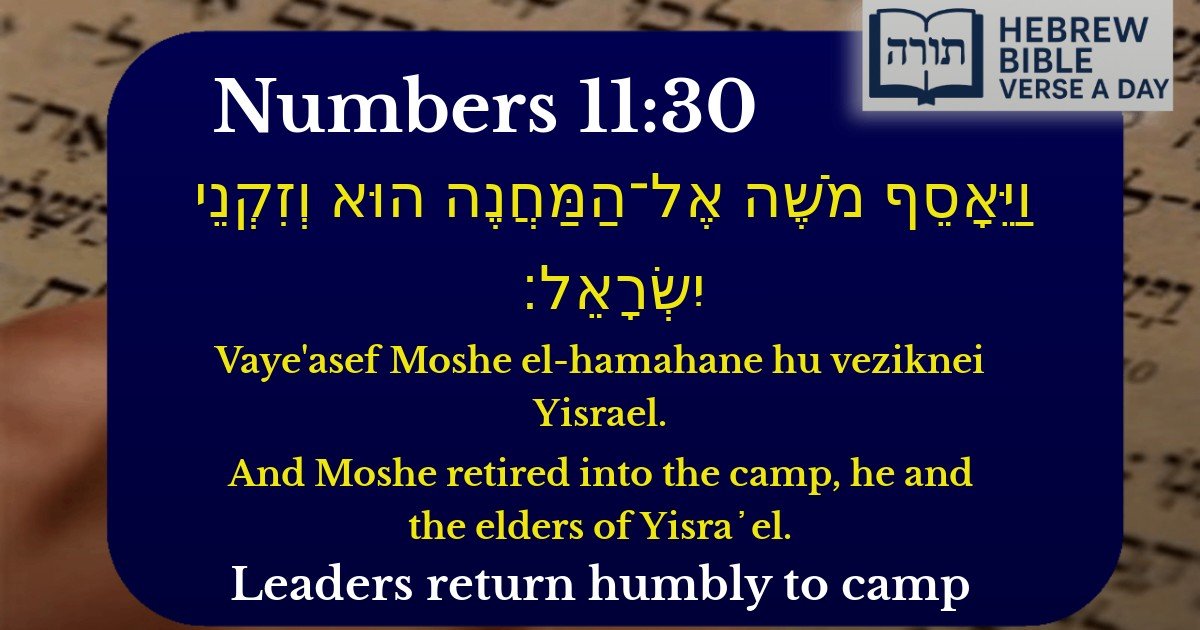

Numbers 11:30 - Leaders return humbly to camp

Numbers 11:30 - במדבר 11:30

Hebrew Text

וַיֵּאָסֵף מֹשֶׁה אֶל־הַמַּחֲנֶה הוּא וְזִקְנֵי יִשְׂרָאֵל׃

English Translation

And Moshe retired into the camp, he and the elders of Yisra᾽el.

Transliteration

Vaye'asef Moshe el-hamahane hu veziknei Yisrael.

Hebrew Leining Text

וַיֵּאָסֵ֥ף מֹשֶׁ֖ה אֶל־הַֽמַּחֲנֶ֑ה ה֖וּא וְזִקְנֵ֥י יִשְׂרָאֵֽל׃

🎵 Listen to leining

Parasha Commentary

Context of the Verse

The verse appears in Shemot (Exodus) 17:10, describing Moshe's actions during the battle against Amalek. After appointing Yehoshua (Joshua) to lead the military campaign, Moshe, along with the elders of Israel, retreats to the camp while the battle rages on.

Rashi's Explanation

Rashi (Exodus 17:10) explains that Moshe and the elders withdrew to the camp to engage in prayer and supplication for Israel's victory. He emphasizes that Moshe did not remain passive but actively supported the war effort through spiritual means. The elders accompanied him to demonstrate unity in seeking divine assistance.

Rambam's Perspective on Leadership

Rambam (Maimonides) in Hilchot Melachim (Laws of Kings 7:15) discusses the role of leaders in wartime. He notes that while military commanders lead the physical battle, righteous leaders like Moshe contribute through prayer and spiritual reinforcement. This division of roles highlights the importance of both physical and spiritual efforts in achieving victory.

Midrashic Insights

  • Mechilta DeRabbi Yishmael (Beshalach 3) teaches that Moshe's retreat was not out of fear but to fulfill his unique role—elevating the nation through prayer while Yehoshua fought on the battlefield.
  • Midrash Tanchuma (Ki Teitzei 11) compares Moshe's actions to a king who sends his soldiers to war while he remains in the palace, ensuring their success through his authority and blessings.

The Role of the Elders

The Ibn Ezra (Exodus 17:10) notes that the elders' presence with Moshe signifies their shared responsibility in guiding the nation. Their collective prayer reinforced the idea that leadership is a communal effort, not dependent on a single individual.

Halachic Implications

The Sefer HaChinuch (Mitzvah 525) derives from this episode that even in times of war, spiritual leaders must prioritize prayer and divine connection. The physical battle is secondary to the spiritual foundation that ensures success.

📚 Talmud Citations

This verse is not quoted in the Talmud.

Frequently Asked Questions

Q: What does it mean that Moshe 'retired into the camp' in Numbers 11:30?
A: Rashi explains that this verse describes Moshe returning to the Israelite camp after dealing with the incident of the quail (slav) and Eldad and Meidad prophesying. The phrase 'retired into the camp' indicates Moshe resumed his regular leadership duties among the people.
Q: Why does the verse mention both Moshe and the elders retiring to the camp?
A: The Talmud (Sanhedrin 17a) teaches that Moshe always involved the elders in leadership matters. Here it shows their shared responsibility - after addressing the people's complaints about meat (described earlier in the chapter), both Moshe and the elders returned together to continue guiding the nation.
Q: What lesson can we learn from Moshe returning to the camp with the elders?
A: The Midrash (Bamidbar Rabbah 15:22) highlights this as an example of proper leadership - even after difficult events (like the people's complaints), true leaders don't abandon their community but return to guide them. Moshe shows humility by working with the elders rather than alone.
Q: How does this verse connect to the surrounding events in Numbers 11?
A: This concludes the episode where the people complained about lacking meat. After Hashem provided quail and punished the gluttons (verses 31-34), Moshe and the elders returned to normal leadership. Rambam (Guide 3:48) sees this as showing leaders must address both spiritual and physical needs of the people.
Q: Why is it significant that Moshe is mentioned before the elders in this verse?
A: The Sifrei (Bamidbar 95) notes this word order teaches that while Moshe worked with the elders, he remained the primary leader. This reflects the Torah's principle of clear leadership hierarchy while still valuing collective wisdom, as seen throughout Jewish tradition.