Frequently Asked Questions
Q: What does 'Qivrot-hatta᾽ava' mean in Numbers 11:35?
A: The name 'Qivrot-hatta᾽ava' (קִבְרוֹת הַתַּאֲוָה) translates to 'Graves of Lust' or 'Burial Places of Craving.' According to Rashi, it refers to the place where the Israelites who craved meat (as mentioned earlier in Numbers 11) were buried after being struck by a plague as punishment for their complaints. The name serves as a reminder of the consequences of inappropriate desires.
Q: Why did the Israelites travel from Qivrot-hatta᾽ava to Ḥażerot?
A: The journey from Qivrot-hatta᾽ava to Ḥażerot was part of the Israelites' travels in the wilderness, guided by the Divine Presence (the Cloud). Ḥażerot was one of their encampments on the way to the Promised Land. The Torah lists these stops to document their journey and teach lessons about faith and obedience.
Q: What lesson can we learn from Numbers 11:35?
A: This verse teaches the importance of controlling desires and being grateful for what Hashem provides. The name 'Qivrot-hatta᾽ava' reminds us of the dangers of excessive craving, as seen when the Israelites complained about the manna. The Midrash emphasizes that contentment and trust in Hashem are essential for spiritual growth.
Q: Is Ḥażerot mentioned elsewhere in the Torah?
A: Yes, Ḥażerot is mentioned again in Numbers 12, where Miriam and Aaron speak against Moshe, leading to Miriam being afflicted with tzara'at (a spiritual skin condition). This teaches that Ḥażerot was also a place where important events occurred, reinforcing the need for proper speech and humility.
Q: How does this verse apply to us today?
A: The journey from Qivrot-hatta᾽ava to Ḥażerot reminds us to reflect on our own desires and attitudes. Just as the Israelites were punished for ingratitude, we must strive to appreciate Hashem's blessings and avoid complaints. The Talmud (Avot 4:1) teaches that true wealth is being satisfied with what one has.


Context of the Verse
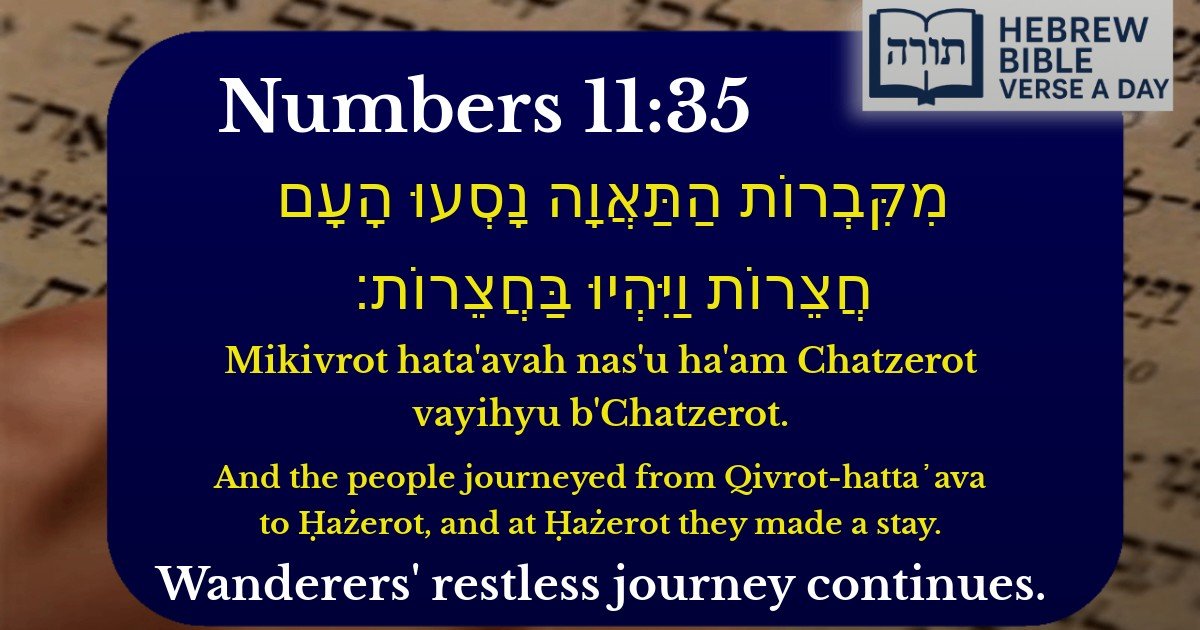
The verse (Bamidbar 11:35) describes the Israelites' journey from Kivrot HaTa'avah ("Graves of Craving") to Chatzerot, marking a transition in their travels through the wilderness. This follows the incident where the people complained about the manna and demanded meat, leading to divine punishment.
Rashi's Explanation
Rashi (Bamidbar 11:35) explains that Kivrot HaTa'avah was so named because those who died due to their excessive craving for meat were buried there. He notes that the journey to Chatzerot was a continuation of their travels, where they would later face another significant event—the rebellion of Miriam and Aharon against Moshe (Bamidbar 12).
Midrashic Insights
The Midrash (Bamidbar Rabbah 19:20) elaborates that the name Kivrot HaTa'avah serves as a lasting reminder of the dangers of uncontrolled desire. The people's dissatisfaction with the heavenly manna—a miraculous food—demonstrated ingratitude and lack of faith, leading to severe consequences.
Rambam's Perspective
Rambam (Hilchot De'ot 1:4) discusses the ethical lesson here, emphasizing that excessive physical desires distance a person from spiritual growth. The episode at Kivrot HaTa'avah serves as a cautionary tale about the need for moderation and trust in Hashem's providence.
Significance of Chatzerot
Halachic and Moral Lessons
The Sforno (Bamidbar 11:35) highlights that the Israelites' stay in Chatzerot was not merely physical but also a period for introspection. The sequence of events teaches that overcoming desire (ta'avah) is necessary before addressing other interpersonal challenges (like lashon hara, as seen with Miriam).