
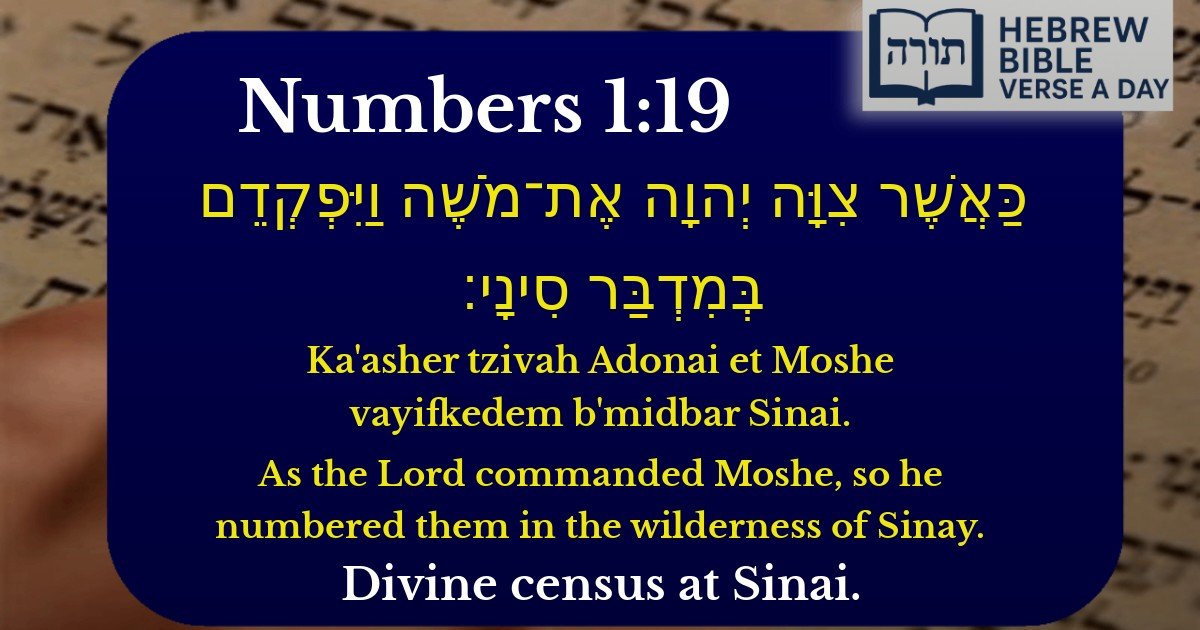

Numbers 1:19 - Divine census at Sinai.

Numbers 1:19 - במדבר 1:19

Hebrew Text

כַּאֲשֶׁר צִוָּה יְהוָה אֶת־מֹשֶׁה וַיִּפְקְדֵם בְּמִדְבַּר סִינָי׃

English Translation

As the Lord commanded Moshe, so he numbered them in the wilderness of Sinay.

Transliteration

Ka'asher tzivah Adonai et Moshe vayifkedem b'midbar Sinai.

Hebrew Leining Text

כַּאֲשֶׁ֛ר צִוָּ֥ה יְהֹוָ֖ה אֶת־מֹשֶׁ֑ה וַֽיִּפְקְדֵ֖ם בְּמִדְבַּ֥ר סִינָֽי׃ {ס}        

🎵 Listen to leining

Parasha Commentary

Context of the Verse

The verse (Bamidbar 3:16) describes how Moshe carried out the census of the Levites in the wilderness of Sinai, following Hashem's explicit command. This census was part of the broader organization of the Mishkan service and the roles of the Levi'im in place of the firstborns.

Rashi's Explanation

Rashi (Bamidbar 3:16) emphasizes that Moshe acted with precision in fulfilling Hashem's command. He notes that the phrase "כַּאֲשֶׁר צִוָּה יְהוָה אֶת־מֹשֶׁה" ("as the Lord commanded Moshe") underscores Moshe's complete adherence to the divine instruction without deviation. Rashi further connects this to the broader theme of Moshe's faithfulness in transmitting and executing Hashem's will.

Rambam's Perspective

In Hilchot Klei HaMikdash (3:1), Rambam discusses the importance of the Levites' role and how their census was a foundational step in establishing the service of the Mishkan. He highlights that this act of counting was not merely administrative but a sacred duty to designate the Levi'im for their holy service.

Midrashic Insights

  • The Sifrei (Bamidbar 3:16) teaches that the census in the wilderness of Sinai was a moment of great sanctity, as it was the place where the Torah was given. This links the Levi'im's role to the broader mission of upholding and teaching Torah.
  • The Midrash Tanchuma (Bamidbar 6) adds that the counting of the Levi'im symbolized their elevation as a chosen group, replacing the firstborns who had initially been designated for service before the sin of the golden calf.

Significance of the Wilderness of Sinai

The Kli Yakar (Bamidbar 3:16) notes that the location—the wilderness of Sinai—was significant because it was where the Levi'im demonstrated their loyalty to Hashem during the incident of the golden calf (Shemot 32:26-29). Their willingness to stand with Moshe earned them their elevated role, and the census here reaffirmed their status.

Practical Lessons

  • The verse teaches the importance of meticulousness in fulfilling mitzvot, as exemplified by Moshe's exact adherence to Hashem's command.
  • It also highlights the concept of mesirut nefesh (self-sacrifice) in divine service, as seen in the Levi'im's dedication.

📚 Talmud Citations

This verse is not quoted in the Talmud.

Frequently Asked Questions

Q: What does Numbers 1:19 mean?
A: Numbers 1:19 describes how Moshe (Moses) followed Hashem's command exactly by counting the Israelites in the wilderness of Sinai. This shows the importance of fulfilling divine commandments precisely as instructed.
Q: Why was counting the Israelites important?
A: According to Rashi and other commentators, counting the Israelites demonstrated their value to Hashem and prepared them for their roles in the journey ahead. The census also organized them for military and tribal purposes as they traveled toward the Promised Land.
Q: What can we learn from Moshe's obedience in this verse?
A: The verse teaches us the importance of following divine commandments meticulously, just as Moshe did. The Talmud (Kiddushin 40a) emphasizes that performing mitzvot with precision demonstrates our commitment to Hashem's will.
Q: Why is the location 'wilderness of Sinai' mentioned?
A: The Midrash (Bamidbar Rabbah) explains that the wilderness of Sinai was significant because it was where the Torah was given. Counting the people there connected this census to their spiritual mission as a nation bound by Torah.
Q: How does this verse apply to us today?
A: Just as Moshe carefully followed Hashem's command, we learn to perform mitzvot with exactness and devotion. The Rambam (Mishneh Torah) teaches that attention to detail in fulfilling commandments brings us closer to Hashem.