Frequently Asked Questions
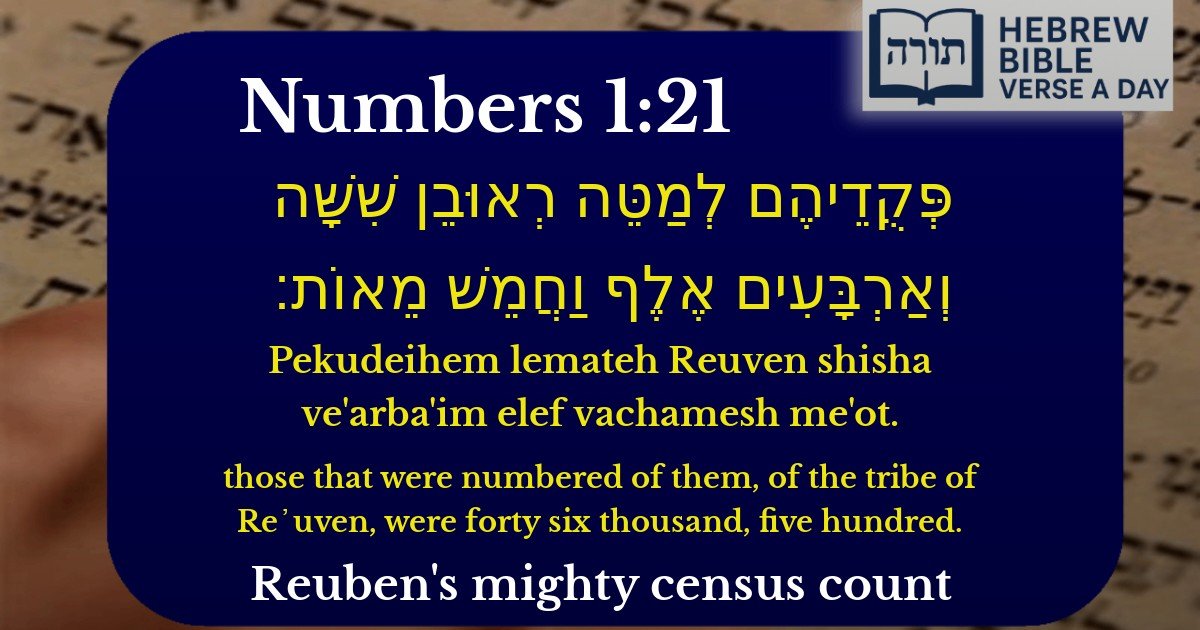
Q: What does the number 46,500 represent in Numbers 1:21?
A: In Numbers 1:21, the number 46,500 represents the total count of men aged 20 and older from the tribe of Reuben who were eligible for military service. This census was taken in the wilderness at G-d's command (Rashi on Numbers 1:2-3).
Q: Why was the tribe of Reuben counted separately in the census?
A: Each tribe was counted separately to know their individual strengths and to organize the camp in the wilderness (Rambam, Mishneh Torah, Hilchot Melachim 4:4). The counting also showed G-d's love for the Jewish people, as one counts valuable possessions (Midrash Tanchuma, Ki Tisa 9).
Q: What significance does the tribe of Reuben have in this census?
A: Reuben was Jacob's firstborn, and his tribe camped to the south of the Tabernacle (Numbers 2:10). Though Reuben lost his firstborn status due to an earlier incident (Genesis 35:22), his tribe remained significant in numbers and position (Rashi on Numbers 1:20).
Q: How does this census apply to Jewish life today?
A: While we no longer count tribes for military service, the principle remains that every Jew matters in the community. Just as each person was counted in the desert, every individual has value in serving G-d (Talmud, Sanhedrin 43b based on Numbers 1:1-2).
Q: Why does the Torah give such exact numbers in the census?
A: The precise numbers teach that every individual is important to G-d (Midrash Bamidbar Rabbah 2:19). The exact count also shows the fulfillment of G-d's promise to Abraham that his descendants would be numerous (Genesis 15:5), and provides historical accuracy (Ramban on Numbers 1:1).


Context in the Torah
The verse (Bamidbar 1:21) records the census count of the tribe of Reuven during the wilderness journey. This count was commanded by Hashem to Moshe and Elazar to organize Bnei Yisrael for military and encampment purposes (Rashi, Bamidbar 1:2). The number—46,500—reflects males aged 20 and older, eligible for army service.
Significance of Reuven's Count
Reuven was the firstborn of Yaakov Avinu, yet his tribe was not the largest. The Midrash (Bamidbar Rabbah 2:7) notes that Reuven's population was smaller than Yehuda's (74,600) due to the consequences of Reuven's earlier actions (see Bereishit 35:22). However, the tribe still maintained substantial numbers, showing Hashem's mercy and the fulfillment of His promise to Avraham of numerous descendants.
Numerical Details
Spiritual Lessons
The Baal HaTurim highlights that the gematria (numerical value) of "Reuven" (רְאוּבֵן) is 259, which corresponds to the 259 years from Avraham's birth until Levi's death—a reminder of the tribe's ancestral legacy. Additionally, the Ohr HaChaim teaches that the census served as a spiritual reckoning, urging each individual to reflect on their purpose in serving Hashem.