
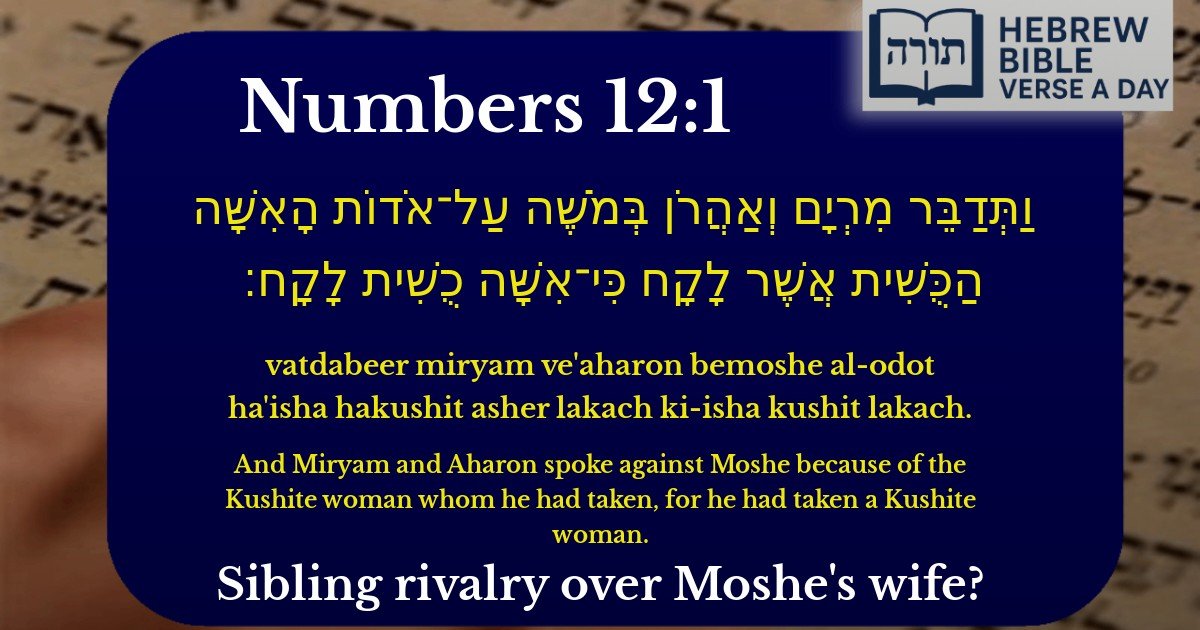

Numbers 12:1 - Sibling rivalry over Moshe's wife?

Numbers 12:1 - במדבר 12:1

Hebrew Text

וַתְּדַבֵּר מִרְיָם וְאַהֲרֹן בְּמֹשֶׁה עַל־אֹדוֹת הָאִשָּׁה הַכֻּשִׁית אֲשֶׁר לָקָח כִּי־אִשָּׁה כֻשִׁית לָקָח׃

English Translation

And Miryam and Aharon spoke against Moshe because of the Kushite woman whom he had taken, for he had taken a Kushite woman.

Transliteration

Vatdabeer miryam ve'aharon bemoshe al-odot ha'isha hakushit asher lakach ki-isha kushit lakach.

Hebrew Leining Text

וַתְּדַבֵּ֨ר מִרְיָ֤ם וְאַהֲרֹן֙ בְּמֹשֶׁ֔ה עַל־אֹד֛וֹת הָאִשָּׁ֥ה הַכֻּשִׁ֖ית אֲשֶׁ֣ר לָקָ֑ח כִּֽי־אִשָּׁ֥ה כֻשִׁ֖ית לָקָֽח׃

🎵 Listen to leining

Parasha Commentary

The Incident of Miriam and Aharon Speaking Against Moshe

The verse (Bamidbar 12:1) describes Miriam and Aharon speaking against Moshe regarding the "Kushite woman" he had married. This passage raises several questions about the nature of their criticism and Moshe's marital status.

Understanding the "Kushite Woman"

Rashi explains that the term "Kushite" does not necessarily refer to ethnicity, but rather to beauty - just as a Kushite's skin color is distinctive, so too was Tzipporah's beauty distinctive. Alternatively, Rashi cites the Midrash that this refers to Moshe having separated from marital relations after receiving prophecy, showing his exceptional level of prophecy and devotion to Hashem.

The Nature of the Criticism

The Talmud (Moed Katan 16b) explains that Miriam heard from Tzipporah that Moshe had separated from her, and she discussed this with Aharon. Their criticism stemmed from their belief that they too were prophets, yet did not separate from their spouses, questioning why Moshe acted differently.

  • Ramban suggests their criticism was about Moshe's separation from his wife, which they felt was unnecessary for prophecy
  • Sforno explains they spoke out of concern for Tzipporah's honor
  • Ibn Ezra notes their words were not intended as full-fledged slander but as familial discussion

Hashem's Response and Lesson

The subsequent verses show Hashem's strong response, emphasizing Moshe's unique prophetic level (Bamidbar 12:6-8). This teaches:

  • The special status of Moshe Rabbeinu as the greatest of all prophets (Rambam, Yesodei HaTorah 7:6)
  • The severity of speaking against others, even when done by righteous individuals like Miriam and Aharon (Rashi on Bamidbar 12:1)
  • The importance of judging leaders favorably and recognizing their unique roles (Kli Yakar)

Contemporary Lessons

The Chofetz Chaim derives from this episode the importance of guarding one's speech, especially regarding Torah scholars and leaders. The punishment Miriam received (tzara'at) serves as an eternal reminder of the severity of improper speech, even when intentions seem noble.

📚 Talmud Citations

This verse is quoted in the Talmud.

📖 Moed Katan 16b
The verse is referenced in a discussion about the proper conduct of leaders and the consequences of speaking against them, illustrating the incident involving Miriam and Aaron speaking against Moses.
📖 Sotah 12a
The verse is mentioned in the context of discussing the virtues of Moses and the unique nature of his prophecy, contrasting it with the prophecy of others like Miriam and Aaron.
📖 Arachin 15b
The verse is cited in a discussion about the severity of lashon hara (evil speech), using the incident of Miriam and Aaron speaking against Moses as an example.

Frequently Asked Questions

Q: Why did Miriam and Aaron speak against Moses regarding his Kushite wife?
A: According to Rashi and the Midrash (Sifrei Bamidbar 99), Miriam and Aaron spoke about Moses separating from his wife (Tzipporah, the Kushite woman) in order to maintain a state of purity for prophecy. They questioned why Moses acted differently from other prophets, who did not separate from their wives. This was considered improper speech (lashon hara), as they should not have criticized Moses, who had a unique level of prophecy.
Q: Who was the Kushite woman that Moses married?
A: The Kushite woman refers to Tzipporah, the daughter of Yitro (Jethro), whom Moses married earlier (Exodus 2:21). The term 'Kushite' can mean she was from the land of Kush (Ethiopia) or, as Rashi explains, it may highlight her exceptional beauty—just as Kushite skin stands out, so did her virtues. Some Midrashim suggest she was called 'Kushite' to emphasize her righteousness.
Q: What was the consequence of Miriam and Aaron speaking against Moses?
A: Hashem rebuked Miriam and Aaron (Numbers 12:4-9), clarifying that Moses was unique among prophets, speaking to Hashem 'face to face.' As a consequence, Miriam was struck with tzara'at (a spiritual skin affliction often linked to lashon hara) and had to remain outside the camp for seven days (Numbers 12:10-15). Aaron repented immediately, and the people waited for Miriam's recovery before continuing their journey.
Q: What lesson can we learn from this incident?
A: This teaches the severity of speaking negatively (lashon hara), even when done with good intentions. Miriam, a righteous prophetess, was still punished for questioning Moses. The Talmud (Arachin 15b) emphasizes that lashon hara harms the speaker, the listener, and the subject. It also highlights the importance of respecting spiritual leaders and recognizing their unique roles.
Q: Why is Miriam mentioned before Aaron in this verse?
A: Rashi explains that Miriam initiated the conversation with Aaron, which is why she is mentioned first. The Talmud (Moed Katan 16b) also notes that since Miriam was the one who watched over Moses as a baby (Exodus 2:4), she may have felt a greater sense of responsibility toward him, leading her to speak first—though this did not justify the criticism.