Frequently Asked Questions
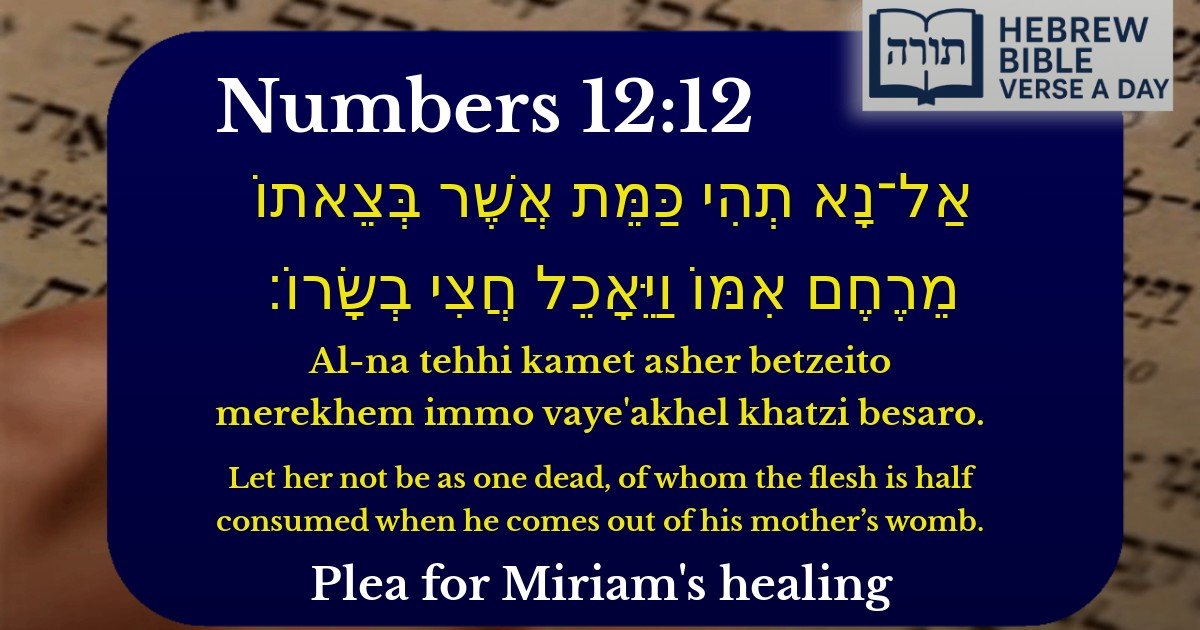
Q: What does Numbers 12:12 mean when it says 'Let her not be as one dead, of whom the flesh is half consumed'?
A: This verse is part of Moshe's (Moses') prayer for his sister Miriam after she was stricken with tzara'at (a spiritual skin affliction) for speaking negatively about him. Rashi explains that Moshe is pleading that Miriam shouldn't remain in her afflicted state like a stillborn baby whose flesh is already partially decomposed at birth. He's asking Hashem to heal her completely.
Q: Why did Moshe use this specific analogy in his prayer for Miriam?
A: According to the Midrash (Tanchuma Tzav 13), Moshe chose this powerful imagery to emphasize the severity of Miriam's condition and the urgency of his prayer. Just as a stillborn child is in a state beyond natural healing, Miriam's tzara'at was a supernatural affliction requiring divine intervention. The Rambam (Hilchot Tumat Tzara'at) teaches that tzara'at serves as a wake-up call for repentance.
Q: What lesson can we learn from Moshe praying for Miriam after she spoke against him?
A: The Talmud (Brachot 10a) derives from here that even when someone wrongs us, we should pray for their wellbeing. Despite Miriam speaking against him, Moshe immediately prayed for her recovery with the shortest but most effective prayer possible ('El na refa na la' - 'Please G-d, heal her now'). This teaches the importance of forgiving others and seeking their welfare.
Q: How does the concept in Numbers 12:12 apply to us today?
A: The Sforno explains this verse reminds us that spiritual ailments (like harmful speech) can have physical consequences. Just as Miriam needed healing after speaking lashon hara (negative speech), we must be mindful of our words and seek repentance when we err. The verse also teaches that sincere prayer can bring healing, both physically and spiritually.
Q: Why does the verse mention 'coming out of his mother's womb'?
A: Rashi notes this emphasizes the unnatural state Moshe is praying to prevent - just as a stillborn never had life outside the womb, Moshe didn't want Miriam to remain in her afflicted state. The Kli Yakar adds that birth represents new beginnings, hinting at Moshe's hope for Miriam's complete recovery and spiritual renewal.


Context of the Verse
This verse appears in Bamidbar (Numbers) 12:12, where Moshe Rabbeinu prays for his sister Miriam after she is stricken with tzara'at (a spiritual affliction often translated as leprosy) for speaking against him. The imagery of a stillborn child with half-consumed flesh is a powerful metaphor for the severity of her condition.
Rashi's Explanation
Rashi explains that Moshe's prayer uses this metaphor to emphasize the urgency of Miriam's healing. Just as a stillborn child is lifeless and partially decomposed, Miriam's affliction rendered her spiritually and physically diminished. Moshe pleads that she should not remain in this state, but rather be restored to full health.
Midrashic Interpretation
The Midrash Tanchuma (Tzav 13) elaborates that this metaphor highlights the unnatural state of Miriam's punishment. Just as a stillborn child is a tragic deviation from the natural order, Miriam's affliction was an aberration from her usual righteousness. The Midrash underscores that even the righteous can falter, but teshuvah (repentance) and prayer can bring restoration.
Rambam's Perspective
Rambam (Hilchot Tumat Tzara'at 16:10) connects this verse to the broader concept of lashon hara (evil speech). He teaches that Miriam's affliction serves as a warning about the grave consequences of harmful speech, even when spoken by someone of her stature. The imagery of a stillborn child underscores the destructive potential of words.
Symbolism of "Half-Consumed Flesh"
Halachic Implications
The Gemara (Moed Katan 28a) derives from this verse that one should pray for the sick using concise yet potent language, as Moshe did. His brief but vivid plea serves as a model for effective tefillah (prayer) in times of distress.