Frequently Asked Questions
Q: What does the number 45,650 represent in Numbers 1:25?
A: In Numbers 1:25, the number 45,650 represents the count of men aged 20 and older from the tribe of Gad who were eligible for military service. This census was taken in the wilderness at G-d's command (Numbers 1:1-3) to organize the Israelites for their journey and defense. Rashi explains that each tribe was counted individually to show their importance.
Q: Why is the tribe of Gad mentioned specifically in this verse?
A: The tribe of Gad is mentioned specifically because the Torah lists each tribe's population separately in Numbers Chapter 1. Gad was one of the twelve tribes descended from Jacob's sons. The Midrash notes that Gad was known for producing strong warriors (Genesis 49:19), which is why their military count is significant.
Q: How does this census number apply to Jewish life today?
A: While we don't conduct tribal censuses today, this verse teaches the importance of counting and valuing each individual in the community. The Rambam (Hilchot Kiddush Hachodesh 5:1) derives from census passages that counting people should be done respectfully, such as through indirect means (like counting half-shekels in Exodus 30:12), showing every person's importance.
Q: Why does the Torah give such exact numbers in the census?
A: The Torah gives exact numbers to emphasize that every individual in Israel matters to G-d. The Talmud (Bava Batra 117b) explains that the detailed counts show G-d's love for the Jewish people, likening it to a king who counts his treasured possessions frequently. The precision also reflects the historical accuracy of the Torah's account.
Q: What can we learn from the tribe of Gad having 45,650 men?
A: We learn that every tribe had a unique role in the Jewish nation. Gad's size (the 7th largest tribe) shows that all tribes, whether larger or smaller, were essential. The Midrash Tanchuma (Bamidbar 12) teaches that just as the tribes camped in specific formations around the Mishkan (Tabernacle), each Jew today has a unique place and purpose in serving G-d.

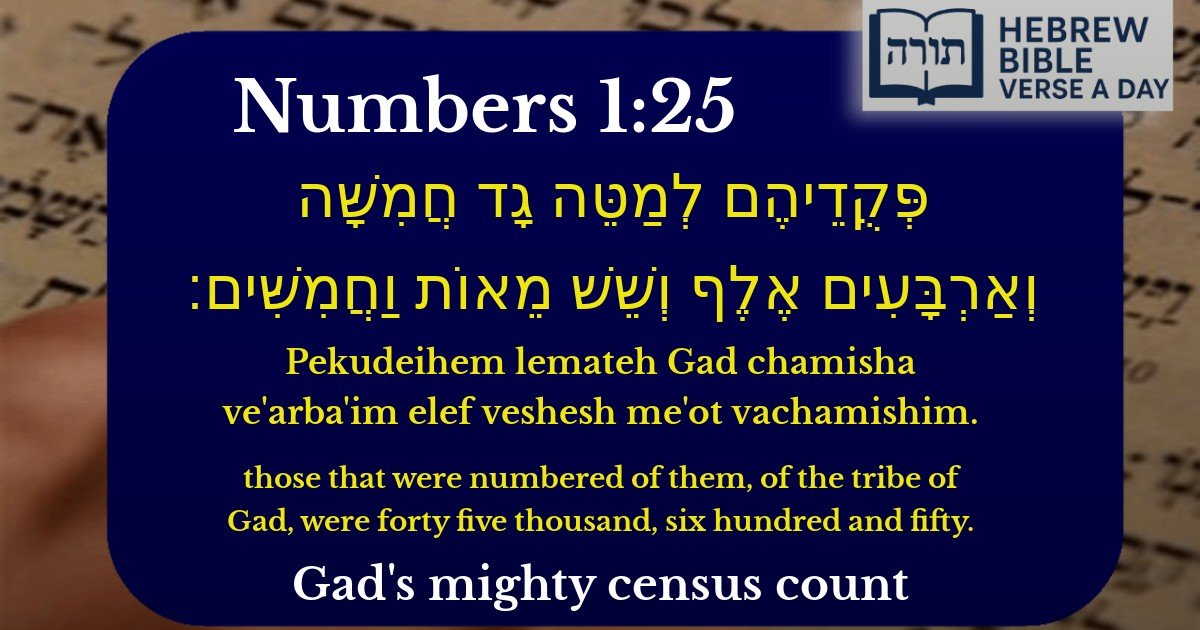

The Tribe of Gad's Census in the Wilderness
The verse (Bamidbar 1:25) records the count of the tribe of Gad as 45,650 men of military age (20 years and older). This census was conducted in the second year after the Exodus, as commanded by Hashem (Bamidbar 1:1-3).
Rashi's Explanation of the Numbers
Rashi notes that the tribe of Gad was counted separately from the other tribes, each maintaining its unique identity while being part of the greater nation. The specific number (45,650) reflects the actual count, not an approximation, demonstrating the precision with which Hashem regards each individual Jew.
Symbolism in the Count
Comparative Tribal Counts
The Midrash Rabbah (Bamidbar 2:16) notes that Gad was the sixth largest tribe at this counting. This positioning is significant as it shows how the tribes were balanced - with some larger and some smaller, but all equally important in forming the complete nation.
Lessons for All Generations
Rambam (Hilchot Kiddush HaChodesh 11:16) derives from these precise counts that every Jew matters in the collective whole. The exact numbering teaches that no individual is lost in the general population when it comes to divine providence and the importance of each person's role in Klal Yisrael.