Frequently Asked Questions
Q: What does the number 74,600 represent in Numbers 1:27?
A: In Numbers 1:27, the number 74,600 represents the count of men aged 20 and older from the tribe of Yehuda (Judah) who were eligible for military service. This census was taken in the wilderness after the Exodus, as commanded by Hashem (Rashi on Numbers 1:2-3).
Q: Why was the tribe of Yehuda counted separately in this verse?
A: Each tribe was counted separately to organize the Israelites for their journey in the wilderness and for future military campaigns. Yehuda was the largest tribe, and its count is listed first because it held a position of leadership among the tribes (Ramban on Numbers 1:20).
Q: What can we learn from the detailed census in Numbers 1:27?
A: The detailed census teaches us that every individual in the tribe of Yehuda—and by extension, all of Israel—was important and counted before Hashem. It also shows the fulfillment of Hashem's promise to make the descendants of Avraham as numerous as the stars (Midrash Tanchuma, Bamidbar 4).
Q: How does the concept of counting tribes apply to Jewish life today?
A: While we no longer conduct tribal censuses, the idea of valuing each individual remains central in Judaism. In communal matters, such as prayer minyans (quorums of 10), every person counts. This verse reminds us that every Jew has a unique role in serving Hashem (Talmud, Berachot 6b).
Q: Why is the tribe of Yehuda mentioned first in the census?
A: Yehuda is mentioned first because it was the leading tribe, from which the Davidic dynasty and future kings of Israel would descend (Genesis 49:10). This reflects its prominence in both spiritual and national leadership (Rashi on Numbers 2:3).

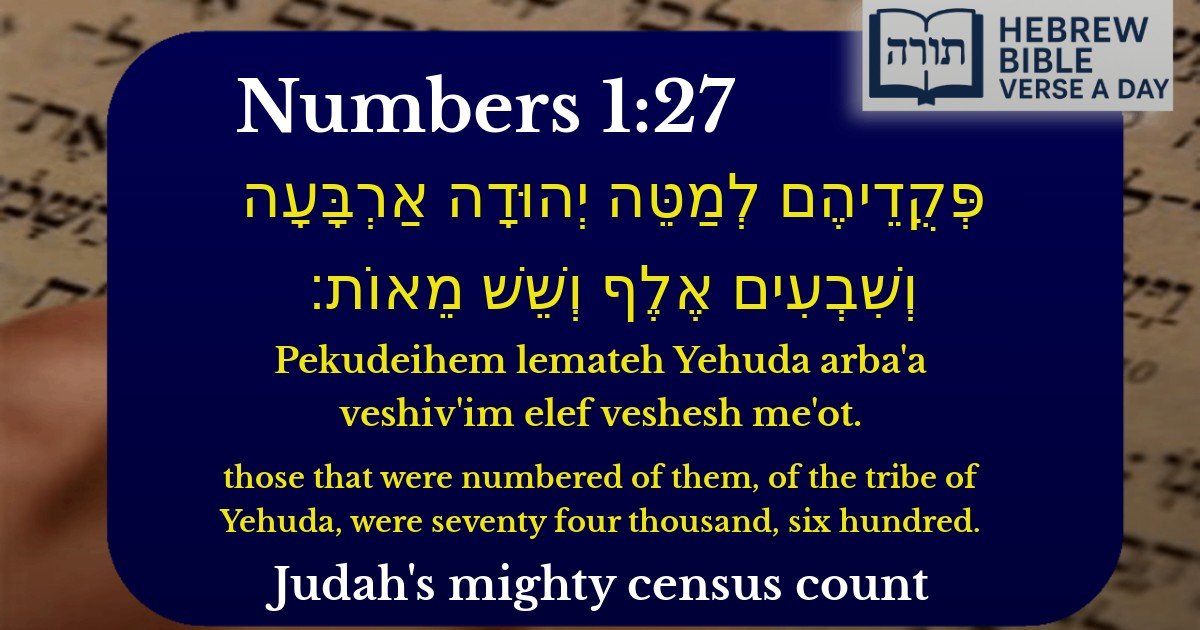

Commentary on the Census of the Tribe of Yehuda
The verse (Bamidbar 1:27) states: "פְּקֻדֵיהֶם לְמַטֵּה יְהוּדָה אַרְבָּעָה וְשִׁבְעִים אֶלֶף וְשֵׁשׁ מֵאוֹת" ("those that were numbered of them, of the tribe of Yehuda, were seventy-four thousand, six hundred"). This census reflects the population of the tribe of Yehuda during the counting in the wilderness.
Rashi's Explanation
Rashi (Bamidbar 1:27) notes that the tribe of Yehuda was the most numerous among the tribes, emphasizing their prominence. He connects this to the blessing given by Yaakov Avinu in Bereishit 49:8, where Yehuda is praised: "יְהוּדָה אַתָּה יוֹדוּךָ אַחֶיךָ" ("Yehuda, your brothers shall acknowledge you"). This numerical strength was a fulfillment of that blessing, demonstrating Yehuda's leadership role among the tribes.
Midrashic Insights
The Midrash (Bamidbar Rabbah 2:7) elaborates that the tribe of Yehuda's large population was a reward for their righteousness and unity. Specifically, it highlights Yehuda's willingness to take responsibility for his actions (as seen in the story of Tamar in Bereishit 38) and his role in protecting Binyamin (Bereishit 44). These merits contributed to their growth and distinction.
Rambam's Perspective
While Rambam does not directly comment on this verse, his principles in Hilchot Melachim (Laws of Kings) underscore the tribe of Yehuda's enduring leadership role, as they were destined to produce the Davidic dynasty. The large census number reflects their divinely ordained position as future kings of Israel.
Symbolism of the Number
Practical Implications
The census served both a practical and spiritual purpose. Practically, it organized the tribes for their journey and encampment in the wilderness. Spiritually, it reinforced the idea that each tribe had a unique role, with Yehuda positioned at the forefront (as per the arrangement around the Mishkan in Bamidbar 2:3).