Frequently Asked Questions
Q: What does it mean that Moshe was 'the trusted one in all My house'?
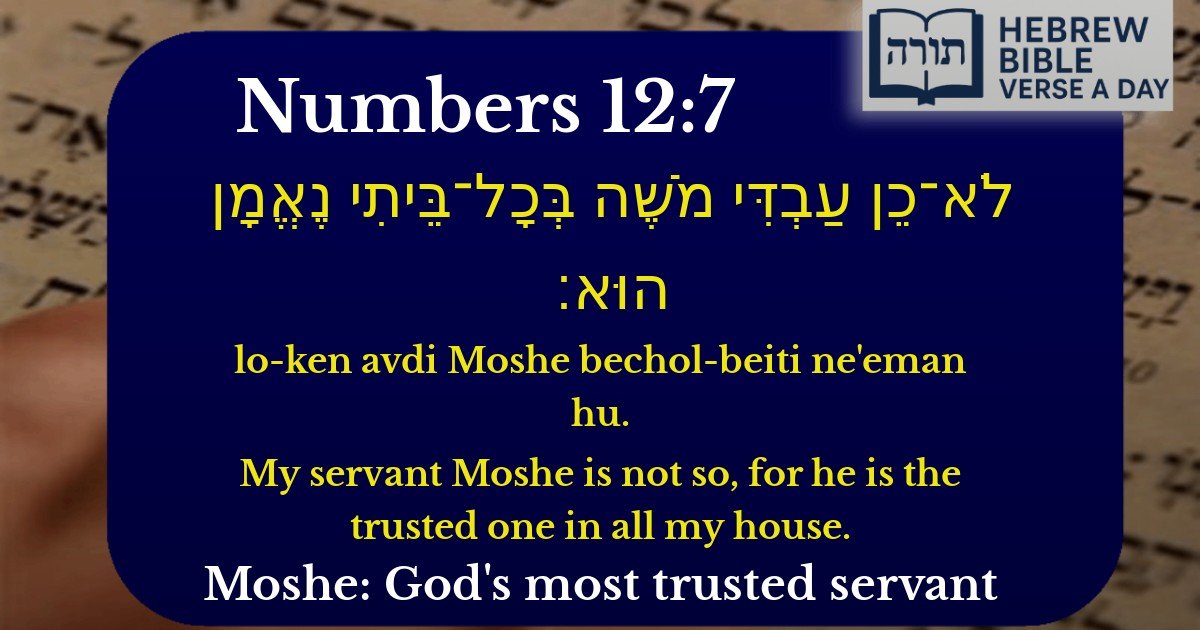
A: This verse (Numbers 12:7) emphasizes Moshe's unique level of trustworthiness in Hashem's 'house'—meaning the entire Jewish people and the divine mission. Rashi explains that Moshe was completely faithful in transmitting Hashem's word without alteration, unlike other prophets who might receive messages through visions or dreams. The Rambam (Hilchos Yesodei HaTorah 7:6) notes that Moshe's prophecy was on a higher level than all other prophets.
Q: Why is Moshe called 'My servant' in this verse?
A: The title 'My servant' (עַבְדִּי) shows Moshe's special closeness to Hashem. The Midrash (Sifrei Bamidbar 12:7) teaches that this title signifies Moshe's total dedication to serving Hashem with humility and loyalty. Unlike others who may have personal motives, Moshe was entirely devoted to fulfilling Hashem's will.
Q: How does this verse relate to the story of Miriam and Aharon speaking about Moshe?
A: This verse comes as Hashem's response when Miriam and Aharon questioned Moshe's uniqueness (Numbers 12:1-2). Hashem clarifies that Moshe's prophetic level was unmatched—'in all My house, he is trusted.' The Talmud (Sotah 9a) explains that while other prophets received messages indirectly, Moshe spoke to Hashem 'face to face' (Devarim 34:10), showing his unparalleled relationship with the Divine.
Q: What lesson can we learn from Moshe being called 'trusted'?
A: The verse teaches the importance of reliability in serving Hashem. The Sforno explains that Moshe's faithfulness in every aspect—leading the people, teaching Torah, and following mitzvos—sets an example for us. Just as Moshe was trustworthy in 'Hashem's house,' we should strive for integrity in our homes, communities, and spiritual commitments.
Q: Does this verse imply that no other leader could reach Moshe's level?
A: Yes, traditional Jewish sources maintain that Moshe's level of prophecy was unique. The Rambam (Introduction to Mishneh Torah) states that Moshe was the greatest of all prophets, and no future leader—including Mashiach—will surpass his direct communication with Hashem. However, every Jew can still emulate his traits of humility (Bamidbar 12:3) and dedication to Torah.


Context of the Verse
The verse (Bamidbar 12:7) appears in the context of Miriam and Aharon speaking against Moshe regarding his separation from his wife. Hashem responds by emphasizing Moshe's unique status as His trusted servant, distinguishing him from all other prophets.
Rashi's Explanation
Rashi explains that the phrase "לֹא־כֵן עַבְדִּי מֹשֶׁה" ("My servant Moshe is not so") means that Moshe was not like other prophets, who receive prophecy in visions or allegories. Instead, Moshe received prophecy "פה אל פה" ("mouth to mouth")—directly and clearly from Hashem (Bamidbar 12:8). Rashi further clarifies that "בְּכָל־בֵּיתִי נֶאֱמָן הוּא" ("he is the trusted one in all My house") refers to Moshe's unwavering faithfulness in transmitting Hashem's word exactly as he received it.
Rambam's Perspective
In Moreh Nevuchim (2:35), Rambam elaborates that Moshe's prophecy was unique in its clarity and directness. Unlike other prophets, who experienced prophecy through dreams or visions, Moshe communicated with Hashem while fully awake and conscious. This underscores why he was deemed "נֶאֱמָן" ("trusted")—his prophecy was without distortion or intermediary.
Midrashic Insights
Implications of Moshe's Unique Status
The Talmud (Yevamot 49b) teaches that all other prophets received prophecy through an unclear "dim glass," while Moshe saw through a "clear glass." This distinction reinforces why Moshe alone was permitted to enter the Ohel Moed (Tent of Meeting) at any time and why his teachings form the unchanging foundation of Torah law.