Frequently Asked Questions
Q: What is the context of Numbers 13:18?
A: Numbers 13:18 is part of Moshe's (Moses') instructions to the twelve spies before they scout the Land of Israel. He tells them to observe the land's quality and the strength of its inhabitants. This mission was crucial in preparing Bnei Yisrael (the Children of Israel) for entering the Promised Land.
Q: Why did Moshe ask the spies to check if the people were strong or weak?
A: According to Rashi, Moshe wanted the spies to assess whether the inhabitants were physically strong or weak to determine if Bnei Yisrael could conquer the land. However, the deeper lesson (as explained in the Midrash) is that their faith in Hashem should have been the primary factor, not just military strength.
Q: What is the significance of checking if the people were few or many?
A: The Ramban explains that Moshe wanted the spies to evaluate the population size to strategize their approach. A smaller population might be easier to overcome, while a larger one would require greater planning. However, the spies' later failure showed that they relied too much on human calculations instead of trusting in Hashem's promise.
Q: How does this verse apply to us today?
A: This verse teaches the importance of balancing practical preparation with emunah (faith). While it's wise to assess challenges (like the spies did), ultimate trust must be in Hashem. The Talmud (Sotah 34b) discusses how the spies' lack of faith led to tragedy, reminding us to rely on Hashem even when facing difficulties.
Q: Why is the Land of Israel described as 'what it is' (מַה־הִוא)?
A: Rashi explains that Moshe instructed the spies to observe the land's nature—whether it was fertile or barren, peaceful or war-torn. The phrase 'what it is' implies an objective assessment, but the deeper lesson (as taught by Chassidic thought) is that the Land of Israel is inherently holy, regardless of outward appearances.

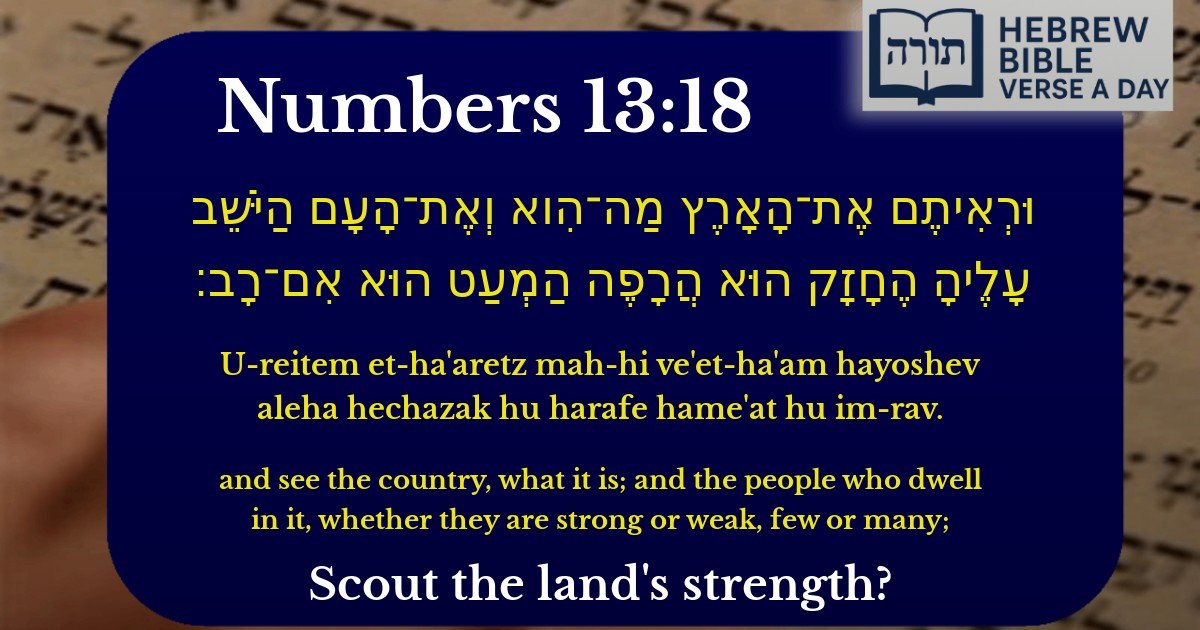

Context of the Verse
This verse (Numbers 13:18) is part of Moshe's instructions to the twelve spies before their mission to scout the Land of Israel. The spies were tasked with assessing the land's qualities and its inhabitants. The phrasing of Moshe's command is significant, as it reflects both practical and spiritual considerations.
Rashi's Commentary
Rashi explains that Moshe's instruction to "see the country, what it is" implies an evaluation of the land's agricultural potential—whether its inhabitants are strong or weak would indicate the land's fertility. A strong people suggests a fertile land, while a weak people suggests the opposite. Rashi also notes that Moshe's phrasing hints at the need to assess whether the inhabitants were vulnerable to conquest (חָזָק or רָפֶה) and whether their numbers were manageable (מְעַט or רָב).
Rambam's Perspective
Rambam (Maimonides), in his Moreh Nevuchim (Guide for the Perplexed), emphasizes that Moshe's directive was not merely a military reconnaissance but also a test of the spies' faith. The people were meant to trust in Hashem's promise, and the spies' mission should have reinforced this trust rather than fostering doubt.
Midrashic Insights
Spiritual Lessons
The verse teaches that physical observations must be framed within emunah (faith). The spies' failure was not in reporting facts but in interpreting them without trust in Hashem's promise. This aligns with the Talmudic teaching (Sotah 34b) that the spies' sin was speaking ill of the land, which stemmed from a lack of faith.
Practical Implications
From an Orthodox Jewish perspective, this verse underscores the importance of: