
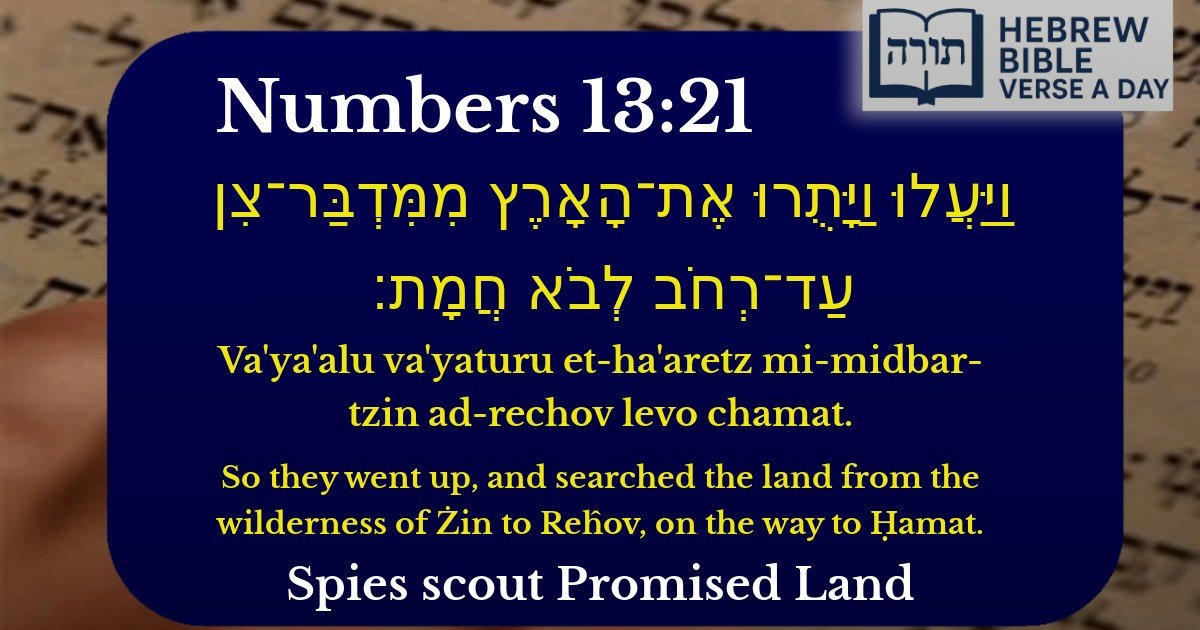

Numbers 13:21 - Spies scout Promised Land

Numbers 13:21 - במדבר 13:21

Hebrew Text

וַיַּעֲלוּ וַיָּתֻרוּ אֶת־הָאָרֶץ מִמִּדְבַּר־צִן עַד־רְחֹב לְבֹא חֲמָת׃

English Translation

So they went up, and searched the land from the wilderness of Żin to Reĥov, on the way to Ḥamat.

Transliteration

Va'ya'alu va'yaturu et-ha'aretz mi-midbar-tzin ad-rechov levo chamat.

Hebrew Leining Text

וַֽיַּעֲל֖וּ וַיָּתֻ֣רוּ אֶת־הָאָ֑רֶץ מִמִּדְבַּר־צִ֥ן עַד־רְחֹ֖ב לְבֹ֥א חֲמָֽת׃

🎵 Listen to leining

Parasha Commentary

Context in the Torah

This verse (Bamidbar 13:21) describes the journey of the twelve spies sent by Moshe to scout the Land of Israel. The mission was to assess the land's fertility, inhabitants, and defenses before Bnei Yisrael would enter.

Geographical Scope of the Spies' Mission

Rashi explains that the spies traversed the entire length of the land from south to north: "from the wilderness of Tzin" (the southern border near Kadesh-Barnea) to "Rechov, on the way to Chamat" (a northern city near modern-day Lebanon). This demonstrates the thoroughness of their mission, as they covered the entire territory promised to Avraham (Bereishit 15:18).

Significance of "Rechov Levo Chamat"

The Ramban notes that Rechov was a key northern boundary marker. The Talmud (Sotah 34b) states that this location was chosen because it represented the northernmost point of Eretz Yisrael's settled area, showing the spies the full extent of the land's bounty and strategic importance.

Spiritual Dimensions of the Scouting Mission

  • The Midrash Tanchuma (Shelach 5) teaches that the spies were meant to see not just physical attributes, but to perceive the land's spiritual qualities - how it was uniquely suited for Torah observance.
  • Rabbi Samson Raphael Hirsch emphasizes that their failure was in judging the land by natural standards alone, rather than trusting in Hashem's promise.

Lessons for Jewish Life

The Kli Yakar highlights that the verse's detailed geography teaches us the importance of fully investigating matters before making decisions, but always within the framework of emunah (faith). Their mistake was allowing their investigation to override their trust in Hashem's promise.

📚 Talmud Citations

This verse is not quoted in the Talmud.

Frequently Asked Questions

Q: What does Numbers 13:21 mean when it says the spies searched the land 'from the wilderness of Zin to Rehov'?
A: This verse describes the route the 12 spies took when scouting the Land of Israel. According to Rashi, 'the wilderness of Zin' refers to the southern border of Israel, while 'Rehov' (near Hamat) represents the northern border. The spies traveled the entire length of the land to fully assess it, as commanded by Moshe (Numbers 13:17-20).
Q: Why is the specific route of the spies in Numbers 13:21 important?
A: The detailed route shows the spies fulfilled Moshe's command completely by surveying all regions of the land. The Talmud (Sotah 34b) notes this demonstrates they were initially faithful in their mission. The boundaries mentioned also correspond to the future borders of Israel's tribal territories, showing the land's full extent that God promised to the Jewish people.
Q: What lesson can we learn from Numbers 13:21 about how to approach tasks?
A: The verse teaches the importance of thoroughness and attention to detail when fulfilling responsibilities. Just as the spies carefully surveyed the entire land, we should approach our tasks with completeness. Rambam (Hilchot De'ot 5:1) teaches that we should avoid extremes and take the middle path - the spies' initial thoroughness was proper, though their later negative report was wrong.
Q: How does the mention of 'Rehov near Hamat' in Numbers 13:21 connect to Jewish history?
A: Rehov near Hamat represents the northern boundary of the Land of Israel. The Midrash (Bamidbar Rabbah 16:11) connects this to God's promise to Avraham that his descendants would inherit the land 'from the river of Egypt to the great river, the Euphrates' (Genesis 15:18). This shows the spies were verifying the land's boundaries as part of God's eternal covenant with the Jewish people.