Frequently Asked Questions
Q: What does Numbers 13:29 mean?
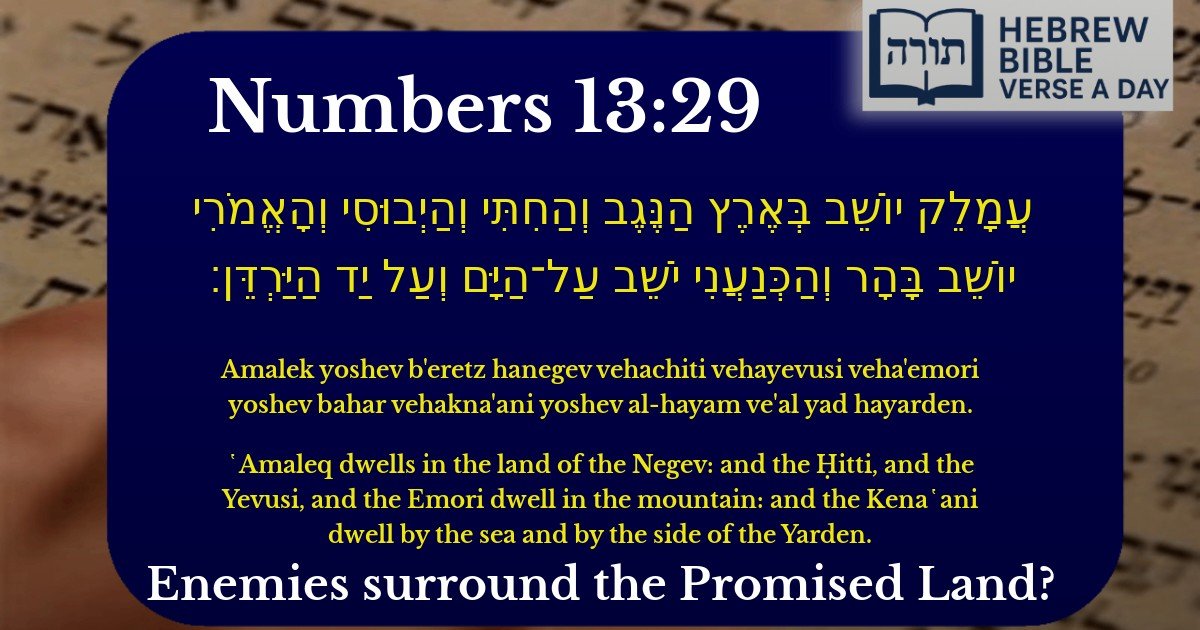
A: Numbers 13:29 describes the locations of different nations living in the land of Canaan when the spies scouted it. Amalek was in the Negev (south), the Hittites, Jebusites, and Amorites were in the mountains, and the Canaanites were near the sea and the Jordan River. This verse gives a geographical breakdown of the inhabitants, showing the challenges Bnei Yisrael would face when entering the land.
Q: Why is Amalek mentioned first in Numbers 13:29?
A: Amalek is mentioned first because they were a particularly hostile nation that attacked Bnei Yisrael shortly after leaving Egypt (Exodus 17:8). Rashi explains that Amalek symbolizes eternal enmity against the Jewish people, and their presence in the Negev was a significant obstacle.
Q: What can we learn from the description of the nations in Numbers 13:29?
A: This verse teaches that conquering the land would require faith and courage, as the nations were spread across different terrains. The Talmud (Sotah 34b) discusses how the spies exaggerated the difficulty, but ultimately, with Hashem’s help, Bnei Yisrael were capable of overcoming these challenges.
Q: How does the division of the nations in Numbers 13:29 apply today?
A: While we no longer face the same physical battles, the verse reminds us that challenges in life may come from different 'directions'—just as the nations were spread across varied landscapes. The Midrash teaches that spiritual growth requires overcoming obstacles with trust in Hashem, just as Bnei Yisrael needed to rely on Him to enter the land.
Q: Why does the Torah list all these nations in Numbers 13:29?
A: The Torah lists these nations to emphasize that the land was inhabited by strong peoples, reinforcing the need for divine assistance. Ramban explains that this was a test of faith—Bnei Yisrael had to trust that Hashem would help them overcome these nations, as promised to Avraham, Yitzchak, and Yaakov.


Geographical Distribution of Nations in Canaan
The verse describes the territorial divisions of the nations inhabiting the land of Canaan before the Israelites entered. This delineation is significant for understanding the future conquest and settlement of the land by Bnei Yisrael. Rashi (on Bamidbar 13:29) explains that this breakdown was given by the spies to Moshe, detailing where each nation resided, which would later influence the strategies for conquering the land.
Amalek in the Negev
The mention of Amaleq dwelling in the Negev is particularly noteworthy. The Negev, a southern arid region, was a strategic area. Ramban (on Bamidbar 13:29) notes that Amalek, a perpetual enemy of Israel (as seen in Shemot 17:8-16), occupied this region to block Israel's path into the land. The Midrash (Tanchuma, Ki Teitzei 9) emphasizes Amalek's role as a symbol of cruelty and opposition to Hashem's chosen people.
The Hittites, Jebusites, and Amorites in the Mountain
The verse lists the Ḥitti, Yevusi, and Emori in the mountainous regions. Rashi (on Devarim 1:44) explains that these nations were well-fortified in the hills, making their conquest more challenging. The Talmud (Sotah 34b) discusses how the Emorim were particularly strong, and their presence in the mountains symbolized their resistance to Israel's entry.
The Canaanites by the Sea and Jordan
The Kena'ani dwelling by the sea and the Jordan highlights their control over fertile coastal plains and riverbanks, key areas for agriculture and trade. Ibn Ezra (on Bamidbar 13:29) points out that the Canaanites were a maritime people, skilled in commerce, which made them a formidable presence. The proximity to the Jordan also positioned them strategically against Israel's crossing into the land.
Spiritual Significance of the Nations' Locations
The Midrash (Bamidbar Rabbah 16:11) teaches that each nation's placement reflected their spiritual characteristics:
This arrangement served as a test for Bnei Yisrael to overcome both physical and spiritual obstacles in inheriting Eretz Yisrael.