Frequently Asked Questions
Q: Who is Hoshea son of Nun mentioned in Numbers 13:8?
A: Hoshea son of Nun is the original name of Yehoshua (Joshua), who later became the leader of the Jewish people after Moshe (Moses). He was from the tribe of Efrayim. The name 'Hoshea' means 'salvation,' and Moshe later added the letter 'yud' to his name, making it 'Yehoshua,' which means 'God is salvation,' as a prayer for divine assistance (Rashi on Numbers 13:16).
Q: Why is the tribe of Efrayim mentioned in Numbers 13:8?
A: The Torah specifies Hoshea's tribal affiliation (Efrayim) to highlight his noble lineage and connection to Yosef (Joseph), as Efrayim was one of Yosef's sons. This also shows that leaders were chosen from all tribes, emphasizing unity among the Jewish people (Ramban on Numbers 13:2-3).
Q: What is the significance of listing the spies by name and tribe in Numbers 13?
A: Listing each spy by name and tribe teaches that these were respected leaders, not ordinary men. The Torah holds people accountable based on their stature—greater knowledge brings greater responsibility (Talmud, Sotah 34b). It also shows that all tribes had a role in scouting the Land of Israel.
Q: How does this verse connect to Yehoshua's later role as Moshe's successor?
A: This verse introduces Yehoshua early in the narrative to show his qualities as a faithful and courageous leader. Unlike the other spies, he (along with Calev) later defended the Land of Israel with complete trust in God, proving his worthiness to lead (Midrash Tanchuma, Shelach 7).

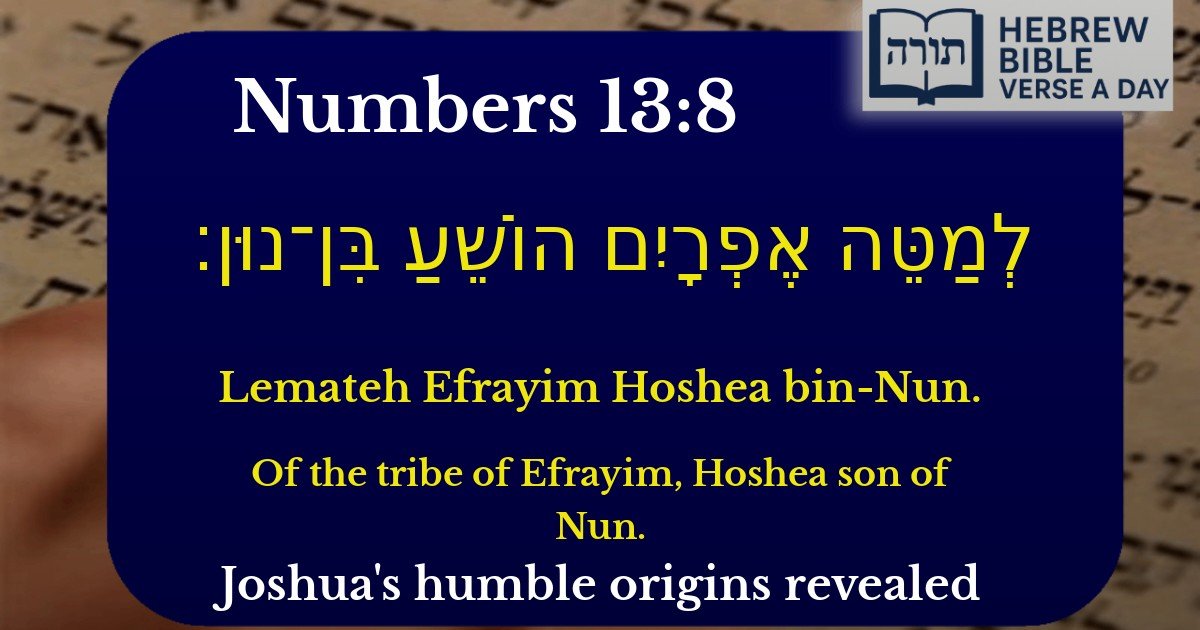

Introduction to the Verse
The verse "לְמַטֵּה אֶפְרָיִם הוֹשֵׁעַ בִּן־נוּן" (Of the tribe of Efrayim, Hoshea son of Nun) appears in Bamidbar (Numbers) 13:8, listing Hoshea (later known as Yehoshua/Joshua) as one of the twelve spies sent to scout the Land of Israel. This verse highlights Yehoshua's lineage and tribal affiliation, which hold deeper significance in Jewish tradition.
Yehoshua's Tribal Connection to Efrayim
Rashi (on Bamidbar 13:8) notes that Yehoshua's lineage traces back to Yosef through Efrayim, one of Yosef's sons. This connection is significant because:
The Significance of the Name "Hoshea"
Originally named Hoshea (הוֹשֵׁעַ), meaning "salvation," Moshe later added the letter yud to his name, transforming it to Yehoshua (יְהוֹשֻׁעַ), meaning "Hashem is salvation" (Bamidbar 13:16, Rashi). This change:
Yehoshua as a Model of Leadership
The Midrash (Sifrei Bamidbar 13:8) emphasizes Yehoshua's humility and dedication to Torah, qualities that made him worthy of succeeding Moshe. Rambam (Hilchot Melachim 1:7) later cites Yehoshua as the paradigm of a Jewish leader appointed by Hashem's command through a prophet.
Lessons from Yehoshua's Lineage
The mention of his father, Nun (נוּן), is interpreted in Kabbalistic sources (Zohar III, 175b) as alluding to faithfulness ("nun" representing ne'eman, faithful). This reinforces Yehoshua's role as a leader who remained loyal to Hashem even when others faltered (e.g., during the incident of the spies).