Frequently Asked Questions
Q: What does Numbers 1:40 mean?
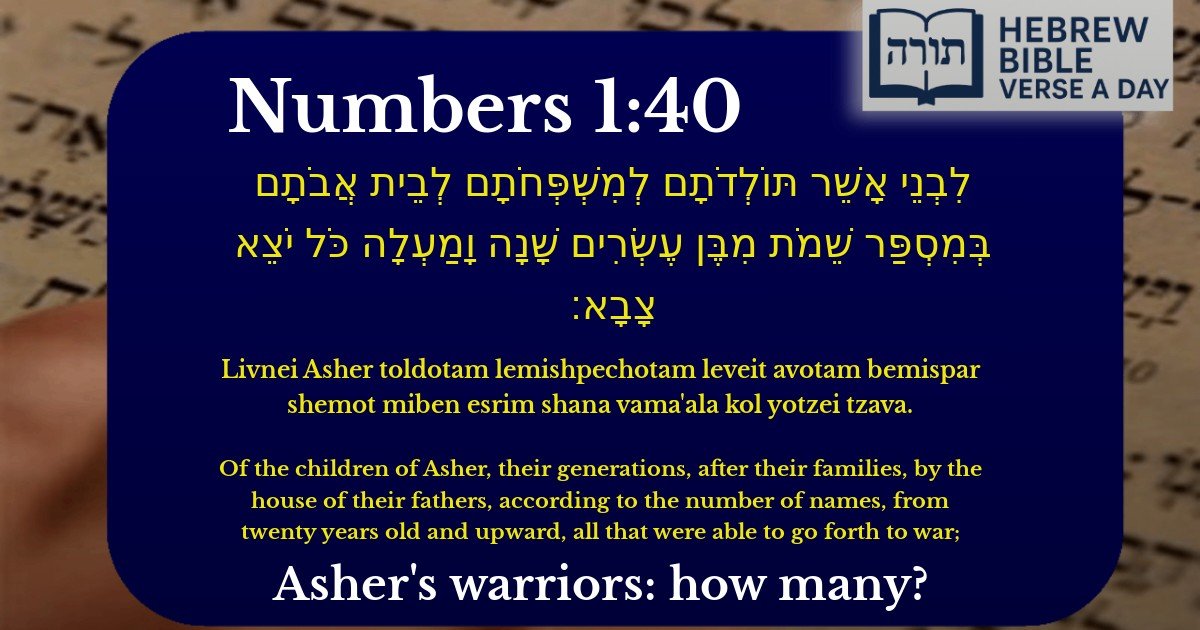
A: Numbers 1:40 describes the counting of the tribe of Asher for military service. It lists them by families and households, including every male aged 20 and older who was fit to go to war. This was part of the census taken in the wilderness to organize the Israelites for their journey and defense (Rashi on Numbers 1:2-3).
Q: Why was the census taken from age 20 and up?
A: According to Jewish tradition, age 20 was the minimum age for military service because it represents physical maturity and strength (Rambam, Hilchot Melachim 7:4). The Talmud (Bava Batra 121b) also notes that this age marks the transition to full responsibility in communal duties.
Q: What can we learn from the counting of the tribe of Asher?
A: The counting teaches the importance of each individual's role in the community. Every person was counted by name, showing that each member of the tribe had value and responsibility (Midrash Bamidbar Rabbah 1:4). It also highlights the need for organization and unity among the Jewish people.
Q: How does this verse apply to Jewish life today?
A: While we no longer conduct military censuses like in ancient times, the principle of communal responsibility remains. Today, Jews are counted for minyan (prayer quorum), charity, and other mitzvot, emphasizing that every individual matters in serving Hashem and supporting the community (Talmud, Megillah 23b).
Q: Why were only men counted for the army?
A: In biblical times, warfare was primarily the duty of men, as they were physically responsible for defense (Rambam, Hilchot Melachim 7:4). However, women had other vital roles in maintaining the spiritual and communal life of Israel (Talmud, Sotah 11b).


Context of the Verse
The verse (Bamidbar 1:40) is part of the census taken of the tribes of Israel in the wilderness, specifically focusing on the tribe of Asher. This census was commanded by Hashem to Moshe and Aharon to count all men aged twenty and older who were fit for military service.
Rashi's Explanation
Rashi (Bamidbar 1:40) emphasizes that the phrase "לִבְנֵי אָשֵׁר תּוֹלְדֹתָם" ("Of the children of Asher, their generations") indicates that the counting was done with meticulous attention to lineage. Each individual was registered according to their family and paternal house, ensuring the purity of their tribal identity. Rashi also notes that the phrase "כֹּל יֹצֵא צָבָא" ("all that were able to go forth to war") refers to those physically capable of serving in battle, excluding those with disabilities or illnesses.
Rambam's Perspective
In Hilchot Melachim (Laws of Kings 7:4), Rambam explains that the age of twenty was chosen because it marks the transition to full physical and emotional maturity, making individuals suitable for the responsibilities of war. This aligns with the Torah's broader principle that certain mitzvot and obligations only apply from this age onward.
Midrashic Insights
Practical Implications
The structure of the census—organized by tribe, family, and paternal house—reinforces the importance of maintaining clear genealogical records. This was essential for tribal inheritances, marital laws (e.g., avoiding forbidden unions), and the allocation of roles in the Mishkan and later the Beit HaMikdash.
Spiritual Lessons
The requirement to be "יֹצֵא צָבָא" ("able to go forth to war") teaches that spiritual readiness is as crucial as physical strength. The Talmud (Sotah 44a) interprets this as being free of sin, as moral integrity determines success in battle. Thus, the census also served as a spiritual accounting, ensuring the nation's fitness for its divine mission.