Frequently Asked Questions
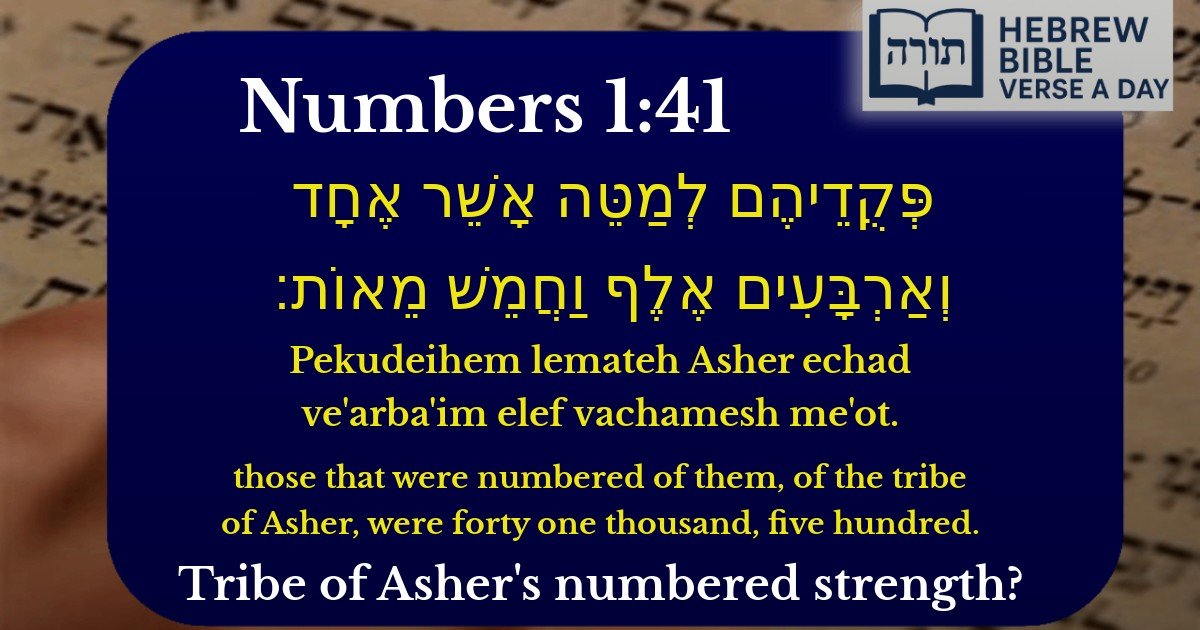
Q: What does the number 41,500 represent in Numbers 1:41?
A: In Numbers 1:41, the number 41,500 represents the count of men aged 20 and older from the tribe of Asher who were eligible for military service. This census was taken in the wilderness after the Exodus, as commanded by Hashem (Rashi on Numbers 1:1-3).
Q: Why was the tribe of Asher counted separately in the census?
A: Each tribe was counted separately to organize the Israelite camp and to recognize the unique role of each tribe. The tribe of Asher, like all tribes, had its own identity and responsibilities within the nation (Rambam, Mishneh Torah, Hilchot Melachim 1:3).
Q: What is the significance of counting the tribes in the Book of Numbers?
A: The counting of the tribes in Sefer Bamidbar (Numbers) shows Hashem's care for each individual and the importance of every member of the Jewish people. It also prepared them for their journey and settlement in Eretz Yisrael (Midrash Bamidbar Rabbah 1:4).
Q: How does the census of the tribes apply to us today?
A: While we no longer conduct tribal censuses, the lesson remains that every Jew counts and has a unique role in the Jewish people. Just as each tribe contributed differently, every individual today has their own mission (Tanya, Chapter 37).
Q: Why does the Torah give such exact numbers in the census?
A: The Torah gives precise numbers to emphasize the truth and accuracy of the count, showing that every individual is important to Hashem. The exact figures also teach us the value of precision in mitzvah observance (Talmud, Yoma 22b).


Context of the Verse
The verse (Bamidbar 1:41) records the census count of the tribe of Asher during the wilderness encampment. This count was part of the larger census of Bnei Yisrael commanded by Hashem to Moshe and Aharon (Bamidbar 1:2-3). The tribe of Asher was the eighth tribe counted, following the order established in Bamidbar 1:5-15.
Significance of the Number
Rashi notes that the number 41,500 reflects the strength and vitality of the tribe of Asher. The Midrash (Bamidbar Rabbah 2:10) explains that each tribe's count represents its unique spiritual and physical qualities. Asher, whose name means "happiness" or "blessing" (Bereshit 30:13), was blessed with fertility and prosperity, as later seen in Devarim 33:24, where Moshe blesses Asher with "dip his foot in oil."
Comparison to Other Tribes
Symbolism in the Count
The Baal HaTurim highlights that the number 41,500 can be broken down numerologically (gematria):
This suggests that Asher's count reflects a balance between divine blessing and material fulfillment.
Historical and Future Implications
The Sforno explains that the census was not merely a tally but a preparation for the military and spiritual mission of entering Eretz Yisrael. Asher's descendants later settled in the fertile northern region (Yehoshua 19:24-31), fulfilling their ancestral blessing of abundance.