Frequently Asked Questions
Q: What does Numbers 14:15 mean?
A: In Numbers 14:15, Moshe (Moses) is pleading with Hashem not to destroy the Jewish people after the sin of the spies. He argues that if the nations of the world see Hashem wiping out the Jewish people 'as one man,' it would damage the perception of Hashem's greatness in the world. Rashi explains that Moshe was concerned about the sanctification of Hashem's Name (Kiddush Hashem) and how the nations would perceive Divine justice.
Q: Why is Moshe's argument in Numbers 14:15 important?
A: Moshe's argument teaches us the importance of how the Jewish people's actions affect Hashem's reputation in the world (Kiddush Hashem or Chilul Hashem). The Talmud (Yoma 86a) discusses how our behavior can sanctify or desecrate Hashem's Name. Moshe prioritized the honor of Heaven even when pleading for mercy, showing that we must always consider how our actions reflect on Hashem.
Q: What can we learn from Numbers 14:15 today?
A: We learn that as Jews, our behavior impacts how the world views Hashem and Torah. The Rambam (Hilchos Yesodei HaTorah 5:10-11) explains that when a Jew acts ethically and spiritually, it brings honor to Hashem. Conversely, improper behavior can cause a Chilul Hashem. This verse reminds us that we represent Torah values to the world.
Q: How does 'as one man' in Numbers 14:15 apply to Jewish unity?
A: The phrase 'as one man' highlights the concept of Jewish unity. Rashi notes that the nations would see the punishment as if the entire people were equally guilty. The Midrash (Tanchuma Shelach 10) teaches that when Jews are united, they are stronger. This teaches us the importance of standing together as a people, especially in difficult times.
Q: Why did Moshe mention what the nations would say in Numbers 14:15?
A: Moshe understood that the nations' perception matters for Kiddush Hashem. As the Sforno explains, the Exodus had already made Hashem's Name great among the nations, and destroying the Jews would lead them to question Hashem's power. This teaches us that our relationship with Hashem isn't private—it affects how the world understands Divine providence.

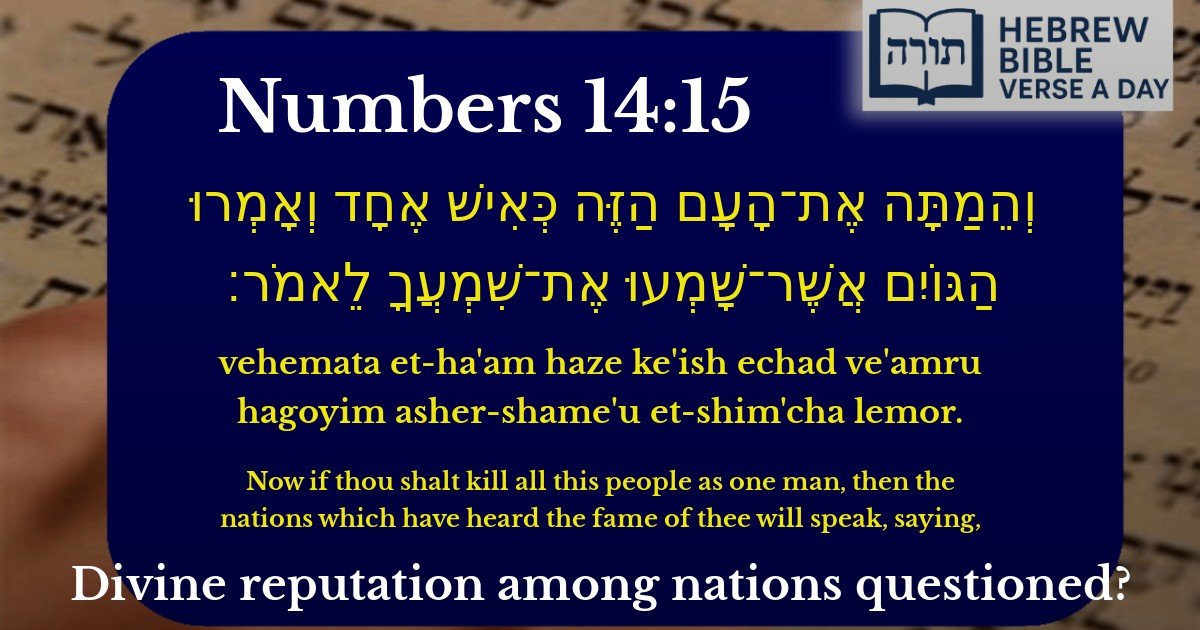

Context of the Verse
This verse (Numbers 14:15) is part of Moshe Rabbeinu's plea to Hashem after the sin of the spies, when the people of Israel expressed fear and lack of faith in entering Eretz Yisrael. Moshe argues that if Hashem destroys the entire nation, it will lead to a Chillul Hashem (desecration of G-d's name) in the eyes of the nations.
Rashi's Explanation
Rashi (Rabbi Shlomo Yitzchaki) comments on the phrase "כְּאִישׁ אֶחָד" ("as one man"): Moshe emphasizes that the nations will perceive the destruction as if the entire people were killed in a single moment, like one individual. This would lead them to question Hashem's power, thinking He was unable to bring them into the land (Rashi on Numbers 14:15).
Rambam's Perspective
The Rambam (Maimonides) discusses the severity of Chillul Hashem in Hilchot Yesodei HaTorah (5:10-11). He explains that when Jews, who are recognized as Hashem's people, act in a way that causes others to disrespect G-d, it is a grave sin. Moshe's argument aligns with this principle—destroying the nation would lead the nations to misunderstand Hashem's justice and mercy.
Midrashic Insights
The Midrash Tanchuma (Shelach 10) elaborates that Moshe invoked the merit of the forefathers (Avraham, Yitzchak, and Yaakov) in his plea. He argued that the nations would not only question Hashem's power but also mock the covenant made with the Avot, suggesting their merit was insufficient to protect their descendants.
Key Themes