Frequently Asked Questions
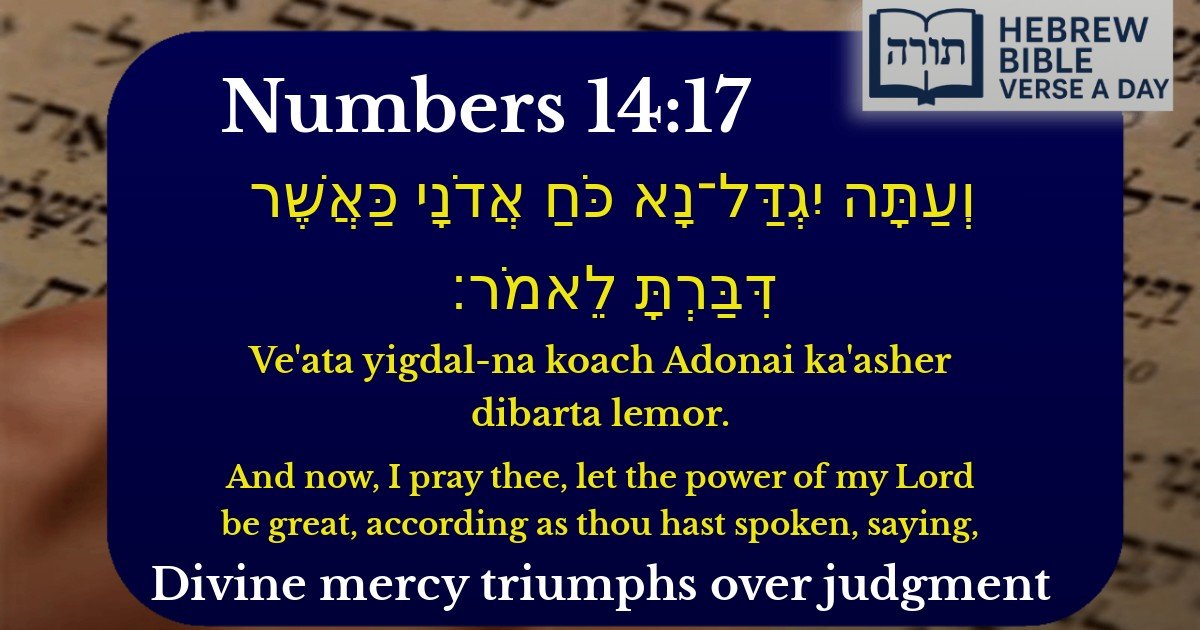
Q: What does Numbers 14:17 mean?
A: In Numbers 14:17, Moshe (Moses) is pleading to Hashem to demonstrate His great power and mercy by forgiving Bnei Yisrael (the Children of Israel) for the sin of the spies. According to Rashi, Moshe is asking Hashem to fulfill His attribute of mercy, as mentioned earlier in the Torah (Shemot 34:6-7), showing that His power is greatest when He forgives.
Q: Why is Moshe asking for Hashem's power to be great in this verse?
A: Moshe is emphasizing that true greatness and power come from showing compassion and forgiveness. The Midrash explains that Moshe was reminding Hashem that His reputation among the nations would be enhanced if He forgave Bnei Yisrael rather than punished them severely. This teaches that mercy is a higher expression of divine strength than strict judgment.
Q: How does Numbers 14:17 apply to us today?
A: This verse teaches us the importance of seeking and valuing divine mercy, both for ourselves and others. The Rambam (Hilchot Teshuvah) explains that teshuvah (repentance) is always possible because Hashem's mercy is boundless. Like Moshe, we should pray for and trust in Hashem's compassion, especially during difficult times.
Q: What can we learn from Moshe's prayer in this verse?
A: We learn from Moshe's words the power of intercessory prayer and advocating for others. The Talmud (Berachot 32a) highlights Moshe as the ultimate defender of the Jewish people, showing that a leader’s role includes praying for their community. This also teaches us to appeal to Hashem’s mercy in our own prayers.
Q: What is the significance of 'as You have spoken' in this verse?
A: Moshe is referring to Hashem’s earlier revelation of the Thirteen Attributes of Mercy (Shemot 34:6-7). Rashi explains that Moshe was holding Hashem to His word, so to speak, by asking Him to act according to His promise of compassion. This teaches us that we can rely on Hashem’s promises of kindness and forgiveness.


Context of the Verse
The verse (Bamidbar 14:17) is part of Moshe Rabbeinu's plea to Hashem after the sin of the spies, when the people of Israel doubted the promise of entering Eretz Yisrael. Moshe appeals to Hashem's mercy and the fulfillment of His word.
Rashi's Explanation
Rashi explains that Moshe is asking Hashem to demonstrate His power through middat harachamim (the attribute of mercy) rather than strict justice. The phrase "let the power of my Lord be great" refers to Hashem's greatness being revealed through forgiveness, as true strength is shown when one forgives despite having the power to punish.
Rambam's Perspective
Rambam (Hilchot Teshuvah 2:4) connects this idea to the principle that Hashem's greatness is manifest in His willingness to accept repentance. Moshe's plea emphasizes that Hashem's promise to Avraham, Yitzchak, and Yaakov should be fulfilled despite the people's sin, demonstrating His boundless compassion.
Midrashic Interpretation
The Midrash (Bamidbar Rabbah 16:21) elaborates that Moshe was invoking the merit of the forefathers (zechut avot). By saying "as You have spoken", Moshe reminded Hashem of His covenant with the Avot, appealing to His unchanging word.
Key Themes