Frequently Asked Questions
Q: Why does the Torah count the tribe of Naftali specifically?
A: The Torah counts each tribe individually to show their unique importance and role within the Jewish people. Rashi explains that counting demonstrates G-d's love for the Jewish people, just as a person counts their valuable possessions frequently. Each tribe had a distinct mission, and the counting of Naftali, like the other tribes, highlights their contribution to the nation.
Q: Why were only men over 20 years old counted for the army?
A: According to Jewish tradition, age 20 marks physical and spiritual maturity for military service. The Rambam (Maimonides) explains that this age represents full strength and responsibility. Additionally, the Midrash teaches that before age 20, a person's sins are not fully accounted for in heavenly judgment, making this the appropriate age for such a serious responsibility as defending the nation.
Q: What does 'able to go forth to war' mean in this verse?
A: The phrase refers not just to physical ability, but also spiritual readiness. The Talmud (Sotah 44b) explains that those who were fearful or sinful would return home, as their lack of faith could endanger others. Thus, 'able to go forth to war' implies both physical fitness and proper spiritual standing to merit G-d's protection in battle.
Q: Why are the tribes counted 'by their families' and 'by their fathers' houses'?
A: The Torah emphasizes family lineage because Jewish identity and tribal affiliation pass through the father. Rashi notes that this structure preserves the integrity of each tribe's unique role. Additionally, the Midrash teaches that family units provide spiritual strength - when people are connected to their roots, they are more steadfast in their service to G-d and the community.
Q: What lesson can we learn today from counting the tribes in the wilderness?
A: This teaches that every individual counts in building the Jewish nation. The Lubavitcher Rebbe emphasized that just as each tribe was counted for its unique contribution, every Jew today has a distinct mission. The counting also reminds us that we must be spiritually 'ready for service' at all times, dedicating our strengths to serving G-d and helping others.

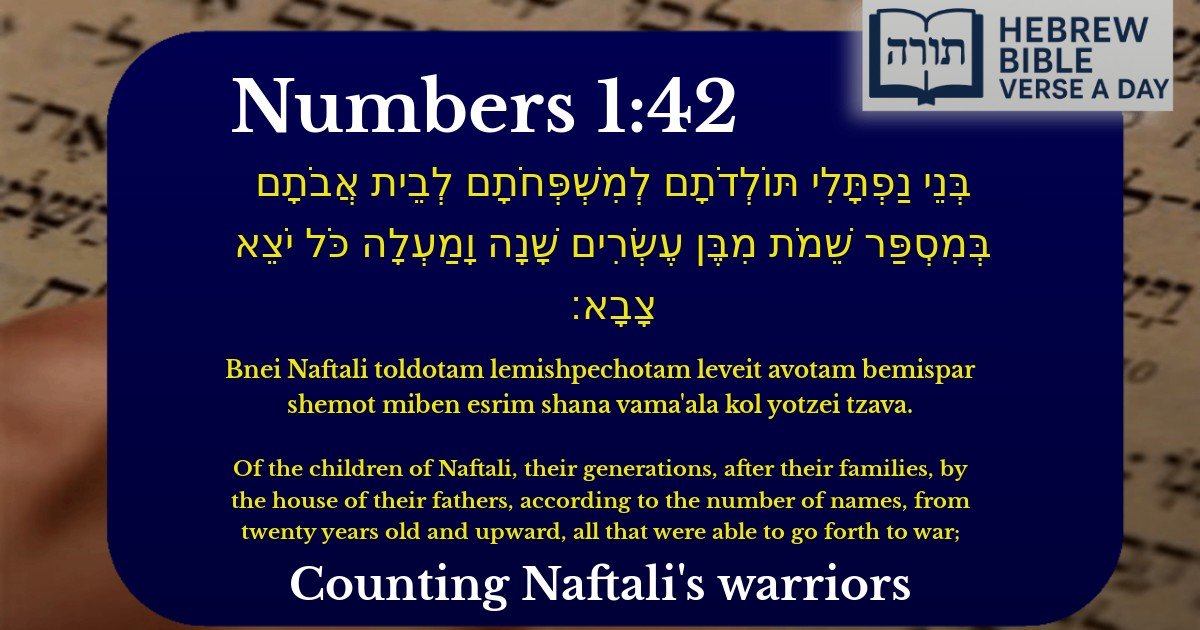

Context of the Verse
The verse (Bamidbar 1:42) is part of the census taken of the tribes of Israel in the wilderness, specifically detailing the counting of the tribe of Naftali. This census was commanded by Hashem to Moshe and Aharon to organize the Israelites for military and communal purposes as they prepared to enter Eretz Yisrael.
Meaning of "תּוֹלְדֹתָם לְמִשְׁפְּחֹתָם" (Their Generations, After Their Families)
Rashi explains that "תּוֹלְדֹתָם" refers to the lineage and descendants of Naftali, while "לְמִשְׁפְּחֹתָם" emphasizes their division into distinct family units. This structure highlights the importance of preserving tribal and familial identity within Klal Yisrael. The Ramban adds that this meticulous recording underscores the divine value of each individual and family within the nation.
Significance of Counting "מִבֶּן עֶשְׂרִים שָׁנָה" (From Twenty Years Old)
The age of twenty is significant because, as the Talmud (Sotah 44b) teaches, this is the age when a man reaches full physical and spiritual maturity, making him fit for military service. The Midrash (Bamidbar Rabbah 1:10) further explains that twenty marks the age when a person is accountable for their actions and capable of contributing to the collective mission of Am Yisrael.
"כֹּל יֹצֵא צָבָא" (All That Were Able to Go Forth to War)
The phrase refers to those physically and spiritually prepared for battle. The Sforno notes that this included not only physical strength but also moral and spiritual readiness, as the wars of Israel were fought with divine assistance. The Kli Yakar emphasizes that "יֹצֵא צָבָא" implies a willingness to step forward in service of the nation, reflecting dedication to the greater good.
Lessons from the Census