Frequently Asked Questions
Q: What does Numbers 14:23 mean in simple terms?
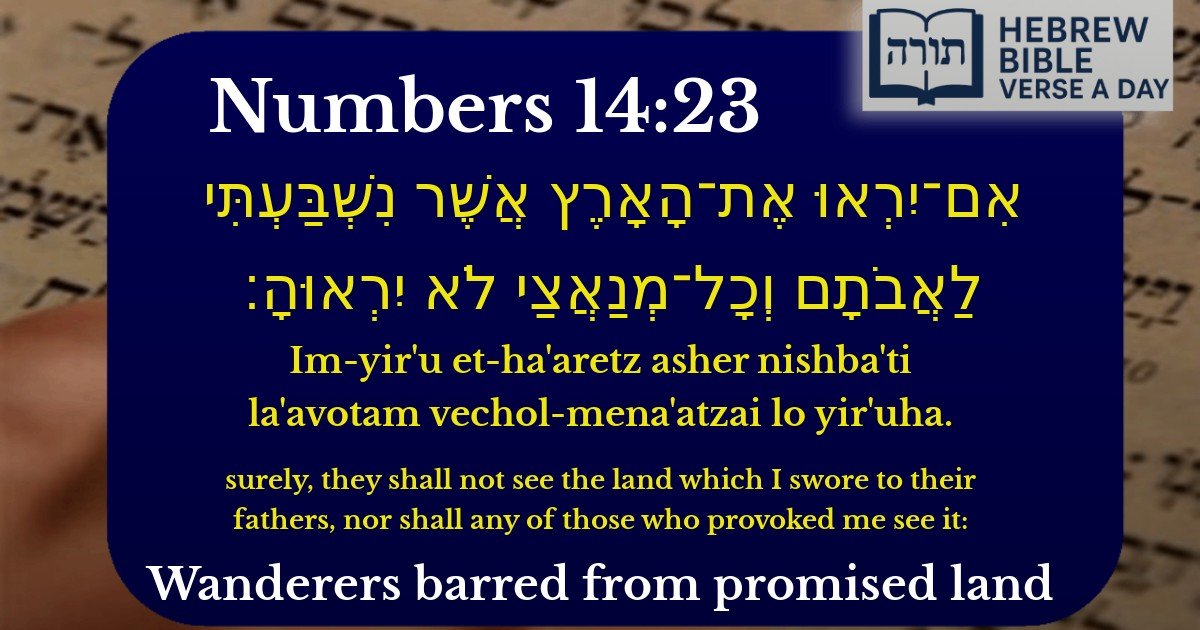
A: Numbers 14:23 means that the generation of Israelites who doubted G-d's promise and rebelled against Him after the spies' negative report would not be allowed to enter the Land of Israel. Only their children would merit to enter the land that G-d swore to give to their forefathers (Abraham, Isaac, and Jacob). This is based on Rashi's explanation that their lack of faith and complaints provoked G-d's decree.
Q: Why was this punishment given in Numbers 14:23?
A: The punishment in Numbers 14:23 was given because the Israelites showed a lack of faith in G-d after hearing the negative report of the spies (Numbers 13-14). Despite witnessing miracles like the Exodus and receiving the Torah, they doubted G-d's ability to bring them into the Land of Israel. The Talmud (Sotah 35a) explains that their rejection of the land was considered a rejection of G-d Himself, leading to this severe consequence.
Q: Who are the 'those who provoked Me' mentioned in Numbers 14:23?
A: The phrase 'those who provoked Me' refers to the Israelites who participated in the rebellion against Moshe (Moses) and Aharon (Aaron) after the spies' report. According to Rambam (Maimonides), this includes those who spoke negatively about the Land of Israel and wished to return to Egypt (Hilchot Teshuvah 4:1). Their lack of trust in G-d's promise led to their exclusion from entering the land.
Q: What lesson can we learn from Numbers 14:23 today?
A: Numbers 14:23 teaches the importance of faith in G-d and gratitude for His promises. The Israelites' lack of trust led to severe consequences, showing that ingratitude and rebellion distance a person from divine blessings. The Midrash (Tanchuma Shelach 8) emphasizes that trusting in G-d, especially during challenges, is essential for spiritual growth and receiving His goodness.
Q: Did anyone from that generation enter the Land of Israel despite Numbers 14:23?
A: Yes, according to Rashi and the Talmud (Sotah 34b), two exceptions were made: Caleb and Yehoshua (Joshua). They were the only spies who gave a faithful report and encouraged the people to trust in G-d (Numbers 14:6-9). Because of their righteousness, they were allowed to enter the land along with the next generation. This teaches that steadfast faith in G-d is rewarded.


Context of the Verse
This verse (Numbers 14:23) appears in the aftermath of the sin of the spies, where the Israelites rejected the Land of Israel out of fear and lack of faith. Hashem responds by decreeing that the generation that left Egypt would not merit to enter the Land, except for Caleb and Joshua.
Key Phrases and Their Meanings
Punishment and Its Implications
The Rambam (Hilchot Teshuvah 4:1) discusses how this decree illustrates the severity of publicly rejecting Hashem's promises. The generation that witnessed miracles in Egypt and at the Red Sea still succumbed to fear, showing that even great spiritual experiences do not guarantee faith without personal effort.
Exceptions to the Decree
As noted in the Talmud (Sotah 34b), Caleb and Joshua were excluded from this punishment because they maintained their faith. The Midrash (Bamidbar Rabbah 16:6) adds that their merit was due to their righteous conduct and refusal to join the rebellion.
Lessons for Future Generations