Frequently Asked Questions
Q: What does the number 53,400 represent in Numbers 1:43?
A: In Numbers 1:43, the number 53,400 represents the count of men aged 20 and older from the tribe of Naphtali who were eligible for military service. This census was taken in the wilderness after the Exodus, as commanded by Hashem (Rashi on Numbers 1:1-3).
Q: Why was the tribe of Naphtali counted separately in the Torah?
A: Each tribe was counted separately to emphasize the unique role and identity of every tribe within the Jewish people. The counting also helped organize the camp in the wilderness and prepare for future battles (Rambam, Mishneh Torah, Hilchot Melachim 12:3).
Q: What lesson can we learn from the census of the tribes in the Torah?
A: The census teaches us that every individual counts and has value in the eyes of Hashem. Even though the tribes were part of a larger nation, each person was counted to show their importance (Midrash Tanchuma, Bamidbar 4).
Q: How does the counting of the tribes apply to us today?
A: Just as each tribe had a unique role, every Jew today has a special purpose in serving Hashem and contributing to the Jewish people. The census reminds us that we are all important parts of a greater whole (Talmud, Sanhedrin 17b).
Q: Why does the Torah give such exact numbers for each tribe?
A: The precise numbers show the fulfillment of Hashem's promise to make the descendants of Avraham as numerous as the stars (Genesis 15:5). The exact count also reflects the Torah's emphasis on truth and accuracy in recording our history (Rashi on Numbers 1:1).

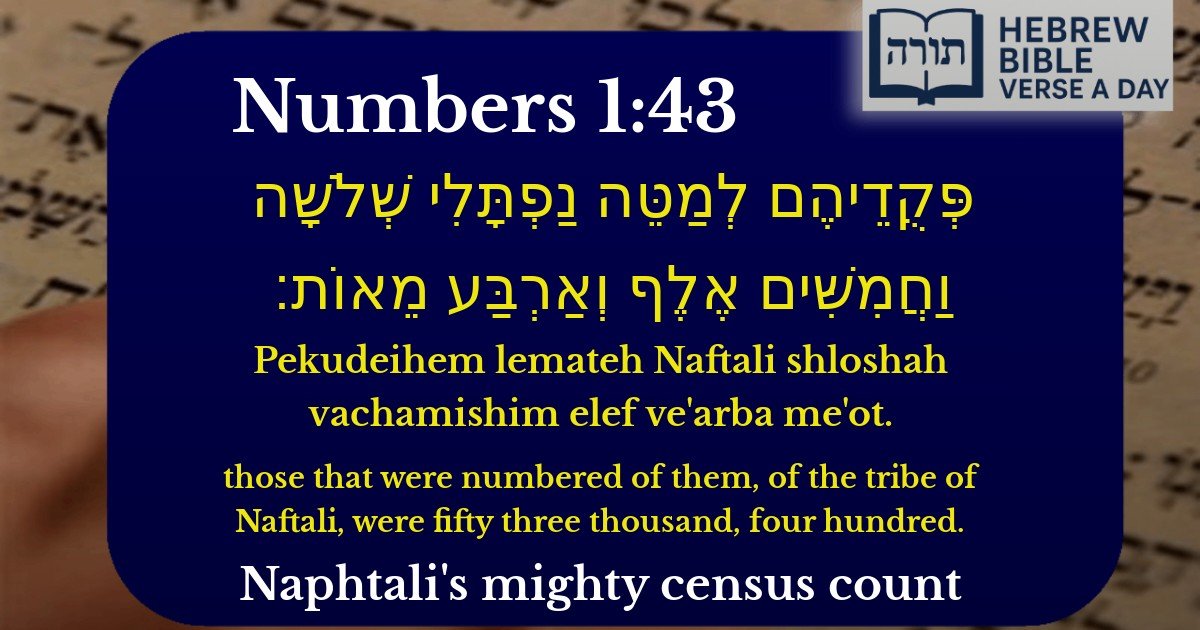

Commentary on the Census of the Tribe of Naftali
The verse (Bamidbar 1:43) states: "פְּקֻדֵיהֶם לְמַטֵּה נַפְתָּלִי שְׁלֹשָׁה וַחֲמִשִּׁים אֶלֶף וְאַרְבַּע מֵאוֹת" ("those that were numbered of them, of the tribe of Naftali, were fifty-three thousand, four hundred"). This census reflects the population of the tribe of Naftali during the wilderness journey.
Significance of the Number
Rashi (on Bamidbar 1:43) notes that the counting was done "לפי הדגלים" ("according to the banners"), meaning each tribe was organized under its own flag, demonstrating their unity and distinct roles within Klal Yisrael. The number 53,400 shows Naftali's strength among the tribes.
Naftali's Blessing and Population
In Bereishit 49:21, Yaakov blesses Naftali: "נַפְתָּלִי אַיָּלָה שְׁלֻחָה הַנֹּתֵן אִמְרֵי שָׁפֶר" ("Naftali is a deer let loose; he delivers beautiful words"). The Midrash (Bereishit Rabbah 98:17) connects this blessing to Naftali's swiftness and productivity, which may symbolize their growth in numbers.
Comparison with Other Tribes
Naftali's count (53,400) was smaller than tribes like Yehuda (74,600) but larger than others like Menashe (32,200). The Baal HaTurim notes that this reflects the balance of strengths among the tribes, each contributing uniquely to the nation.