Frequently Asked Questions
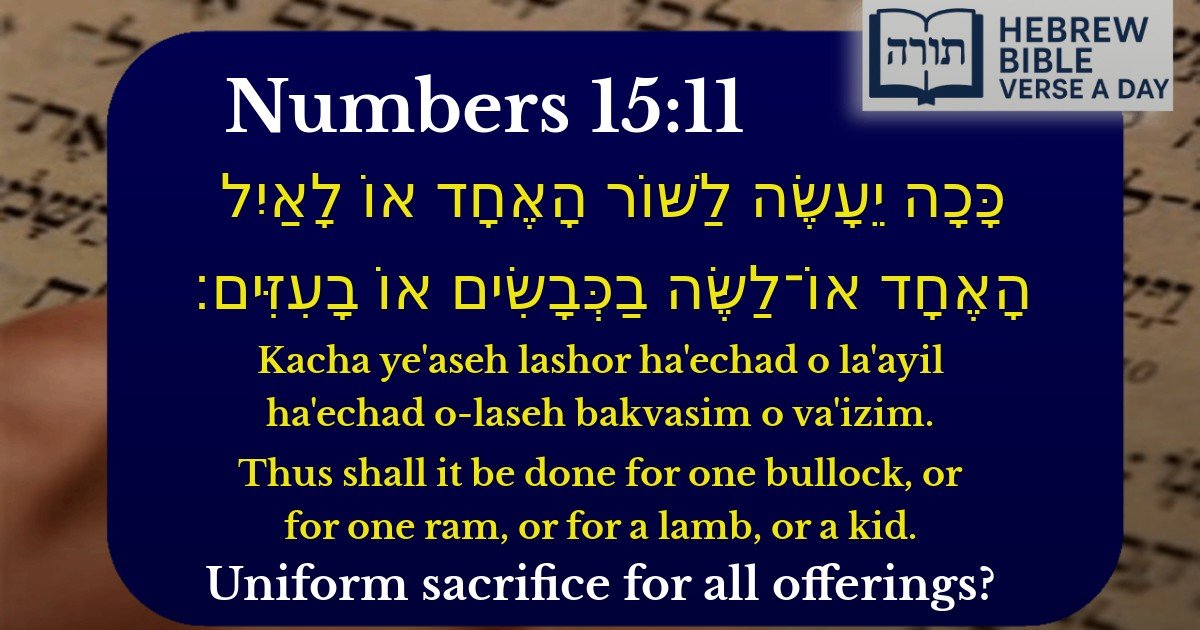
Q: What does Numbers 15:11 mean?
A: Numbers 15:11 describes the uniform procedure for offering certain sacrifices (a bull, ram, lamb, or goat) in the Mishkan (Tabernacle) and later the Beit HaMikdash (Temple). Rashi explains that this teaches that the same basic sacrificial laws apply regardless of which animal is brought, though details like the amount of flour and oil for the accompanying meal offering vary based on the animal (see Numbers 15:4-10).
Q: Why is this verse important?
A: This verse is important because it establishes consistency in the sacrificial service. The Rambam (Hilchot Maaseh HaKorbanot) explains that the Torah provides clear, standardized procedures for offerings to ensure proper worship. This verse emphasizes that whether one brings a large or small animal, the same reverence and halachic (Jewish legal) precision must be observed.
Q: What can we learn from Numbers 15:11 today?
A: Although we currently lack the Beit HaMikdash and cannot bring sacrifices, the Talmud (Berachot 26b) teaches that prayer replaces sacrifices. This verse reminds us that our prayers - whether lengthy or brief - should be offered with the same sincerity and structured devotion as the ancient sacrifices. The Midrash (Tanchuma) also sees this as a lesson that all Jews, regardless of status, have equal access to divine service.
Q: Why does the Torah specify different animals in this verse?
A: The Talmud (Chullin 16a) explains that the Torah lists different animals to show that the same laws apply across species, but also to accommodate people of varying economic means. Rashi notes that a wealthy person might bring a bull, while someone with fewer means could bring a sheep or goat. The verse teaches that all are acceptable before Hashem when brought with proper intent.
Q: How does this verse connect to the surrounding verses?
A: This verse concludes a section (Numbers 15:1-11) detailing the meal offerings that accompany animal sacrifices. The Sforno explains that by stating 'thus shall it be done,' the Torah connects this law to the preceding verses which specify exact measurements of flour, oil, and wine for each type of offering. The uniformity in procedure highlights the order and precision required in divine service.


Context in the Torah
This verse appears in Bamidbar (Numbers) 15:11, within the section detailing the laws of korbanot (offerings) brought in the Mishkan (Tabernacle) and later in the Beit HaMikdash (Temple). The verse specifies the uniform procedure for offering different animals—bullocks, rams, lambs, or goats—as burnt offerings or peace offerings.
Rashi's Explanation
Rashi (Rabbi Shlomo Yitzchaki) comments that the phrase "כָּכָה יֵעָשֶׂה" ("Thus shall it be done") teaches that the same sacrificial rites apply regardless of the type of animal being offered. This includes:
Rambam's Perspective
In Hilchot Ma'aseh HaKorbanot (Laws of Sacrificial Procedures), the Rambam (Maimonides) emphasizes that the uniformity in procedure underscores the principle that all korbanot, regardless of the animal's size or value, are equally valid when offered with proper intent (kavanah). This aligns with the Talmudic teaching in Menachot 110a that "whether one offers much or little, what matters is that one directs their heart to Heaven."
Midrashic Insight
The Sifrei (a halachic Midrash on Bamidbar) links this verse to the idea of divine accessibility: Hashem accepts offerings from all, whether wealthy (who might bring a bullock) or of modest means (who might bring a lamb or goat). This reflects the verse in Vayikra (Leviticus) 1:17, where even a poor person's bird offering is described as a "pleasing aroma to Hashem."
Symbolic Meaning
Rabbi Samson Raphael Hirsch notes that the inclusion of different animals teaches that every individual, with their unique capabilities and circumstances, can achieve closeness to Hashem through their offerings. The bullock (strong and laborious) and the lamb (gentle and dependent) represent different human traits, yet both are equally valid paths to divine service.