Frequently Asked Questions
Q: What does the verse about separating challah mean?
A: This verse (Numbers 15:20) commands Jewish people to separate a portion of dough when baking bread, called 'challah,' as a gift to Hashem. Just as farmers would separate terumah (a portion) from their grain harvest, we separate a small piece of dough when baking bread. Today, this mitzvah applies when baking a significant quantity of dough (approximately 2.6 lbs of flour).
Q: Why do we separate challah from dough?
A: Separating challah fulfills the Torah commandment in this verse. Rashi explains this teaches gratitude - just as we acknowledge Hashem's role in our harvests by separating terumah, we acknowledge His role in our daily bread. The Talmud (Chullin 137b) discusses the details of this mitzvah, showing its importance in connecting our physical sustenance to spiritual awareness.
Q: How is the mitzvah of challah done today without the Temple?
A: Since we cannot bring the challah portion to the Kohen (priest) without the Temple, today we separate a small piece of dough (about an olive's size) while reciting a blessing, then burn it respectfully. The Shulchan Aruch (Yoreh De'ah 322) details these halachic procedures that allow us to observe this mitzvah properly in our times.
Q: What is the connection between challah and the threshing floor mentioned in the verse?
A: The verse compares challah to 'terumat goren' (the grain offering) to teach that both involve separating the first portion for holiness. Rambam (Hilchot Bikkurim 5:1) explains this shows all our sustenance - whether from the field or our kitchen - requires recognizing Hashem's blessings by setting aside a portion for sacred purposes before enjoying the remainder.
Q: What lesson can we learn from the mitzvah of challah?
A: The Midrash (Bamidbar Rabbah 15:12) teaches that challah represents dedicating the 'first' to Hashem before our personal use. Just as we separate challah from dough, we should prioritize spirituality in all aspects of life. Many Jewish women particularly cherish this mitzvah, seeing it as infusing the physical act of baking with spiritual meaning and bringing blessing to their homes.

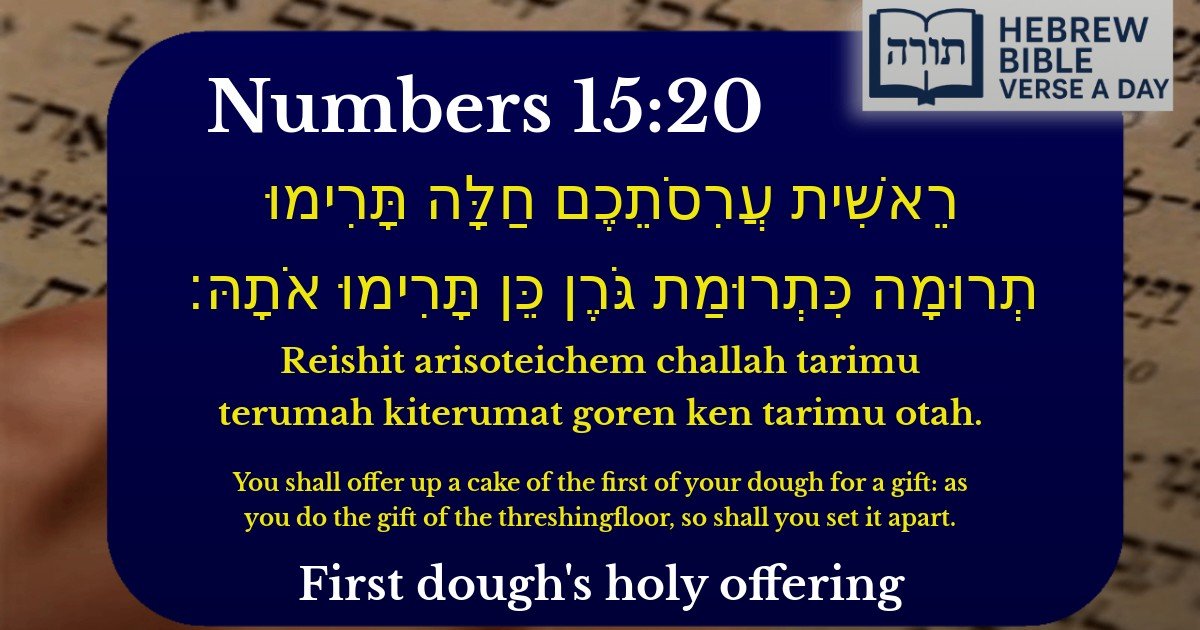

The Mitzvah of Challah
The verse (Numbers 15:20) commands the separation of challah from dough as a gift to Hashem, similar to the offering of the first fruits from the threshing floor. This mitzvah applies specifically in Eretz Yisrael, as derived from the context of the passage (Rambam, Hilchot Bikkurim 5:1).
Comparison to Terumat Goren
The Torah compares challah to terumat goren (the grain offering) to teach that:
Halachic Details
The mitzvah applies to dough made from the five species of grain (wheat, barley, spelt, rye, and oats) when kneaded with at least 1.666 kg of flour (Shulchan Aruch, Yoreh De'ah 324:1). Today, without the Beit Hamikdash, we burn a small piece of the separated dough instead of giving it to the Kohen.
Spiritual Significance
The Midrash (Bamidbar Rabbah 15:12) explains that separating challah acknowledges that our sustenance comes from Hashem. By sanctifying the first portion, we elevate all our material blessings. The Zohar (III 269a) teaches that this mitzvah brings blessing into the home.