
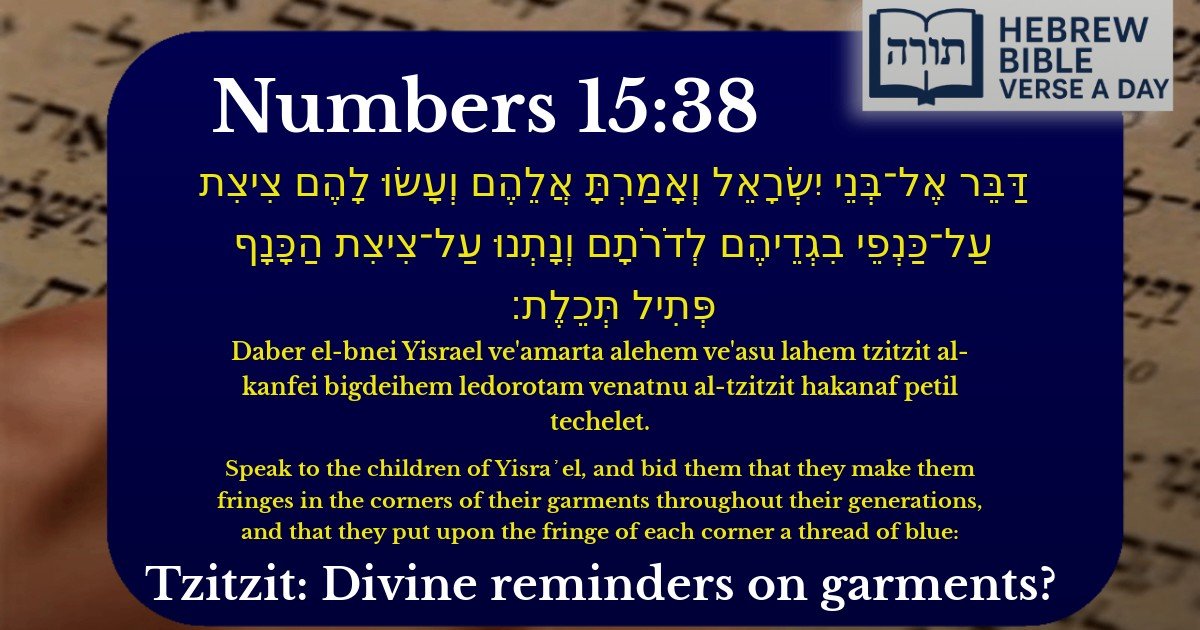

Numbers 15:38 - Tzitzit: Divine reminders on garments?

Numbers 15:38 - במדבר 15:38

Hebrew Text

דַּבֵּר אֶל־בְּנֵי יִשְׂרָאֵל וְאָמַרְתָּ אֲלֵהֶם וְעָשׂוּ לָהֶם צִיצִת עַל־כַּנְפֵי בִגְדֵיהֶם לְדֹרֹתָם וְנָתְנוּ עַל־צִיצִת הַכָּנָף פְּתִיל תְּכֵלֶת׃

English Translation

Speak to the children of Yisra᾽el, and bid them that they make them fringes in the corners of their garments throughout their generations, and that they put upon the fringe of each corner a thread of blue:

Transliteration

Daber el-bnei Yisrael ve'amarta alehem ve'asu lahem tzitzit al-kanfei bigdeihem ledorotam venatnu al-tzitzit hakanaf petil techelet.

Hebrew Leining Text

דַּבֵּ֞ר אֶל־בְּנֵ֤י יִשְׂרָאֵל֙ וְאָמַרְתָּ֣ אֲלֵהֶ֔ם וְעָשׂ֨וּ לָהֶ֥ם צִיצִ֛ת עַל־כַּנְפֵ֥י בִגְדֵיהֶ֖ם לְדֹרֹתָ֑ם וְנָ֥תְנ֛וּ עַל־צִיצִ֥ת הַכָּנָ֖ף פְּתִ֥יל תְּכֵֽלֶת׃

🎵 Listen to leining

Parasha Commentary

The Mitzvah of Tzitzit

The verse (Bamidbar 15:38) commands Bnei Yisrael to attach tzitzit (fringes) to the corners of their garments. Rashi explains that this mitzvah serves as a constant reminder of all the commandments, as stated later in the same passage (Bamidbar 15:39): "And you shall see them and remember all the commandments of Hashem." The physical act of seeing the tzitzit awakens one's spiritual consciousness.

The Significance of the Thread of Techelet

The verse specifies that one thread of the tzitzit should be dyed techelet (blue). Rambam (Hilchot Tzitzit 2:1) explains that techelet resembles the color of the sky, which in turn reminds a person of the Divine Throne of Glory (Kisei HaKavod), thereby inspiring awe of Heaven. The Talmud (Menachot 43b) further states that seeing the techelet is equivalent to seeing the Shechinah (Divine Presence) itself.

Generational Observance

The phrase "l'dorotam" (throughout their generations) emphasizes the eternal nature of this mitzvah. The Sifrei (a halachic Midrash) comments that this teaches the obligation applies in all places and at all times, even outside the Land of Israel. The mitzvah of tzitzit is unique in that it accompanies a person throughout daily activities, serving as a continuous spiritual anchor.

Practical Halachic Considerations

  • The Shulchan Aruch (Orach Chaim 9:1) rules that the mitzvah applies specifically to four-cornered garments, following the opinion of the majority of Rishonim.
  • The Mishna Berurah (9:3) notes that the ideal fulfillment includes techelet, though its absence does not invalidate the tzitzit.
  • Rabbi Samson Raphael Hirsch explains that the numerical value of tzitzit (600) plus the eight strings and five knots totals 613, symbolically representing all 613 mitzvot.

📚 Talmud Citations

This verse is quoted in the Talmud.

📖 Menachot 43b
The verse is discussed in the context of the mitzvah of tzitzit, particularly focusing on the requirement of the blue thread (tekhelet) and its significance.
📖 Berakhot 14b
The verse is referenced in a discussion about the importance of remembering the commandments and the role of tzitzit in this remembrance.
📖 Niddah 25b
The verse is mentioned in a broader discussion about the laws of tzitzit and their application.

Frequently Asked Questions

Q: What is the meaning of the commandment to wear tzitzit (fringes)?
A: The commandment of tzitzit, as stated in Numbers 15:38, serves as a physical reminder of our spiritual obligations to Hashem. Rashi explains that the tzitzit are meant to remind us of all the mitzvot (commandments), just as a servant might wear a uniform to remember whom they serve. The thread of blue (tekhelet) symbolizes the heavens and helps direct our thoughts toward divine service.
Q: Why is there a blue thread (tekhelet) in the tzitzit?
A: The Torah specifies that one thread of the tzitzit should be tekhelet (blue), as this color resembles the sea, the sky, and ultimately the Divine Throne (Talmud, Menachot 43b). Rambam (Hilchot Tzitzit 2:1) explains that tekhelet serves as a visual reminder of our connection to Hashem and His commandments. The exact shade of tekhelet was lost for centuries but has been revived in modern times based on historical and rabbinic research.
Q: Do women have to wear tzitzit?
A: According to Halacha (Jewish law), women are exempt from the mitzvah of tzitzit because it is a time-bound positive commandment (Talmud, Kiddushin 29a). The Rambam (Hilchot Tzitzit 3:9) states that while women are not obligated, they may choose to wear tzitzit if they wish, though this is not common in Orthodox practice. The exemption is based on the principle that women are generally exempt from mitzvot that must be performed at specific times.
Q: What is the significance of tying knots in the tzitzit?
A: The knots in the tzitzit carry deep symbolic meaning. According to the Talmud (Menachot 39a), the tzitzit strings are wound and knotted in a specific way to represent the 613 mitzvot. The numerical value of the word 'tzitzit' (600) plus the eight strings and five knots equals 613. The Arizal (a renowned Kabbalist) also teaches that the knots and windings have mystical significance, connecting the wearer to higher spiritual realms.
Q: How does wearing tzitzit apply to us today?
A: Tzitzit remain a central mitzvah for Jewish men today, serving as a constant reminder of our relationship with Hashem and our commitment to Torah. The Sefer HaChinuch (Mitzvah 386) explains that seeing the tzitzit helps prevent us from straying after our eyes and hearts. In modern times, many wear a tallit katan (small four-cornered garment) under their clothes to fulfill this commandment throughout the day, keeping the spiritual connection alive in daily activities.