
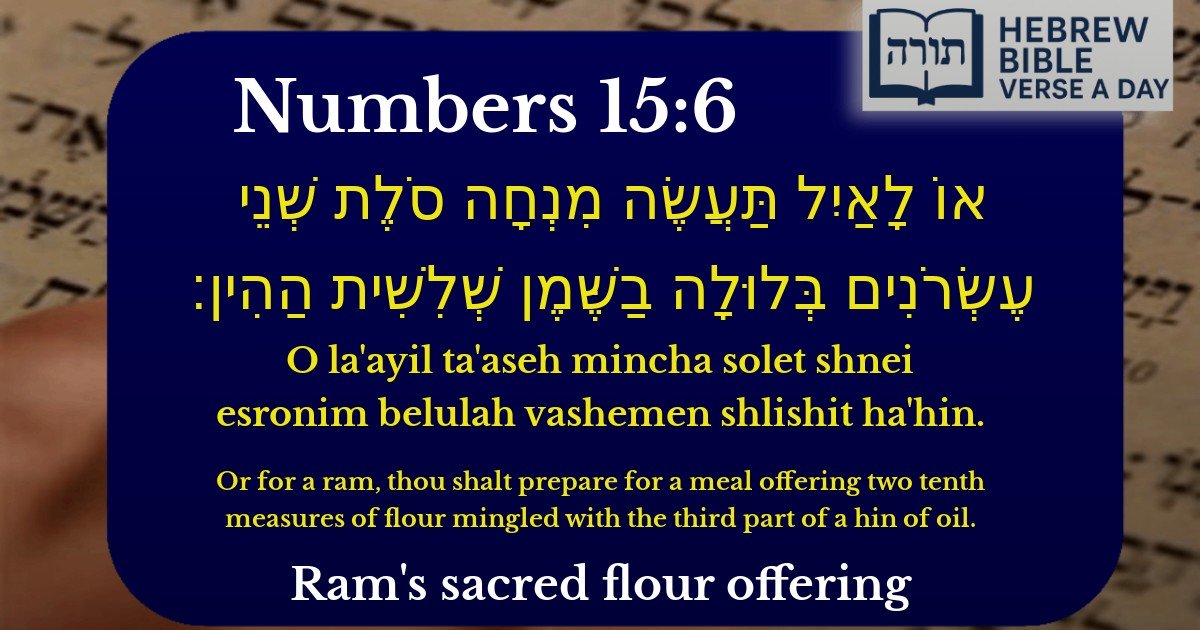

Numbers 15:6 - Ram's sacred flour offering

Numbers 15:6 - במדבר 15:6

Hebrew Text

אוֹ לָאַיִל תַּעֲשֶׂה מִנְחָה סֹלֶת שְׁנֵי עֶשְׂרֹנִים בְּלוּלָה בַשֶּׁמֶן שְׁלִשִׁית הַהִין׃

English Translation

Or for a ram, thou shalt prepare for a meal offering two tenth measures of flour mingled with the third part of a hin of oil.

Transliteration

O la'ayil ta'aseh mincha solet shnei esronim belulah vashemen shlishit ha'hin.

Hebrew Leining Text

א֤וֹ לָאַ֙יִל֙ תַּעֲשֶׂ֣ה מִנְחָ֔ה סֹ֖לֶת שְׁנֵ֣י עֶשְׂרֹנִ֑ים בְּלוּלָ֥ה בַשֶּׁ֖מֶן שְׁלִשִׁ֥ית הַהִֽין׃

🎵 Listen to leining

Parasha Commentary

Context in the Torah

This verse (Numbers 15:6) appears in the section detailing the meal offerings (minchah) that accompany animal sacrifices, specifically for a ram. The Torah outlines precise measurements for flour and oil, emphasizing the importance of exactness in divine service.

Explanation of the Measurements

  • Two tenth measures of flour: Rashi (on Numbers 15:4) explains that an isaron (tenth measure) is a volume equal to 43.2 eggs' bulk. Two tenths would thus be 86.4 eggs' bulk of fine flour (solet). The Vilna Gaon notes that the doubling for a ram (compared to a lamb's single tenth) signifies a more substantial offering.
  • Mixed with oil: The flour is to be thoroughly mingled (belulah) with oil. Rambam (Hilchos Maaseh HaKorbanos 13:4) states this ensures even distribution, symbolizing completeness in one's devotion to Hashem.
  • Third part of a hin: A hin is approximately 6 logim (12 eggs' bulk), so a third is 2 logim. The Talmud (Menachos 89a) derives that this ratio (oil to flour) reflects a divine standard for all meal offerings.

Symbolism and Halachic Significance

The Midrash (Bamidbar Rabbah 17:5) teaches that the minchah represents a person's livelihood, and its offering demonstrates gratitude to Hashem for sustenance. The oil, which enhances the flour, alludes to wisdom (as oil symbolizes enlightenment in Tanach—e.g., "Your word is a lamp to my feet," Tehillim 119:105).

Halachically, the precise measurements teach hiddur mitzvah (beautifying commandments), as codified by the Shulchan Aruch (Orach Chaim 242:1). Any deviation invalidates the offering, underscoring the need for meticulousness in avodas Hashem.

Connection to the Ram Sacrifice

The ram (ayil) often symbolizes strength (as in Akedat Yitzchak). The Kli Yakar (Numbers 15:6) suggests that the larger meal offering mirrors the ram's elevated status among sacrifices, hinting at the donor's wholehearted commitment—flour (sustenance) and oil (wisdom) united in divine service.

📚 Talmud Citations

This verse is not quoted in the Talmud.

Frequently Asked Questions

Q: What does Numbers 15:6 teach about the meal offering for a ram?
A: Numbers 15:6 specifies that when bringing a ram as a sacrifice, the accompanying meal offering (mincha) must consist of two tenths of an ephah (about 4.4 liters) of fine flour mixed with one-third of a hin (about 1.2 liters) of olive oil. This teaches the precise measurements required for korbanot (sacrifices) in the Mishkan (Tabernacle) and later the Beit Hamikdash (Temple). Rashi explains that these measurements reflect the importance of following halacha (Jewish law) meticulously in divine service.
Q: Why is olive oil used in the meal offering in Numbers 15:6?
A: Olive oil is used because it represents purity and quality, as it is one of the finest liquids (Talmud Menachot 86a). The Torah frequently associates olive oil with holiness, such as in the menorah's lighting (Exodus 27:20) and anointing oil (Exodus 30:22-25). Rambam (Hilchot Maaseh Hakorbanot 13:4) explains that the oil binds the flour, creating a proper offering to Hashem.
Q: What practical lesson can we learn from the detailed measurements in Numbers 15:6?
A: The precise measurements teach us the importance of precision and care in mitzvot (commandments). Just as the korbanot (sacrifices) required exact amounts, we learn that serving Hashem demands attention to detail (Talmud Eruvin 4a). The Midrash (Sifrei Bamidbar 110) also notes that this teaches us to give generously but according to halachic guidelines, balancing devotion with discipline.
Q: How does the meal offering in Numbers 15:6 connect to prayer today?
A: Since the destruction of the Beit Hamikdash (Temple), our prayers (tefillah) replace sacrifices (Talmud Berachot 26b). The mincha (meal offering) corresponds to the afternoon Mincha prayer. Just as the flour and oil were carefully prepared, we must approach prayer with focus and sincerity (Rambam, Hilchot Tefillah 4:16). The oil symbolizes the 'light' of devotion we bring to our tefillot.