Frequently Asked Questions
Q: What does Numbers 16:28 mean?
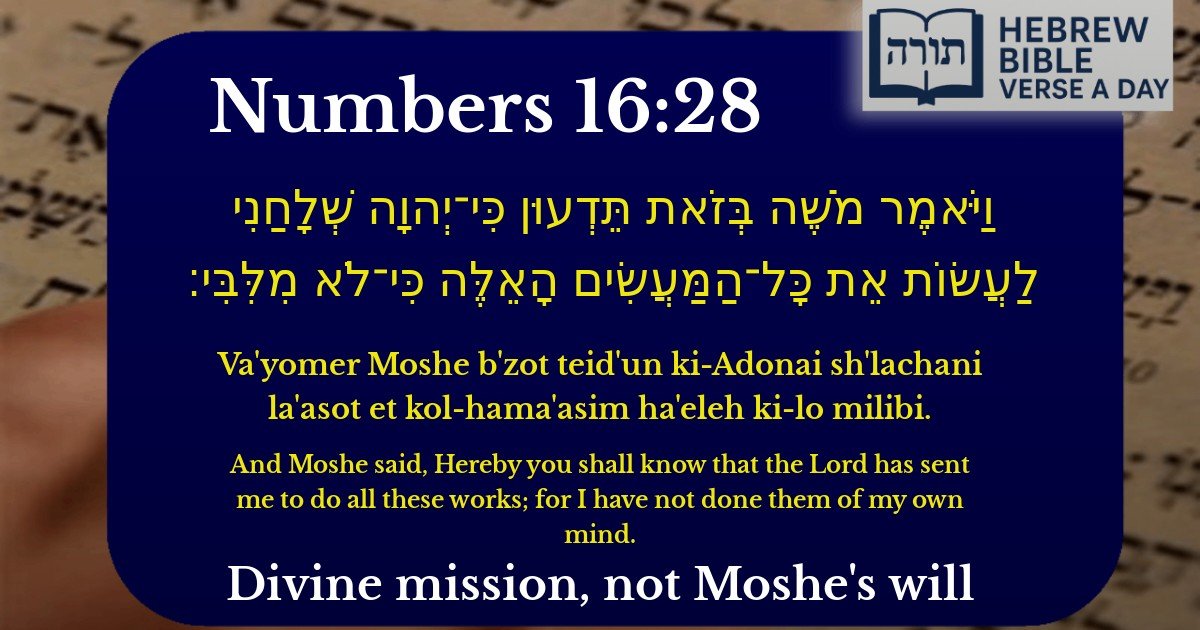
A: In Numbers 16:28, Moshe (Moses) is speaking to the people during Korach's rebellion. He declares that the miracles and judgments about to happen will prove that he is acting on Hashem's command, not his own will. Rashi explains that Moshe was emphasizing that his leadership and actions were divinely ordained, not self-motivated.
Q: Why is Numbers 16:28 important?
A: This verse is important because it reinforces the principle of true prophecy in Judaism. Moshe demonstrates that a genuine prophet acts only according to Hashem's will, not personal desires. The Rambam (Maimonides) lists this as a key test of a true prophet in Hilchos Yesodei HaTorah.
Q: What can we learn from Moshe's statement in this verse?
A: We learn the importance of humility and submission to Hashem's will. Even Moshe, the greatest prophet, emphasized that his authority came solely from Hashem. The Talmud (Sotah 5a) teaches that humility is one of the most important traits a person can have, and Moshe exemplifies this perfectly here.
Q: How does Numbers 16:28 apply to leadership today?
A: This verse teaches that authentic Jewish leadership must be about serving Hashem and the community, not personal ambition. As the Midrash (Tanchuma Korach 5) explains, Moshe's contrast with Korach shows that true leaders attribute their authority to Hashem rather than seeking power for themselves.
Q: What was the context of Moshe saying this verse?
A: This was said during Korach's rebellion (Numbers 16), when Korach and his followers challenged Moshe's leadership. Moshe was proving that his authority came from Hashem. The Talmud (Sanhedrin 110a) discusses how this incident became a warning against divisive disputes that aren't for Heaven's sake.


Context of the Verse
This verse (Bamidbar 16:28) appears during the rebellion of Korach and his followers against Moshe and Aharon. Moshe responds to their challenge by declaring that his actions are not of his own initiative but are divinely mandated. The phrase "כִּי־לֹא מִלִּבִּי" ("for I have not done them of my own mind") emphasizes that Moshe's leadership and miracles are entirely directed by Hashem.
Rashi's Explanation
Rashi explains that Moshe is asserting that the miracles performed—such as the splitting of the sea, the giving of the manna, and the other wonders—were not his own inventions. Rather, they were all done at Hashem's command. This counters Korach's accusation that Moshe was acting arrogantly or self-servingly.
Rambam's Perspective
In Moreh Nevuchim (Guide for the Perplexed), Rambam discusses prophecy and emphasizes that true prophets like Moshe act only as conduits for Hashem's will. Moshe's statement here aligns with the principle that a prophet does not act independently but serves as a messenger of the Divine.
Midrashic Insights
Halachic Implications
The Gemara (Sanhedrin 99a) derives from this verse that one who claims prophecy falsely—acting "מִלִּבִּי" (of their own mind)—is liable for severe consequences. Moshe's declaration thus serves as a model for discerning true prophecy from false claims.
Chassidic Interpretation
The Baal Shem Tov teaches that Moshe's words remind us that all our actions should be aligned with divine will, not personal desire. This verse becomes a lesson in bitul (self-nullification) before Hashem's commandments.