

Join Our Newsletter To Be Informed When New Videos Are Posted
Hebrew Text
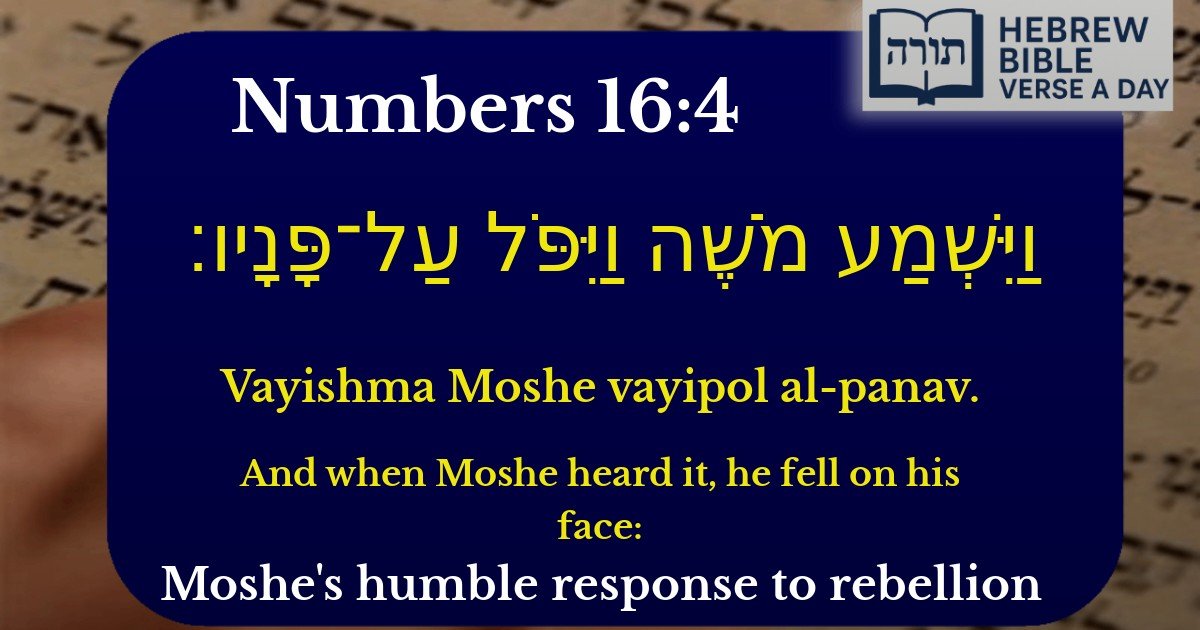
וַיִּשְׁמַע מֹשֶׁה וַיִּפֹּל עַל־פָּנָיו׃
English Translation
And when Moshe heard it, he fell on his face:
Transliteration
Vayishma Moshe vayipol al-panav.
Hebrew Leining Text
וַיִּשְׁמַ֣ע מֹשֶׁ֔ה וַיִּפֹּ֖ל עַל־פָּנָֽיו׃
🎵 Listen to leining
Parasha Commentary
📚 Talmud Citations
This verse is quoted in the Talmud.
📖 Sotah 14a
The verse is referenced in a discussion about Moses' humility and his reaction to the complaints of Korah and his followers.
📖 Sanhedrin 110a
The verse is mentioned in the context of the rebellion of Korah, illustrating Moses' response to the challenge to his leadership.
Understanding Moshe's Reaction
The verse (Bamidbar 16:4) describes Moshe's response upon hearing the complaints of Korach and his followers. Falling on his face is a significant gesture in Tanach, often indicating deep humility, prayer, or distress. Rashi explains that Moshe fell on his face because he perceived the gravity of the rebellion and sought divine guidance on how to respond.
Spiritual Significance of Falling on the Face
According to the Talmud (Berachos 34b), falling on one's face (nefilas apayim) is an act of extreme supplication before Hashem. The Midrash (Bamidbar Rabbah 18:6) adds that Moshe did this to demonstrate his complete reliance on Hashem in the face of this challenge, rather than relying on his own wisdom or authority.
Moshe's Humility
Rambam (Hilchos De'os 2:3) cites this incident as an example of Moshe's extraordinary humility. Despite being the unquestioned leader of Israel, he didn't respond with anger or pride when challenged, but with humility and prayer. The Or HaChaim notes that Moshe's reaction teaches leaders how to respond to criticism - with introspection rather than indignation.
Contrast with Korach's Approach
Halachic Implications
The Shulchan Aruch (Orach Chaim 131:1) discusses how Moshe's action became the model for the Tachanun prayer where we literally fall on our faces. The Mishna Berurah there explains this connects us to Moshe's example of humility before Hashem.