Frequently Asked Questions
Q: What does it mean when the Torah says 'And the Lord spoke to Moshe, saying'?
A: This phrase appears frequently in the Torah to indicate that Hashem is giving a direct commandment or instruction to Moshe (Moses) to transmit to the Jewish people. Rashi explains that this wording emphasizes the divine origin of the commandments and Moshe's role as the faithful transmitter of Hashem's word.
Q: Why does the Torah repeat 'saying' after 'And the Lord spoke to Moshe'?
A: The Talmud (Yoma 4a) teaches that the word 'saying' (לֵּאמֹר) implies that Moshe was to repeat and explain these words to the Jewish people. It indicates that the message wasn't just for Moshe personally, but was meant to be conveyed to others. Rambam notes this establishes the principle of Torah she'ba'al peh (Oral Torah) where Moshe would explain and elaborate on the written commandments.
Q: How many times does this phrase appear in the Torah?
A: The exact phrase 'And the Lord spoke to Moshe, saying' appears over 70 times in the Torah. The Midrash (Sifra) points out that this frequent repetition teaches us that every divine communication was equally important, whether it dealt with major principles or minor details. Each time marks a new instruction from Hashem to Moshe.
Q: What can we learn from how Hashem spoke to Moshe?
A: The Rambam (Moreh Nevuchim 1:65) explains that this phrasing teaches us about prophecy - that Moshe received divine communication clearly and directly, unlike other prophets who received messages through visions or dreams. The Sforno adds that it shows Moshe's unique level of prophecy, where he could speak with Hashem 'face to face' at any time (Deuteronomy 34:10).
Q: Why is it important that the Torah specifies it was Moshe who received these words?
A: The Talmud (Sanhedrin 99a) teaches that this establishes Moshe as the primary transmitter of Torah. As Rashi notes on Exodus 19:9, Moshe served as the reliable intermediary between Hashem and Israel. This is fundamental to Jewish belief in the divine origin of both the Written and Oral Torah, as Moshe faithfully transmitted everything he received from Hashem.

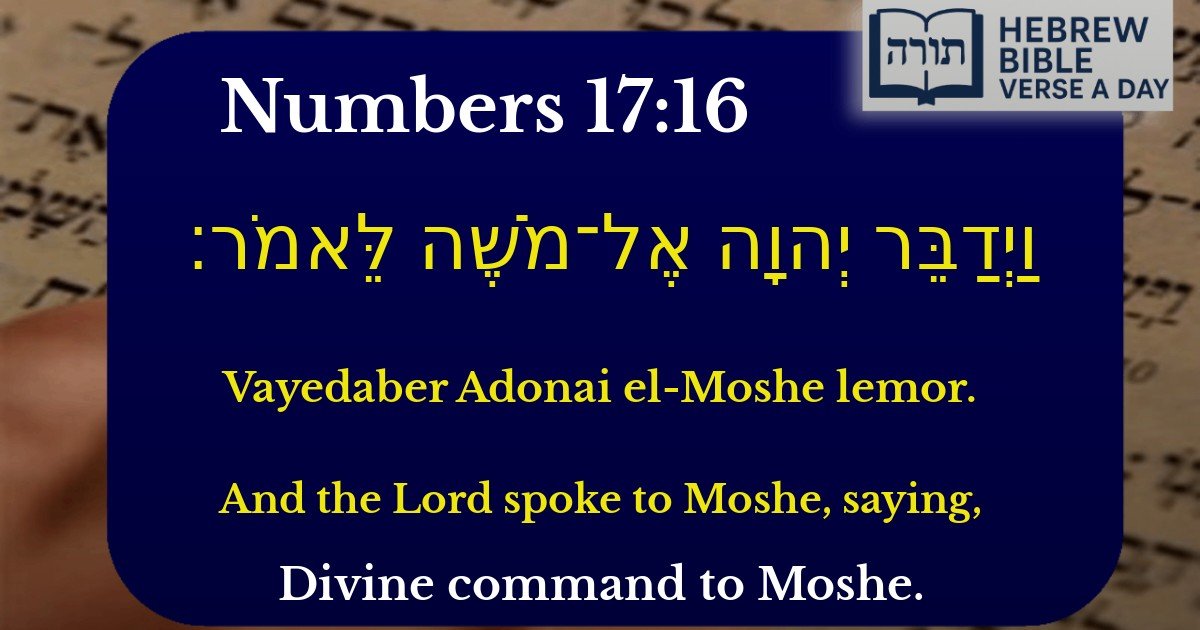

The Divine Communication to Moshe
The verse "וַיְדַבֵּר יְהוָה אֶל־מֹשֶׁה לֵּאמֹר" ("And the Lord spoke to Moshe, saying") appears frequently in the Torah, marking the transmission of divine commandments and teachings. Rashi (on Shemot 6:2) explains that this phrasing emphasizes the clarity and directness of Hashem's communication with Moshe, distinguishing it from other forms of prophecy. Unlike other prophets who received messages through visions or allegories, Moshe heard Hashem's words "באספקלריא המאירה" ("through a clear lens"), as stated in the Talmud (Yevamot 49b).
The Significance of "לֵּאמֹר" ("Saying")
The term "לֵּאמֹר" is interpreted in multiple ways by our sages:
The Unique Relationship Between Hashem and Moshe
The Torah emphasizes that Hashem spoke directly to Moshe (במדבר 12:8), a level of intimacy unmatched by other prophets. The Rambam (Yesodei HaTorah 7:6) elaborates that Moshe's prophecy was the foundation of Torah authority, as he alone received the entirety of the Written and Oral Law at Sinai. This verse thus serves as a recurring reminder of the authenticity of Moshe's transmission of the divine will to Klal Yisrael.
Halachic Implications
The Mechilta (Bo 1) derives from this phrasing that Moshe could not initiate prophecy on his own—he only spoke when first addressed by Hashem. This principle reinforces the idea that true prophecy is not subject to human will, but is entirely dependent on divine revelation.