Frequently Asked Questions
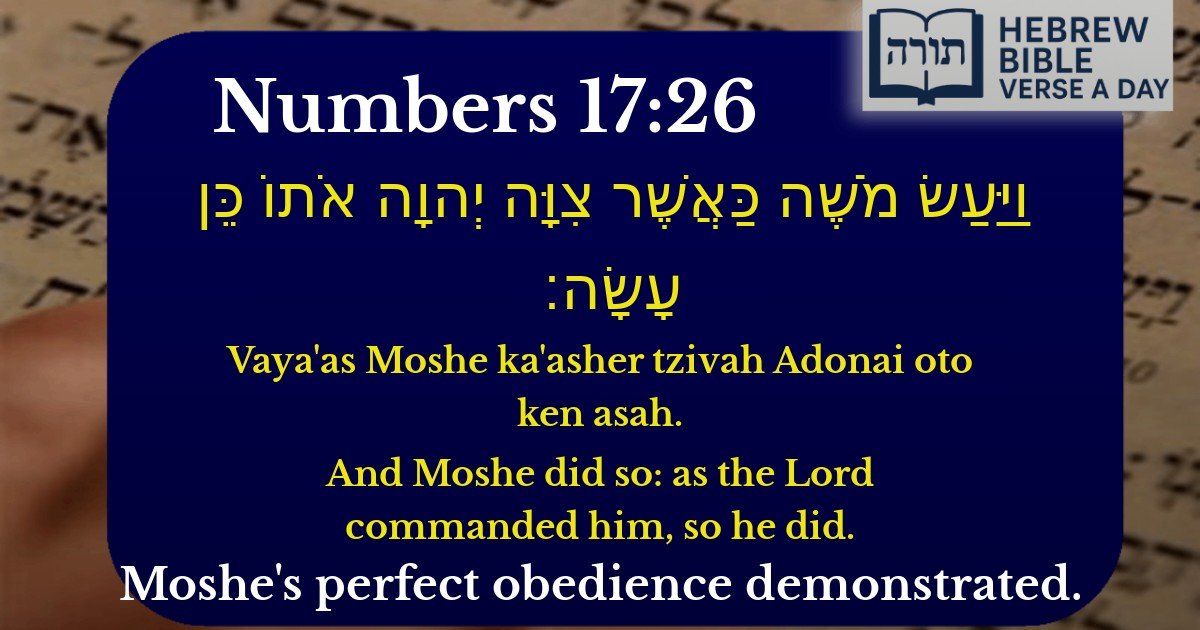
Q: What does the verse 'And Moshe did so: as the Lord commanded him, so he did' mean?
A: This verse (Numbers 17:26) emphasizes Moshe's complete obedience to Hashem's commandments. According to Rashi, it highlights that Moshe carried out every detail of the instruction regarding the test of the staffs (to confirm Aharon's chosen status as Kohen Gadol) exactly as commanded, without adding or omitting anything.
Q: Why is Moshe's exact fulfillment of Hashem's command important?
A: The Rambam teaches that precise fulfillment of mitzvot is fundamental in Judaism. Moshe's actions here set an example for all Jews to follow commandments meticulously, as the Talmud (Shabbat 97a) states that careful observance leads to spiritual elevation. This verse reinforces the principle of 'na'aseh v'nishma' - first obeying, then understanding.
Q: What lesson can we learn from Moshe's actions in this verse?
A: The Midrash (Bamidbar Rabbah 18:23) derives from this verse that true leadership means complete submission to Divine will. Just as Moshe followed Hashem's instructions exactly, we learn the importance of performing mitzvot with precision and without alteration, as the Sages teach in Pirkei Avot (1:1) about making 'a fence around the Torah.'
Q: How does this verse apply to our lives today?
A: The Chofetz Chaim explains that this verse teaches us to perform mitzvot with the same care Moshe demonstrated. Whether it's prayer, kosher observance, or acts of kindness, we should strive to fulfill all commandments exactly as transmitted through the Torah and our Sages, without taking shortcuts or making unauthorized changes.
Q: Why does the Torah repeat 'he did' after saying 'Moshe did so'?
A: Rashi explains the double language ('did so... he did') comes to emphasize that Moshe completed the entire commandment properly. The Talmud (Yoma 28b) notes this teaches that righteous people say little but do much - Moshe didn't just begin the action, but saw it through to complete fulfillment exactly as instructed.


Literal Interpretation (Peshat)
The verse (Exodus 40:16) describes Moshe's exact fulfillment of Hashem's commandments regarding the construction of the Mishkan (Tabernacle). Rashi emphasizes that Moshe did not deviate in any way from the divine instructions, highlighting his complete obedience and precision in carrying out Hashem's will.
Midrashic Insights (Derash)
The Midrash Tanchuma (Pekudei 11) expounds on this verse, noting that Moshe's actions serve as a model for all generations. Just as Moshe meticulously followed Hashem's commands without adding or omitting anything, so too should Bnei Yisrael adhere strictly to mitzvot. The Midrash further praises Moshe for his humility, as he did not take personal credit but attributed everything to Hashem's command.
Halachic Perspective
Rambam (Hilchot Yesodei HaTorah 9:1) derives from this verse a fundamental principle in halacha: one must not alter mitzvot even if the intention is to enhance their observance. Moshe's exact compliance demonstrates that divine commandments must be performed precisely as transmitted, without human modification.
Spiritual Lessons