
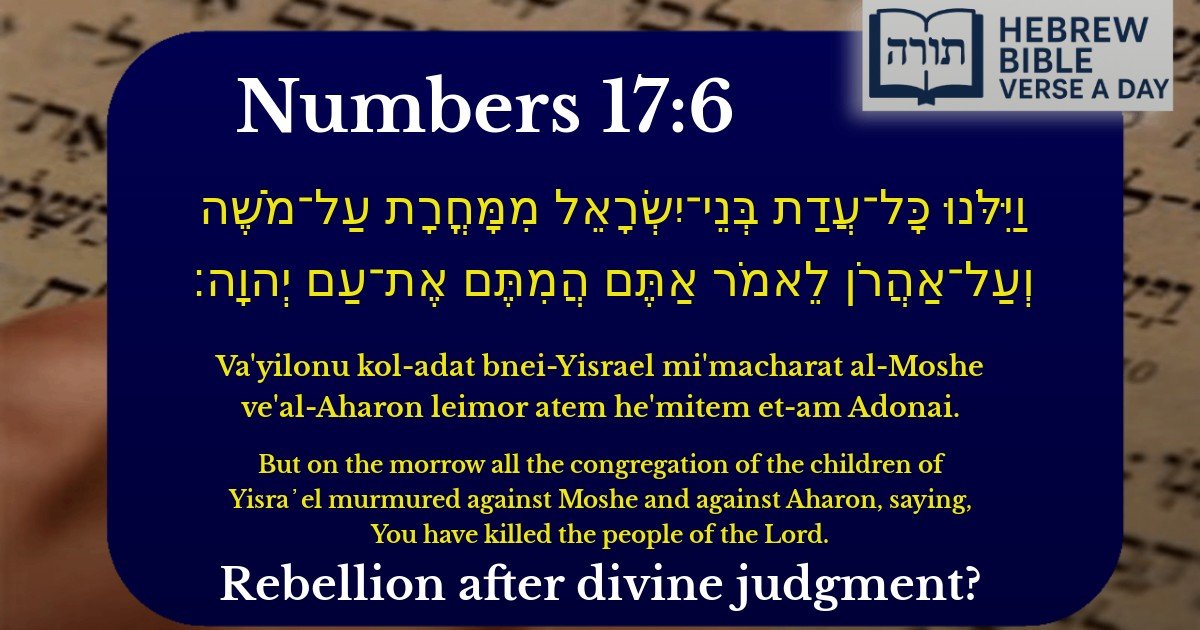

Numbers 17:6 - Rebellion after divine judgment?

Numbers 17:6 - במדבר 17:6

Hebrew Text

וַיִּלֹּנוּ כָּל־עֲדַת בְּנֵי־יִשְׂרָאֵל מִמָּחֳרָת עַל־מֹשֶׁה וְעַל־אַהֲרֹן לֵאמֹר אַתֶּם הֲמִתֶּם אֶת־עַם יְהוָה׃

English Translation

But on the morrow all the congregation of the children of Yisra᾽el murmured against Moshe and against Aharon, saying, You have killed the people of the Lord.

Transliteration

Va'yilonu kol-adat bnei-Yisrael mi'macharat al-Moshe ve'al-Aharon leimor atem he'mitem et-am Adonai.

Hebrew Leining Text

וַיִּלֹּ֜נוּ כׇּל־עֲדַ֤ת בְּנֵֽי־יִשְׂרָאֵל֙ מִֽמׇּחֳרָ֔ת עַל־מֹשֶׁ֥ה וְעַֽל־אַהֲרֹ֖ן לֵאמֹ֑ר אַתֶּ֥ם הֲמִתֶּ֖ם אֶת־עַ֥ם יְהֹוָֽה׃

🎵 Listen to leining

Parasha Commentary

Context of the Verse

The verse (Bamidbar 17:6) describes the aftermath of the rebellion of Korach and his followers, where the earth swallowed them as divine punishment. The next day, the entire congregation of Israel complains against Moshe and Aharon, accusing them of killing "the people of Hashem." This reflects a recurring theme of discontent among Bnei Yisrael in the wilderness.

Rashi's Explanation

Rashi (Bamidbar 17:6) explains that the people mistakenly believed Moshe and Aharon were responsible for the deaths of Korach's followers. They failed to recognize that this was a divine decree, not human action. Rashi emphasizes their lack of faith and their tendency to blame their leaders unjustly.

Rambam's Perspective

Rambam (Hilchos De'os 1:4) discusses how human nature inclines people to follow the opinions of the masses. Here, the entire congregation murmurs against Moshe and Aharon, demonstrating how collective doubt can lead to sin. The Rambam would view this as a failure in emunah (faith) and a lack of proper judgment.

Midrashic Insights

  • Midrash Tanchuma (Korach 12): The Midrash highlights the ingratitude of Bnei Yisrael, who had just witnessed open miracles yet still doubted Moshe's leadership. Their accusation, "You have killed the people of Hashem," shows their distorted perception—they considered Korach's faction righteous despite their rebellion.
  • Yalkut Shimoni (Korach 752): The Yalkut interprets their complaint as a sign of misplaced compassion—they mourned the wrongdoers instead of recognizing divine justice.

Lessons from the Talmud

The Talmud (Sanhedrin 110a) discusses the severity of opposing Torah leadership, citing Korach's rebellion as a paradigm of machlokes (dispute) not for the sake of Heaven. The people's murmuring the next day shows how easily discontent spreads, even after witnessing divine intervention.

Spiritual Implications

This episode teaches the dangers of:

  • Blaming Leaders Unjustly: Accusing Moshe and Aharon of murder reflects a lack of hakaras hatov (gratitude) and an inability to accept divine justice.
  • Collective Complaining: The entire congregation's murmuring demonstrates how a community can be swayed by emotion rather than truth.
  • Misplaced Sympathy: Mourning the wicked (Korach's faction) instead of upholding righteousness leads to further sin.

📚 Talmud Citations

This verse is quoted in the Talmud.

📖 Sanhedrin 110a
The verse is referenced in the context of discussing the rebellion of Korach and his followers, illustrating the complaints of the Israelites against Moses and Aaron.

Frequently Asked Questions

Q: Why were the Israelites complaining against Moshe and Aharon in Numbers 17:6?
A: The Israelites complained because they mistakenly blamed Moshe and Aharon for the death of Korach's followers (Rashi on Numbers 17:6). After witnessing the miraculous punishment of Korach's rebellion, they failed to understand that it was Divine justice, not Moshe and Aharon's doing.
Q: What lesson can we learn from the Israelites' complaint in this verse?
A: This teaches us the danger of blaming leaders for events that are actually Divine decrees (Midrash Tanchuma Korach 12). The Israelites should have recognized Hashem's hand in these events rather than accusing their righteous leaders.
Q: Why does the verse say 'the people of Hashem' when referring to those who died?
A: The term 'people of Hashem' shows that even though Korach's followers sinned, they were still considered part of the Jewish people (Ramban on Numbers 17:6). Their deaths pained the nation, demonstrating how all Jews are connected.
Q: How does this verse relate to the story of Korach's rebellion?
A: This verse comes immediately after Korach's rebellion is punished (Numbers 16). It shows how the people reacted with fear and misplaced blame rather than learning the proper lesson about the dangers of challenging Torah authority (Talmud Sanhedrin 110a).
Q: What does this teach us about dealing with tragedy according to Jewish thought?
A: This teaches that when tragedy strikes, we must examine our own actions rather than blaming others (Rashi on Numbers 17:6). The proper response is introspection and teshuva (repentance), not accusations against righteous leaders.