Frequently Asked Questions
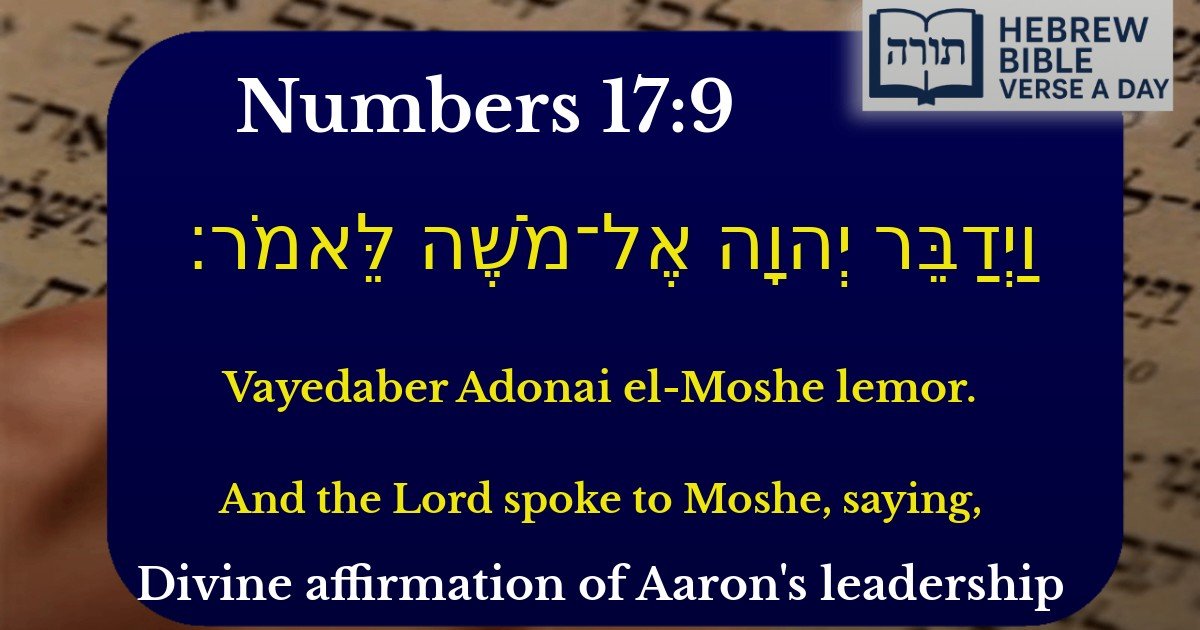
Q: What does it mean when the Torah says 'And the Lord spoke to Moshe, saying'?
A: This phrase appears frequently in the Torah to introduce divine commandments or instructions given to Moshe (Moses). According to Rashi, this wording emphasizes that Moshe received the words directly from Hashem (God) to transmit to Bnei Yisrael (the Children of Israel) exactly as they were given, without adding or omitting anything.
Q: Why does the Torah repeat 'saying' after 'And the Lord spoke to Moshe'?
A: The double language ('spoke... saying') teaches that Moshe was commanded not only to hear the words himself but also to relay them to others. The Talmud (Yoma 4b) explains that this phrasing indicates Moshe's role as the faithful transmitter of Torah to the Jewish people.
Q: How is this verse relevant to us today?
A: This verse reminds us of the divine origin of the Torah and the importance of faithfully transmitting Jewish tradition. The Rambam (Maimonides) includes belief in divine prophecy and Moshe's unique role as a fundamental principle of Jewish faith, showing this verse's lasting significance.
Q: Why is Moshe referred to by name here instead of as 'Moshe Rabbeinu' (Moses our teacher)?
A: The simple mention of 'Moshe' reflects the direct, personal communication between Hashem and Moshe. Traditional commentators note that this demonstrates the close relationship and clarity of prophecy that Moshe experienced, which was unique among all prophets (as explained in Rambam's Hilchos Yesodei HaTorah 7:6).
Q: What can we learn from how Hashem communicated with Moshe?
A: This teaches us about the importance of clear communication in transmitting Torah values. The Midrash (Sifrei) notes that Hashem always spoke to Moshe clearly and directly, modeling how we should teach Torah to others - with patience, clarity, and accuracy.


Introduction to Divine Communication
The verse "וַיְדַבֵּר יְהוָה אֶל־מֹשֶׁה לֵּאמֹר" ("And the Lord spoke to Moshe, saying") appears frequently in the Torah, marking the beginning of divine communication. Rashi (on Shemot 6:2) explains that this phrase emphasizes the clarity and directness of Hashem's speech to Moshe, distinguishing it from other forms of prophecy. Unlike other prophets who received messages through visions or dreams, Moshe experienced direct, face-to-face communication (בפַּעֲמוֹנִים וּבִמְרָאָה, לא בַּחֲלוֹם).
The Significance of "לֵּאמֹר"
The word "לֵּאמֹר" ("saying") is interpreted by the Midrash (Shemot Rabbah 28:6) as an instruction for Moshe to convey the divine message to Bnei Yisrael. Rambam (Hilchos Yesodei HaTorah 7:6) elaborates that Moshe served as the intermediary to transmit Torah to the people, ensuring the preservation of divine will. The Sforno adds that this term implies Moshe was to deliver the message precisely as received, without alteration.
Moshe's Unique Prophetic Role
Theological Implications
The Ohr HaChaim (on Shemot 6:2) highlights that this phrasing underscores the authenticity of Torah as divine revelation. The repetition of such verses throughout the Torah reinforces that every mitzvah and teaching originates from Hashem, not human invention. This principle is foundational to Orthodox Jewish belief in Torah MiSinai.