
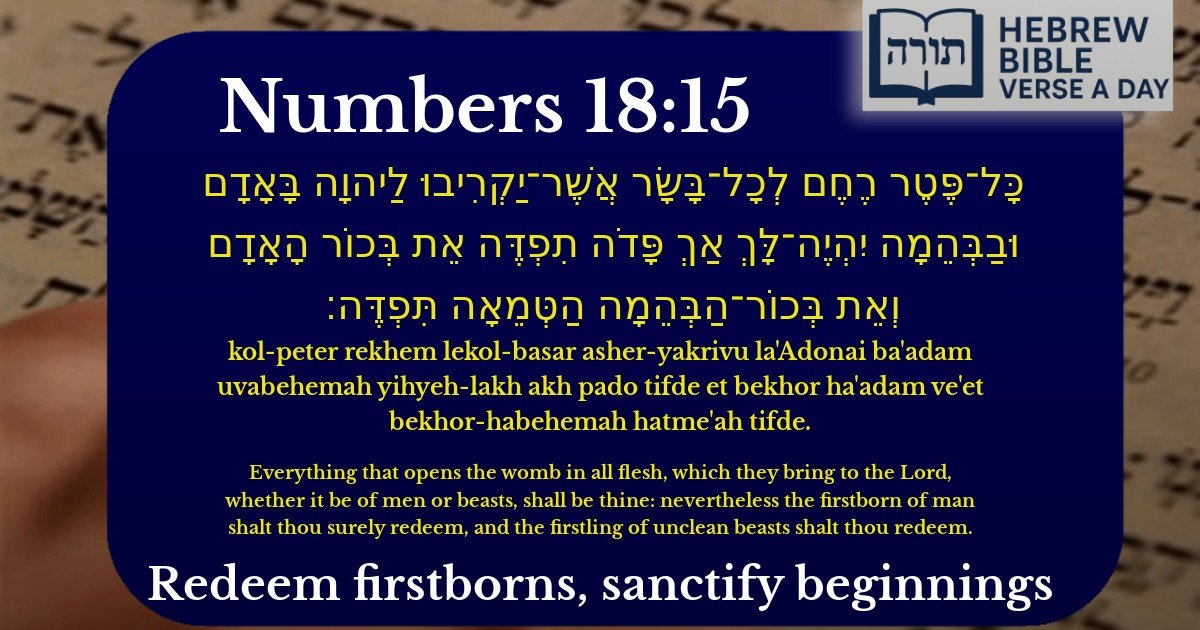

Numbers 18:15 - Redeem firstborns, sanctify beginnings

Numbers 18:15 - במדבר 18:15

Hebrew Text

כָּל־פֶּטֶר רֶחֶם לְכָל־בָּשָׂר אֲשֶׁר־יַקְרִיבוּ לַיהוָה בָּאָדָם וּבַבְּהֵמָה יִהְיֶה־לָּךְ אַךְ פָּדֹה תִפְדֶּה אֵת בְּכוֹר הָאָדָם וְאֵת בְּכוֹר־הַבְּהֵמָה הַטְּמֵאָה תִּפְדֶּה׃

English Translation

Everything that opens the womb in all flesh, which they bring to the Lord, whether it be of men or beasts, shall be thine: nevertheless the firstborn of man shalt thou surely redeem, and the firstling of unclean beasts shalt thou redeem.

Transliteration

Kol-peter rekhem lekol-basar asher-yakrivu la'Adonai ba'adam uvabehemah yihyeh-lakh akh pado tifde et bekhor ha'adam ve'et bekhor-habehemah hatme'ah tifde.

Hebrew Leining Text

כׇּל־פֶּ֣טֶר רֶ֠חֶם לְֽכׇל־בָּשָׂ֞ר אֲשֶׁר־יַקְרִ֧יבוּ לַֽיהֹוָ֛ה בָּאָדָ֥ם וּבַבְּהֵמָ֖ה יִֽהְיֶה־לָּ֑ךְ אַ֣ךְ ׀ פָּדֹ֣ה תִפְדֶּ֗ה אֵ֚ת בְּכ֣וֹר הָֽאָדָ֔ם וְאֵ֛ת בְּכֽוֹר־הַבְּהֵמָ֥ה הַטְּמֵאָ֖ה תִּפְדֶּֽה׃

🎵 Listen to leining

Parasha Commentary

Overview of the Verse

The verse (Numbers 18:15) discusses the laws of pidyon haben (redemption of the firstborn son) and the sanctity of firstborn animals, both kosher and non-kosher. It establishes that the firstborn of humans and certain animals must be redeemed, while others are designated for the Kohanim (priests).

Key Concepts and Interpretations

  • כָּל־פֶּטֶר רֶחֶם (Everything that opens the womb): Rashi explains that this refers to the first issue of the womb, whether human or animal, which is inherently sanctified to Hashem.
  • יִהְיֶה־לָּךְ (shall be thine): The sanctified firstborns are given to the Kohanim as part of their portion, as derived from Bamidbar Rabbah.
  • אַךְ פָּדֹה תִפְדֶּה (nevertheless, you shall surely redeem): The Torah mandates the redemption of a firstborn Israelite male through the payment of five silver shekels to a Kohen (based on Shemot 13:13 and the Mishnah in Bekhorot 8:7).
  • בְּכוֹר־הַבְּהֵמָה הַטְּמֵאָה (firstling of unclean beasts): Rambam (Hilchot Bikkurim 12:1) clarifies that non-kosher firstborn animals must also be redeemed, but their value is given to the Kohen rather than the animal itself being consecrated.

Halachic Implications

The verse establishes two distinct mitzvot:

  • Pidyon HaBen: The obligation to redeem a firstborn son on the 31st day after birth (Chullin 11b).
  • Firstborn Animals: Kosher firstborn animals (e.g., sheep, cattle) are given to the Kohen and sacrificed, while non-kosher firstborns (e.g., donkeys) are redeemed with a lamb or its monetary equivalent (Shemot 13:13).

Midrashic Insight

The Midrash Tanchuma (Korach 10) connects this mitzvah to the Exodus, where Hashem spared the firstborn of Israel during the Plague of the Firstborn. Thus, the firstborn retain a sanctity that requires redemption, symbolizing gratitude for divine mercy.

📚 Talmud Citations

This verse is quoted in the Talmud.

📖 Bekhorot 4b
The verse is discussed in the context of the laws regarding the redemption of the firstborn of humans and animals, particularly focusing on the distinction between clean and unclean animals.
📖 Arakhin 29a
The verse is referenced in a discussion about the valuation and redemption of firstborns, emphasizing the obligation to redeem the firstborn of humans and unclean animals.

Frequently Asked Questions

Q: What does Numbers 18:15 mean?
A: Numbers 18:15 discusses the laws of firstborns (bechorim). It states that the firstborn of both humans and animals are to be dedicated to Hashem. However, human firstborns must be redeemed (through the mitzvah of Pidyon HaBen), and non-kosher animals must also be redeemed or given to the Kohen (priest). Kosher animals, however, are sacrificed. This verse highlights the special status of firstborns in Jewish law.
Q: Why is redeeming the firstborn (Pidyon HaBen) important?
A: The redemption of the firstborn son (Pidyon HaBen) is a mitzvah commanded in the Torah (Numbers 18:15-16). It commemorates the miracle of Hashem sparing the Jewish firstborns during the Plague of the Firstborn in Egypt. A Kohen performs the ceremony, and the father redeems his son by giving five silver coins (equivalent to the value of five shekels in the Torah). This mitzvah applies only under specific conditions, such as when the father and mother are not from priestly or Levite families.
Q: What is the difference between kosher and non-kosher firstborn animals in this verse?
A: Numbers 18:15 distinguishes between kosher (clean) and non-kosher (unclean) firstborn animals. A firstborn kosher animal (like a cow or sheep) is holy and must be given to the Kohen to be offered as a sacrifice in the Temple. A firstborn non-kosher animal (like a donkey) cannot be sacrificed, so it must either be redeemed (by giving its value to the Kohen) or, if not redeemed, destroyed. This teaches that holiness applies differently based on the animal's status in Jewish law.
Q: How does the concept of firstborns apply today without the Temple?
A: Today, since the Temple is not standing, the laws of firstborns still apply but in modified ways. For a firstborn son, Pidyon HaBen is performed as usual (if the conditions are met). For kosher animals, since they cannot be sacrificed, they must be given to a Kohen, who then returns them or sells them back. Non-kosher firstborn animals (like donkeys) are still redeemed with a lamb or its value. These laws remind us of the sanctity of firstborns and our connection to the Temple service.
Q: What is the deeper meaning behind dedicating firstborns to Hashem?
A: The dedication of firstborns symbolizes gratitude to Hashem for life and sustenance. Rashi explains that this mitzvah originated after the Exodus, when Hashem spared Jewish firstborns in Egypt (Exodus 13:2). By consecrating firstborns, we acknowledge that everything belongs to Hashem, and the 'first' (whether a child, animal, or produce) has special sanctity. This teaches humility and reinforces the idea that our blessings come from Hashem.