Frequently Asked Questions
Q: What does Numbers 18:16 mean?
A: Numbers 18:16 discusses the redemption of firstborn sons in Jewish tradition. According to the Torah, every firstborn male must be redeemed (pidyon haben) by giving five silver shekels to a Kohen (priest) after the child is one month old. This mitzvah commemorates the sparing of Jewish firstborns during the plague of the firstborn in Egypt (Exodus 13:13–15). The verse specifies the exact amount and the age at which the redemption takes place.
Q: Why is the redemption price set at five shekels?
A: The Torah sets the redemption price at five silver shekels (based on the sacred shekel weight) as a fixed amount for all firstborn sons, regardless of economic status. Rashi explains that this standardization ensures equality—every family fulfills the mitzvah in the same way. The number five may also symbolize the five books of the Torah, emphasizing the importance of Torah study in Jewish life.
Q: At what age is a firstborn son redeemed?
A: The verse states that the pidyon haben (redemption of the firstborn) takes place 'from a month old.' In practice, the ceremony is performed after the baby completes 30 days of life (Talmud, Kiddushin 29a). If the 30th day falls on Shabbat or a holiday, the ceremony is delayed to the next weekday (Shulchan Aruch, Yoreh De'ah 305:10).
Q: Does this mitzvah still apply today?
A: Yes, Orthodox Jews still perform pidyon haben today for firstborn sons who meet the criteria (e.g., the child is the firstborn to the mother, born naturally, and neither parent is a Kohen or Levi). The ceremony involves giving five silver coins (or their equivalent value) to a Kohen while reciting blessings. This mitzvah serves as a reminder of our gratitude to Hashem for sparing the Jewish firstborns in Egypt.
Q: What is the significance of the 'shekel of the sanctuary' mentioned in the verse?
A: The 'shekel of the sanctuary' refers to a standardized weight used for holy purposes in the Mishkan (Tabernacle) and later the Temple. Rashi explains that this shekel was worth 20 gerah (a smaller unit). Using this sacred measurement ensured fairness and holiness in fulfilling commandments. Today, we calculate the equivalent value in current currency based on the weight of pure silver (approximately 96 grams).


Context in the Torah
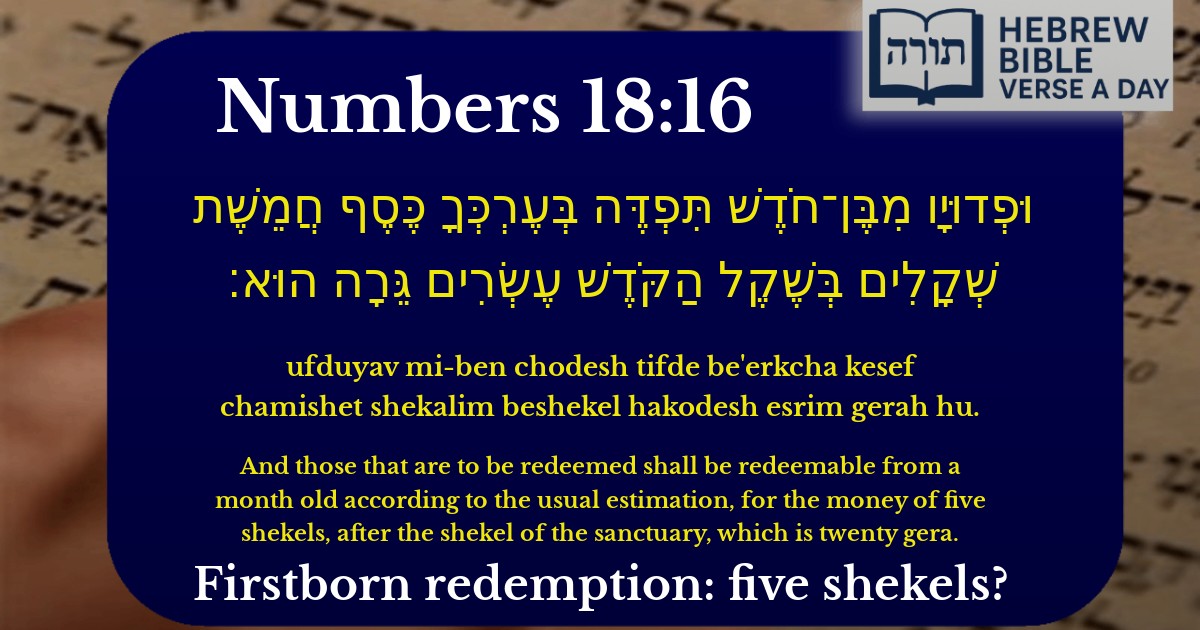
This verse (Bamidbar 18:16) appears in the context of the laws concerning the redemption of firstborn sons (Pidyon HaBen) and the sanctity of firstborn animals. The Torah establishes that firstborn sons must be redeemed from a Kohen for five silver shekels after they reach one month of age.
Explanation of the Verse
The verse specifies that the redemption of a firstborn son must take place "from a month old" (מִבֶּן־חֹדֶשׁ). Rashi explains that this means the mitzvah applies only after the child has completed thirty days of life, as before this time, the infant's viability is not fully assured (based on Niddah 44b). The amount of redemption is "five shekels" (חֲמֵשֶׁת שְׁקָלִים), which must be paid in the sacred shekel weight of the Sanctuary (שֶׁקֶל הַקֹּדֶשׁ). The verse further clarifies that this shekel consists of "twenty gera" (עֶשְׂרִים גֵּרָה), establishing the standard measurement.
Halachic Details from Rambam
Rambam (Hilchot Bikkurim 11:1-5) elaborates on the laws of Pidyon HaBen:
Symbolic Meaning from Midrash
The Midrash (Bamidbar Rabbah 12:4) connects the five shekels to the five times the word "nefesh" (soul) appears in the context of firstborn redemption (Bamidbar 3:44-48), emphasizing the spiritual significance of redeeming a Jewish soul. The Chatam Sofer adds that the five shekels correspond to the five books of the Torah, underscoring the child's future obligation to study and uphold Torah.
Practical Observance
In practice, the Pidyon HaBen ceremony involves: