Frequently Asked Questions
Q: What does Numbers 18:28 mean?
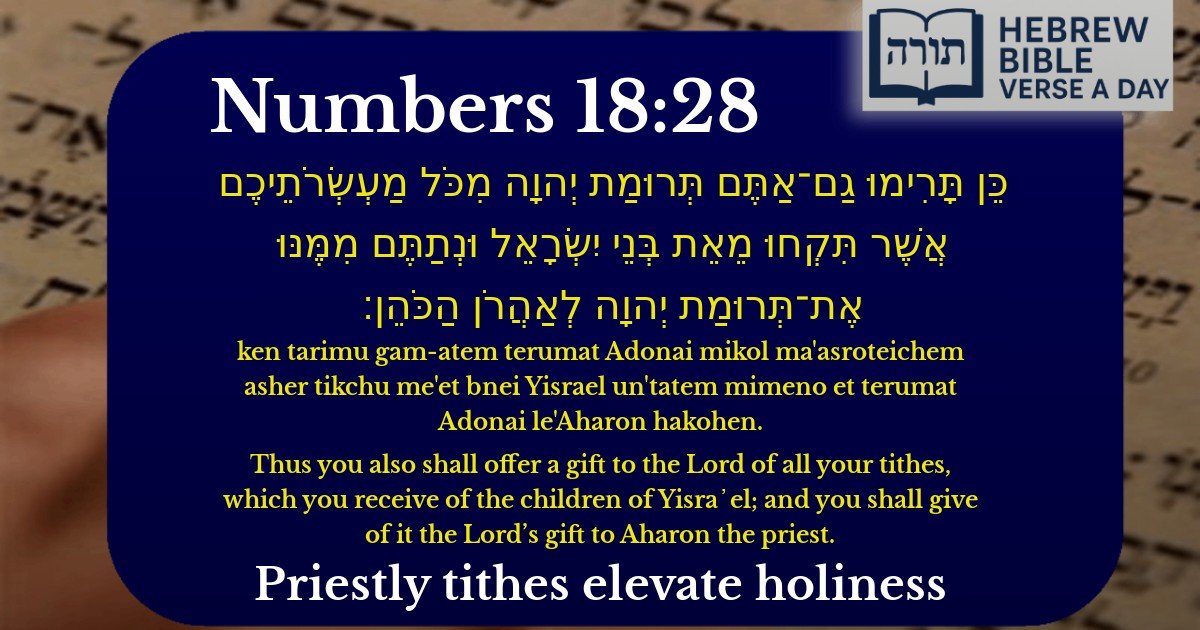
A: Numbers 18:28 instructs the Levites to take a portion (terumah) from the tithes (ma'aser) they receive from the Israelites and give it to the Kohanim (priests), specifically to Aharon and his descendants. This is part of the system of tithes described in the Torah to support the tribe of Levi, who did not receive a portion of land in Israel.
Q: Why is giving terumah (the gift) to the Kohanim important?
A: Giving terumah to the Kohanim is important because it sustains the priestly class, who serve in the Mishkan (Tabernacle) and later the Beit HaMikdash (Temple). Since the Kohanim and Levites did not inherit land, this system ensured they could focus on their spiritual duties. Rashi explains that this teaches the principle of supporting those who dedicate their lives to divine service.
Q: What can we learn from this verse today?
A: Even though we do not currently have the Beit HaMikdash or the full system of tithes, this verse teaches the importance of supporting Torah scholars and communal leaders who devote themselves to spiritual service. The Rambam (Hilchos Matnos Aniyim 10:1) discusses how this concept applies to tzedakah (charity) in our times.
Q: Who were the tithes (ma'aser) given to originally?
A: The Israelites gave tithes (ma'aser) to the Levites (Bamidbar 18:21). The Levites, in turn, took a tenth of what they received (called 'terumas ma'aser') and gave it to the Kohanim, as stated in this verse. This ensured both the Levites and Kohanim were provided for.
Q: Does this mitzvah still apply today?
A: While the full system of terumah and ma'aser only applies when the Beit HaMikdash is standing, certain agricultural tithes (like ma'aser kesafim, giving a tenth of income to charity) are still observed as a remembrance. The Shulchan Aruch (Yoreh De'ah 331) discusses the details of giving ma'aser in our times.


Context of the Verse
This verse appears in Bamidbar (Numbers) 18:28, within the broader discussion of the gifts given to the Kohanim (priests) and Levi'im (Levites). The Torah outlines the obligations of the Levi'im to separate a portion of the tithes they receive from the rest of Bnei Yisrael and give it to the Kohanim as a terumah (heave-offering) to Hashem.
Explanation of the Verse
The verse commands the Levi'im to separate a portion of the ma'aser (tithe) they receive from the people of Israel and give it as terumat Hashem (a gift to the Lord) to Aharon HaKohen and his descendants. This portion is known as terumat ma'aser (the tithe of the tithe). Rashi explains that this is one-tenth of the tithe the Levi'im receive, which they must then give to the Kohanim.
Halachic Requirements
Symbolic and Ethical Lessons
The Midrash Tanchuma (Korach 8) teaches that this mitzvah reinforces the principle of gratitude and hierarchy in divine service. Just as the Levi'im receive their sustenance from the tithes of Bnei Yisrael, they must acknowledge their own dependence on Hashem by giving a portion to the Kohanim, who serve in the Mishkan (Tabernacle) or Beit HaMikdash (Temple). This cycle of giving reflects the interconnectedness of the Jewish people in avodat Hashem (service of God).
Practical Implications
Even today, though the Temple is not standing, the concept of terumat ma'aser remains relevant in discussions of agricultural laws in Eretz Yisrael. The Chazon Ish (Zera'im, Ma'aser Sheni 5:8) discusses the proper way to separate tithes in accordance with halachic guidelines, ensuring that the sanctity of these gifts is preserved even in contemporary times.