

Join Our Newsletter To Be Informed When New Videos Are Posted
Hebrew Text
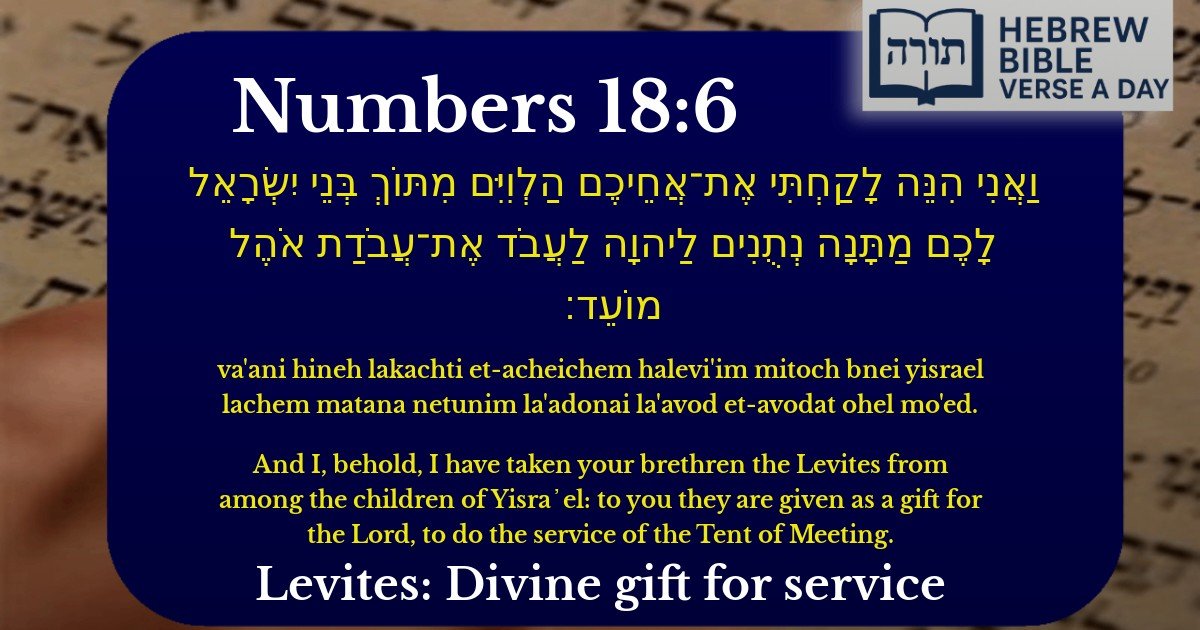
וַאֲנִי הִנֵּה לָקַחְתִּי אֶת־אֲחֵיכֶם הַלְוִיִּם מִתּוֹךְ בְּנֵי יִשְׂרָאֵל לָכֶם מַתָּנָה נְתֻנִים לַיהוָה לַעֲבֹד אֶת־עֲבֹדַת אֹהֶל מוֹעֵד׃
English Translation
And I, behold, I have taken your brethren the Levites from among the children of Yisra᾽el: to you they are given as a gift for the Lord, to do the service of the Tent of Meeting.
Transliteration
Va'ani hineh lakachti et-acheichem halevi'im mitoch bnei yisrael lachem matana netunim la'adonai la'avod et-avodat ohel mo'ed.
Hebrew Leining Text
וַאֲנִ֗י הִנֵּ֤ה לָקַ֙חְתִּי֙ אֶת־אֲחֵיכֶ֣ם הַלְוִיִּ֔ם מִתּ֖וֹךְ בְּנֵ֣י יִשְׂרָאֵ֑ל לָכֶ֞ם מַתָּנָ֤ה נְתֻנִים֙ לַֽיהֹוָ֔ה לַעֲבֹ֕ד אֶת־עֲבֹדַ֖ת אֹ֥הֶל מוֹעֵֽד׃
🎵 Listen to leining
Parasha Commentary
📚 Talmud Citations
This verse is quoted in the Talmud.
📖 Arakhin 11a
The verse is cited in a discussion about the Levites and their role in the service of the Tabernacle, emphasizing their unique status as a gift to the priests for divine service.
📖 Horayot 6b
Referenced in the context of discussing the roles and responsibilities of the Levites and priests, highlighting their separation for sacred duties.
The Divine Selection of the Levites
The verse (Bamidbar 18:6) emphasizes that the Levites were taken "from among the children of Yisrael" as a special gift to serve in the Mishkan. Rashi explains that this selection was not arbitrary but a divine decree from Hashem, distinguishing the Levites for sacred service. The term "matanah" (gift) underscores that their role is both an honor and a responsibility bestowed upon them by Hashem.
The Levites' Role in the Mishkan
Rambam (Hilchot Klei HaMikdash 3:1-2) elaborates that the Levites were entrusted with specific duties in the Mishkan, including guarding its sanctity, transporting its vessels, and assisting the Kohanim. The phrase "la'avod et avodat Ohel Moed" highlights that their service was not merely functional but a sacred avodah (divine service) requiring purity and devotion.
Midrashic Insights
The Gift to the Kohanim
The verse states the Levites were given "to you" (the Kohanim). Ibn Ezra explains this reflects their subordinate role, assisting the Kohanim in higher rituals. The Kli Yakar emphasizes the mutual dependence: while the Kohanim rely on the Levites for support, the Levites derive their sanctity from association with the Kohanim.