Frequently Asked Questions
Q: What does Numbers 19:16 mean?
A: Numbers 19:16 discusses the laws of ritual impurity (tum'ah) in Jewish tradition. It states that anyone who touches a dead body, a human bone, a grave, or someone killed by a sword in an open field becomes ritually impure for seven days. This impurity affects a person's ability to participate in certain holy activities, like entering the Temple or eating sacred foods, until they undergo purification.
Q: Why is touching a dead body impure in Judaism?
A: In Jewish law (halacha), death is considered a source of ritual impurity (tum'at met) because holiness is associated with life. The Torah teaches that contact with death creates a spiritual distance from sanctity, which is why purification is required before engaging in holy matters. This concept is derived from verses like Numbers 19:16 and is elaborated upon in the Talmud (e.g., Chagigah 3b) and commentaries like Rashi.
Q: How does the purification process work for someone who becomes impure from a dead body?
A: According to Numbers 19, a person who becomes impure from contact with the dead must undergo purification using the ashes of the red heifer (para aduma). This involves being sprinkled with the mixture on the third and seventh days, immersing in a mikveh (ritual bath), and waiting until evening to become pure. The Mishnah (Parah) and Rambam (Hilchot Parah Adumah) explain this process in detail.
Q: Does this law still apply today without the Temple?
A: While the full purification process with the red heifer cannot be performed today due to the absence of the Temple, the concept of tum'at met (impurity from the dead) still has halachic relevance. For example, Kohanim (priests) must avoid contact with dead bodies to maintain their ritual purity (Rambam, Hilchot Avel 3:1). Additionally, Jewish burial societies (Chevra Kadisha) follow strict protocols to handle the deceased with respect and minimize impurity.
Q: What is the significance of the seven-day impurity period?
A: The seven-day period (Numbers 19:16) mirrors other purification processes in the Torah, such as the purification after childbirth (Leviticus 12) or a zavah (a woman with irregular bleeding). Seven days represents a complete cycle of time, symbolizing spiritual renewal. The Talmud (Moed Katan 28a) also connects this period to mourning practices, showing how physical and spiritual purification are intertwined in Jewish tradition.

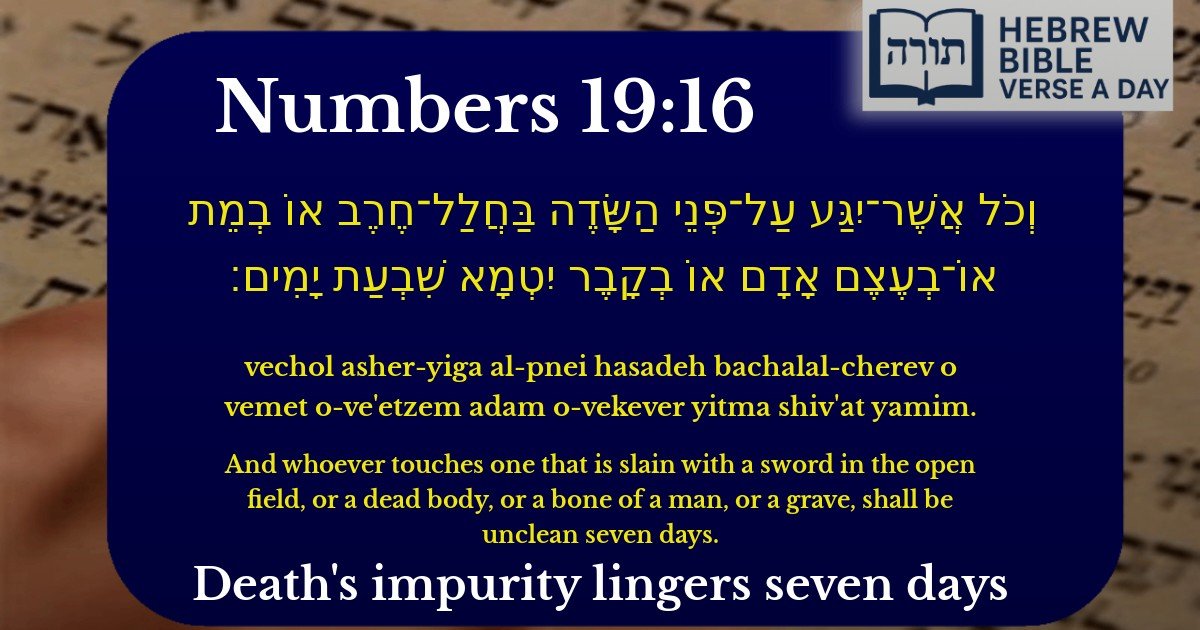

Overview of the Verse
The verse (Bamidbar 19:16) discusses the laws of tum'ah (ritual impurity) contracted through contact with a corpse or related objects. This is part of the broader discussion of the parah adumah (red heifer) ritual, which provides purification from corpse impurity. The Torah specifies four sources of this severe impurity: a person slain by a sword, a dead body, a human bone, or a grave.
Sources of Tum'ah
Duration of Impurity
The verse states that the impurity lasts seven days, requiring purification through the sprinkling of the mei chatat (waters mixed with ashes of the red heifer) on the third and seventh days (Bamidbar 19:12). The Talmud (Yoma 14a) explains that this seven-day period is unique to corpse impurity, distinguishing it from other forms of tum'ah.
Halachic Implications
The Rambam (Hilchot Tum'at Met 1:2) rules that these laws apply equally to men and women, and to Jews and non-Jews. The Chazon Ish (Ohalot 22:4) discusses modern applications, such as impurity from cemeteries or archaeological findings. The Shulchan Aruch (Yoreh De'ah 372) details practical precautions to avoid contracting this impurity.