
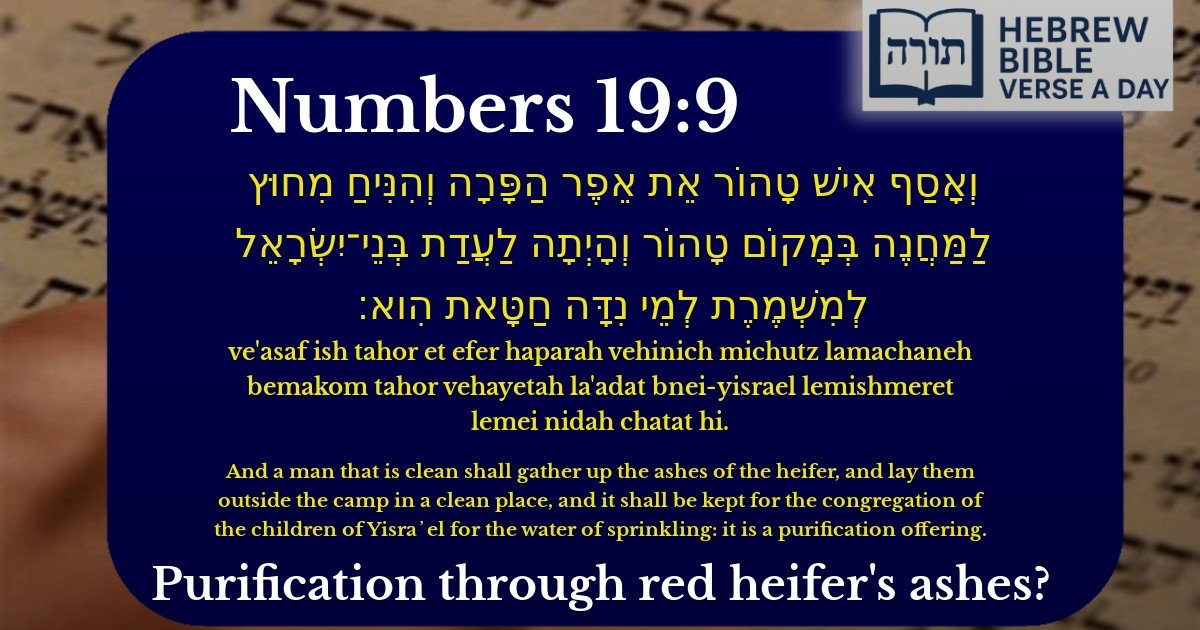

Numbers 19:9 - Purification through red heifer's ashes?

Numbers 19:9 - במדבר 19:9

Hebrew Text

וְאָסַף אִישׁ טָהוֹר אֵת אֵפֶר הַפָּרָה וְהִנִּיחַ מִחוּץ לַמַּחֲנֶה בְּמָקוֹם טָהוֹר וְהָיְתָה לַעֲדַת בְּנֵי־יִשְׂרָאֵל לְמִשְׁמֶרֶת לְמֵי נִדָּה חַטָּאת הִוא׃

English Translation

And a man that is clean shall gather up the ashes of the heifer, and lay them outside the camp in a clean place, and it shall be kept for the congregation of the children of Yisra᾽el for the water of sprinkling: it is a purification offering.

Transliteration

Ve'asaf ish tahor et efer haparah vehinich michutz lamachaneh bemakom tahor vehayetah la'adat bnei-yisrael lemishmeret lemei nidah chatat hi.

Hebrew Leining Text

וְאָסַ֣ף ׀ אִ֣ישׁ טָה֗וֹר אֵ֚ת אֵ֣פֶר הַפָּרָ֔ה וְהִנִּ֛יחַ מִח֥וּץ לַֽמַּחֲנֶ֖ה בְּמָק֣וֹם טָה֑וֹר וְ֠הָיְתָ֠ה לַעֲדַ֨ת בְּנֵֽי־יִשְׂרָאֵ֧ל לְמִשְׁמֶ֛רֶת לְמֵ֥י נִדָּ֖ה חַטָּ֥את הִֽוא׃

🎵 Listen to leining

Parasha Commentary

Overview of the Verse

This verse (Bamidbar 19:9) describes the process of gathering and preserving the ashes of the parah adumah (red heifer), which are used to purify individuals who have become ritually impure through contact with the dead. The Torah emphasizes the meticulous care required in handling these ashes, as they are essential for preparing the mei niddah (waters of purification).

Key Elements of the Verse

  • וְאָסַף אִישׁ טָהוֹר ("And a man that is clean shall gather"): Rashi explains that this refers to a Kohen who has maintained ritual purity, underscoring the importance of purity in handling the ashes of the parah adumah.
  • אֵת אֵפֶר הַפָּרָה ("the ashes of the heifer"): The ashes must be from a completely red heifer, as detailed earlier in the parashah (Bamidbar 19:2). The Rambam (Hilchos Parah Adumah 3:1) elaborates on the strict requirements for the parah adumah.
  • וְהִנִּיחַ מִחוּץ לַמַּחֲנֶה בְּמָקוֹם טָהוֹר ("and lay them outside the camp in a clean place"): The Mishnah (Parah 3:1) specifies that the ashes were stored on the Mount of Olives in a designated pure location to prevent contamination.
  • לְמֵי נִדָּה ("for the water of sprinkling"): The ashes are mixed with spring water to create the purification solution. The Talmud (Yoma 14a) discusses the precise measurements and preparation of this mixture.
  • חַטָּאת הִוא ("it is a purification offering"): Though the parah adumah is not a typical korban (sacrifice), it is called a chatas because it atones for the impurity of death, as explained by the Ramban.

Symbolism and Deeper Meaning

The parah adumah is considered one of the most enigmatic mitzvos in the Torah. The Midrash (Bamidbar Rabbah 19:3) notes that even King Solomon, the wisest of men, could not fully grasp its meaning. The paradox of the parah adumah—purifying the impure while making the pure impure—teaches humility and the limits of human understanding in divine commandments.

Practical Halachic Implications

The Mishnah (Parah 3:7-11) details the exact procedures for gathering and storing the ashes, emphasizing the need for utmost care to prevent contamination. The Gemara (Chagigah 25a) further discusses the laws of who may handle the ashes and under what conditions. The Rambam (Hilchos Parah Adumah 4:4) codifies these laws, stressing that the ashes must be guarded carefully to remain valid for future use.

📚 Talmud Citations

This verse is quoted in the Talmud.

📖 Yoma 42b
The verse is discussed in the context of the laws concerning the red heifer and its ashes, particularly focusing on the purity required for those handling the ashes.
📖 Parah 3:5
This Mishnah references the verse in discussing the procedures for gathering and storing the ashes of the red heifer, emphasizing the requirement for a clean place outside the camp.
📖 Moed Katan 14a
The verse is cited in a discussion about the impurity associated with the red heifer and the necessity of maintaining purity in handling its ashes.

Frequently Asked Questions

Q: What is the red heifer (parah adumah) mentioned in Numbers 19:9?
A: The red heifer (parah adumah) is a completely red cow without blemish, used in a special purification process described in Numbers 19. Its ashes were mixed with water to purify those who became ritually impure through contact with the dead. This mitzvah is considered a 'chok'—a commandment whose reason is not fully revealed to us (Rashi on Numbers 19:2).
Q: Why were the ashes of the red heifer kept outside the camp?
A: The ashes were kept outside the camp in a clean place (Numbers 19:9) because they were used to purify people who had become ritually impure (tamei) through contact with death. Since impurity cannot enter the holy camp (especially when the Mishkan or Temple stood), the purification materials were stored outside (Rambam, Hilchot Parah Adumah 4:1).
Q: What does 'water of sprinkling' (מי נדה) mean in this verse?
A: The 'water of sprinkling' (מי נדה) refers to the mixture of the red heifer's ashes with spring water, which was then sprinkled on the impure person on the third and seventh days of their purification process (Numbers 19:17-19). This water had the power to purify from tum'at met (impurity from contact with the dead), as explained in the Mishnah (Parah 11:7).
Q: Why is the red heifer called a 'purification offering' (חטאת היא) if it doesn't atone for sin?
A: Even though the red heifer doesn't atone for sins like other 'chatat' offerings, it is called a 'purification offering' (חטאת היא) because it removes the severe impurity of contact with death, which prevents a person from entering the Mishkan or Temple (Rashi on Numbers 19:9). The Talmud (Yoma 42b) explains that just as a sin offering purifies from sin, the parah purifies from impurity.
Q: Do we still use the ashes of the red heifer today?
A: Since we currently lack the Temple and a valid red heifer (which must meet very specific requirements), we cannot perform this purification today. However, Orthodox Jews still study its laws in anticipation of the future redemption when the Temple service will be restored (Rambam, Hilchot Parah Adumah 3:4). Currently, all Jews are considered ritually impure from contact with the dead until this purification can be reinstated.