Frequently Asked Questions
Q: What is the meaning of 'the water of Meriva' in Numbers 20:13?
A: The 'water of Meriva' refers to the incident where the Israelites quarreled (Meriva means 'strife') with Moshe and Aharon at Kadesh, demanding water. According to Rashi, this event showed a lack of faith in Hashem, who had previously provided miracles for them. The name 'Meriva' serves as a reminder of this failure in trust.
Q: Why did Hashem say He was 'sanctified' through the Israelites' strife?
A: The sanctification refers to Hashem's justice being displayed. Ramban explains that even when the people acted improperly, Hashem's response—providing water while also holding Moshe and Aharon accountable—demonstrated His holiness and fairness. This teaches that divine justice upholds His sanctity in all situations.
Q: What lesson can we learn from the incident at Mei Meriva?
A: The Talmud (Sanhedrin 101a) derives from this episode the importance of speaking gently and avoiding anger, as Moshe's striking the rock (instead of speaking to it) led to consequences. It also teaches, as Midrash Tanchuma notes, that complaining against Hashem's leaders is akin to complaining against Hashem Himself.
Q: How does this verse connect to Moshe not entering the Land of Israel?
A: Rashi (on Numbers 20:12) explains that Moshe's deviation from Hashem's command to speak to the rock—instead striking it—resulted in him being barred from entering Eretz Yisrael. This underscores the precision required in fulfilling mitzvos and the gravity of a leader's actions.
Q: Is there a modern-day application of the Mei Meriva story?
A: Yes. The Kli Yakar emphasizes that strife and lack of faith, as shown at Meriva, hinder spiritual growth. Today, this reminds us to trust Hashem during challenges and avoid divisiveness. Additionally, the Chofetz Chaim teaches that the episode warns against public criticism, as the quarrel occurred 'before the eyes of Israel.'


Understanding the Verse
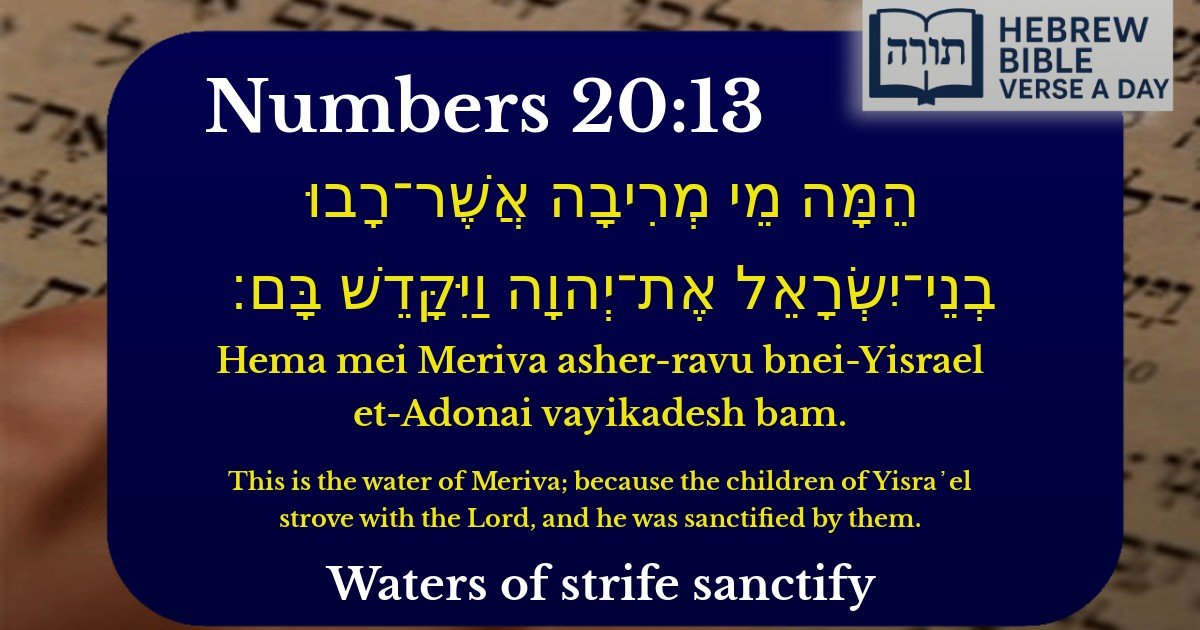
The verse (Bamidbar 20:13) refers to the incident at Mei Merivah (the Waters of Strife), where Bnei Yisrael quarreled with Hashem due to their lack of water in the wilderness. The phrase "וַיִּקָּדֵשׁ בָּם" ("and He was sanctified by them") indicates that despite their rebellion, Hashem's holiness was ultimately revealed through this event.
Rashi's Explanation
Rashi (Bamidbar 20:13) explains that the name "Mei Merivah" (Waters of Strife) was given because Bnei Yisrael contended with Hashem. He further notes that Moshe and Aharon failed to sanctify Hashem properly in this incident, which led to their punishment of not entering Eretz Yisrael. Rashi emphasizes that the people's lack of faith provoked this test.
Rambam's Perspective
Rambam (Hilchos Yesodei HaTorah 8:2) discusses how miracles serve to demonstrate Hashem's presence. Here, the miracle of water from the rock was meant to strengthen faith, yet the people's complaints showed a lack of trust. The sanctification of Hashem's name ("וַיִּקָּדֵשׁ בָּם") refers to the eventual revelation of His justice and power, even in rebuke.
Midrashic Insights
Lessons from the Incident
The episode teaches: