Frequently Asked Questions
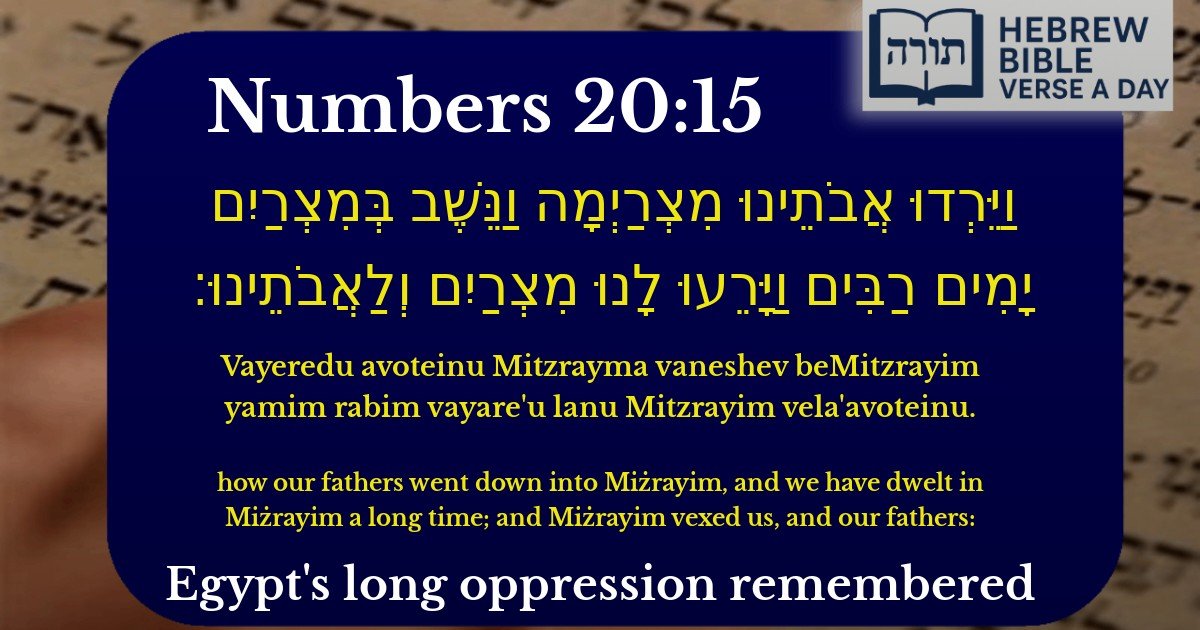
Q: What does Numbers 20:15 mean when it says 'our fathers went down into Egypt'?
A: This verse refers to the descent of Jacob and his family to Egypt, as described in Genesis 46. According to Rashi, this was the beginning of the Jewish people's exile in Egypt, which ultimately led to the Exodus. The term 'went down' (וַיֵּרְדוּ) implies a spiritual descent as well, as living in exile among idolaters presented challenges to maintaining Torah values.
Q: Why does the verse mention that Egypt 'vexed us and our fathers'?
A: The Torah recounts the suffering of the Jewish people in Egyptian bondage (as described in Exodus 1). The Midrash (Shemot Rabbah 1:12) explains that the Egyptians gradually increased their oppression, starting with heavy labor and later decreeing the drowning of Jewish boys. This verse serves as a reminder of our ancestors' hardships and G-d's eventual redemption.
Q: How long did the Jewish people actually dwell in Egypt according to this verse?
A: The verse mentions 'a long time' (יָמִים רַבִּים). According to Exodus 12:40-41 and the Talmud (Megillah 9a), the Jewish people spent 210 years in Egypt. Rashi explains that this period included both comfortable years under Joseph's influence and difficult years of slavery.
Q: Why is this historical reference important in Numbers 20?
A: Moses mentions this history when speaking to the king of Edom (Numbers 20:14-21), explaining the Jewish people's journey and right to pass through lands on their way to Canaan. The Ramban explains this establishes our historical connection to the Land of Israel and G-d's promise to our ancestors.
Q: What lesson can we learn today from Numbers 20:15?
A: This verse teaches us to remember our history - both the challenges of exile and G-d's redemption. The Sforno notes that recalling past hardships strengthens our faith during difficult times. Additionally, it reminds us of the importance of maintaining Jewish identity even in foreign environments, as our ancestors did in Egypt.


Context in the Torah
This verse appears in Devarim (Deuteronomy 26:6), where Moshe recounts the descent of the Jewish people into Egypt and their subsequent suffering. It is part of the declaration made when bringing bikkurim (first fruits) to the Beit HaMikdash, acknowledging Hashem's redemption from Egyptian bondage.
Rashi's Commentary
Rashi explains that the phrase "וַיֵּרְדוּ אֲבֹתֵינוּ מִצְרַיְמָה" ("our fathers went down into Egypt") refers specifically to Yaakov and his sons, emphasizing that their descent was a precursor to the eventual enslavement. He notes that the term "וַיָּרֵעוּ" ("vexed us") refers to the Egyptians' harsh oppression, as stated in Shemot (Exodus 1:11-14).
Rambam's Perspective
In Hilchot Bikkurim (Laws of First Fruits 2:6), Rambam highlights the obligation to recount the Exodus when bringing bikkurim, linking gratitude for the land of Israel to the memory of Egyptian suffering. This verse serves as a reminder of divine providence—how Hashem redeemed us from oppression to bring us to Eretz Yisrael.
Midrashic Interpretation
The Mechilta (on Shemot 20:2) elaborates that the phrase "וַנֵּשֶׁב בְּמִצְרַיִם יָמִים רַבִּים" ("we have dwelt in Egypt a long time") alludes to the 210 years of exile, which included both prosperity under Yosef and later suffering. The Sifrei (Devarim 301) adds that the prolonged stay intensified the Egyptians' cruelty, fulfilling the prophecy given to Avraham (Bereishit 15:13).
Key Themes